
Overview
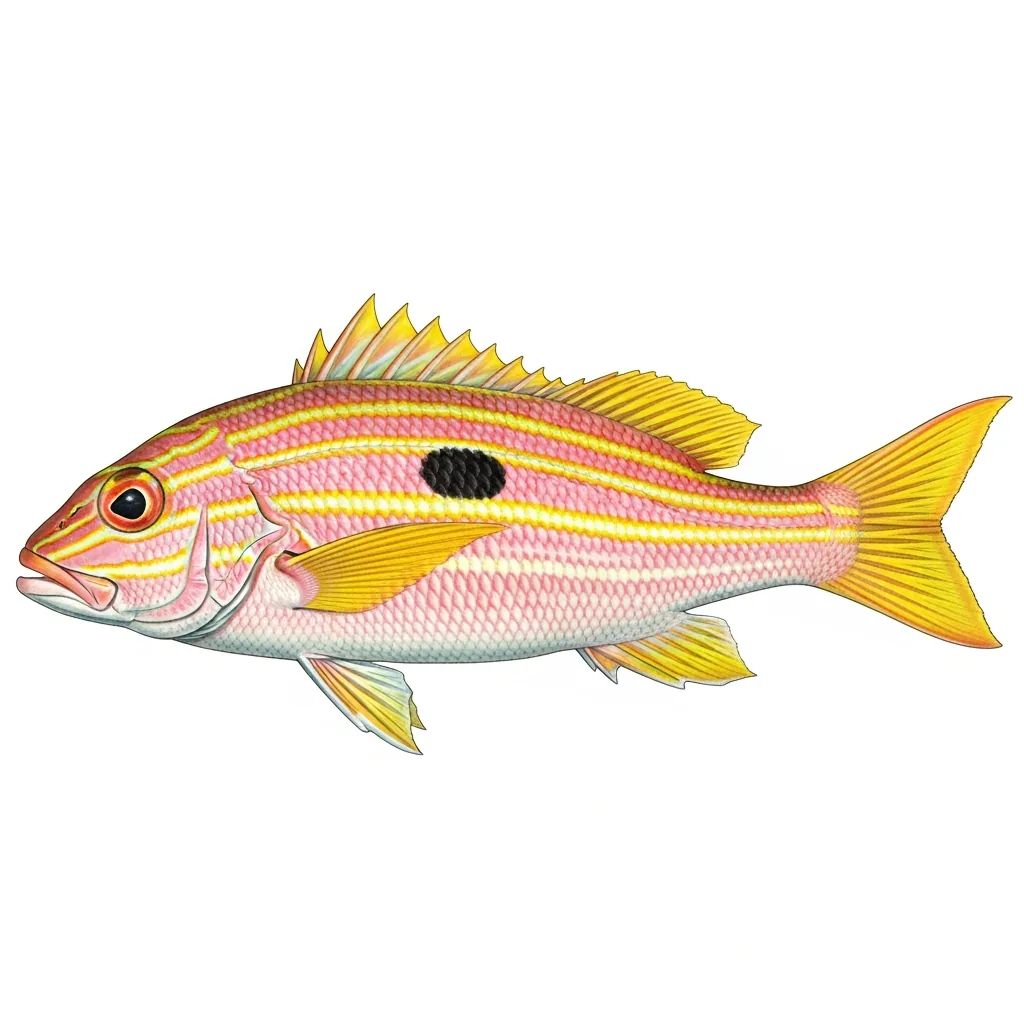
Colorful and abundant snapper in the Gulf. Easy to catch, great for beginners, and delicious to eat.
Identification
- Body
- Body is fusiform and laterally compressed.
- Colouration
- Colored with red and golden stripes on a silvery-yellowish background.
- Sexual dimorphism
- Absent/Not clearly visible
- Growth
- Moderate, quickly reaches full maturity.
Taxonomy
- Family
- Lutjanidae
- Order
- Perciformes
- Class
- Actinopterygii
Related species
Habitat & distribution
- Environment
- Coast, Open sea, Reefs
- Preferred bottom
- Sand, Reef, Seagrass
- Geographic distribution
- Found in the Gulf of Mexico, the Caribbean Sea, and along the Atlantic coasts of the Americas.
- Micro-habitat
- Typically hangs around sandy bottoms and coral reefs.
Often found in protected areas rich in hideouts among corals and vegetation.
Presence by sea area
Diet
- Primary prey
- crustaceans, small fish, cephalopods
- Secondary prey
- shrimp, crabs, mollusks
- Occasional prey
- algae, plankton
- Feeding behaviour
- Opportunistic predator, actively feeds during the day near coral reefs.
- Natural predators
- sharks, barracuda, larger fish
Diet varies depending on seasonal prey availability.
Behaviour
- Activity
- diurnal
- Social behaviour
- small_groups
- Aggressiveness
- medium
- Migration
- Non-migratory, with limited movements for feeding and spawning.
- Seasonal behaviour
- May form larger groups during the breeding season.
- Juveniles
- Juveniles tend to stay in areas rich in marine vegetation.
- Adults
- Adults form small groups and move between reefs and sandy bottoms.
Reproduction
- Spawning season
- March, April, May
- Spawning depth
- Between 20 and 60 meters
- Eggs
- Pelagic eggs, small, transparent.
- Larval stage
- Planktonic larvae that develop rapidly.
- Sexual maturity
- 2-3 years
When to catch Lane Snapper
Activity calendar
Activity by season
Best times
This species shows peak fishing activity in spring, summer and autumn, when the productivity index (FPI) reaches its highest values.
Fishing activity decreases in winter, when conditions are less favourable.
Ideal conditions
Water temperature
Where to catch it
Best spots
Bottom preference
Spot type
Fishing techniques
Recommended
Other applicable
Recommended baits
Baits by pressure
How to really catch it
The lane snapper is an elegant, lively snapper, marked by red and golden stripes and a dark spot on its side that often gives it away as it glides over sand and coral. It moves in small groups, feeds decisively during the day, and for that very reason offers dynamic, practical fishing to anyone who can read the bottom well.
🐟 Good to know
An important biological trait is its habitat shift with growth: juveniles tend to remain in areas rich in marine vegetation, while adults move between reefs and sandy bottoms. That separation also helps anglers, because it suggests where to look for different size classes.
🌊 Where & when
You’ll find it along coasts, offshore, and on reefs, from the Gulf of Mexico to the Caribbean and along the Atlantic coasts of the Americas, over bottoms from 2 to 100 meters, especially near sand, seagrass, and coral reefs. The most interesting months run from March to November; between March and May, during spawning, it may gather more than usual between 20 and 60 meters.
🎣 How to really catch it
The most concrete way to target it is bottom fishing along the edges where sand meets structure, letting shrimp, squid, fresh fish, or crabs work close to the seabed where it searches for crustaceans, small fish, and cephalopods. A light spinning rod, 10-15 lb main line, 20 lb fluorocarbon leader, size 1/0-2/0 hooks, and a 20-30 g sinker are enough to feel the sharp bites and handle its quick bursts and spiraling fight.
💡 The detail that makes the difference
If you have to choose one exact spot, don’t stop on the heart of the reef: look for the edge, where the reef opens onto clean sand. That is where adults move to feed during the day, and presenting the bait neatly on the bottom, without lifting it too much, is often the approach most consistent with its real behavior.
Catch & handling tips
- Fight
- Fights energetically with quick dashes and spirals in the water.
- Handling
- Handle with care to avoid injuries from sharp dorsal fins.
- Release
- Gently release after checking the fish's well-being.
Curiosities & culture
- Record catches
- Maximum documented size: up to about 60 cm (source: FishBase). IGFA All-Tackle record: 3.72 kg (8 lb 3 oz), caught off Mississippi (USA) in 2001.
- In the kitchen
- Appreciated grilled or fried, popular in Caribbean coastal dishes.
- Cultural notes
- Symbol of abundance in the Caribbean, often depicted in local decorations.
- Historical notes
- Common fish in catches by traditional fishermen in the Gulf.