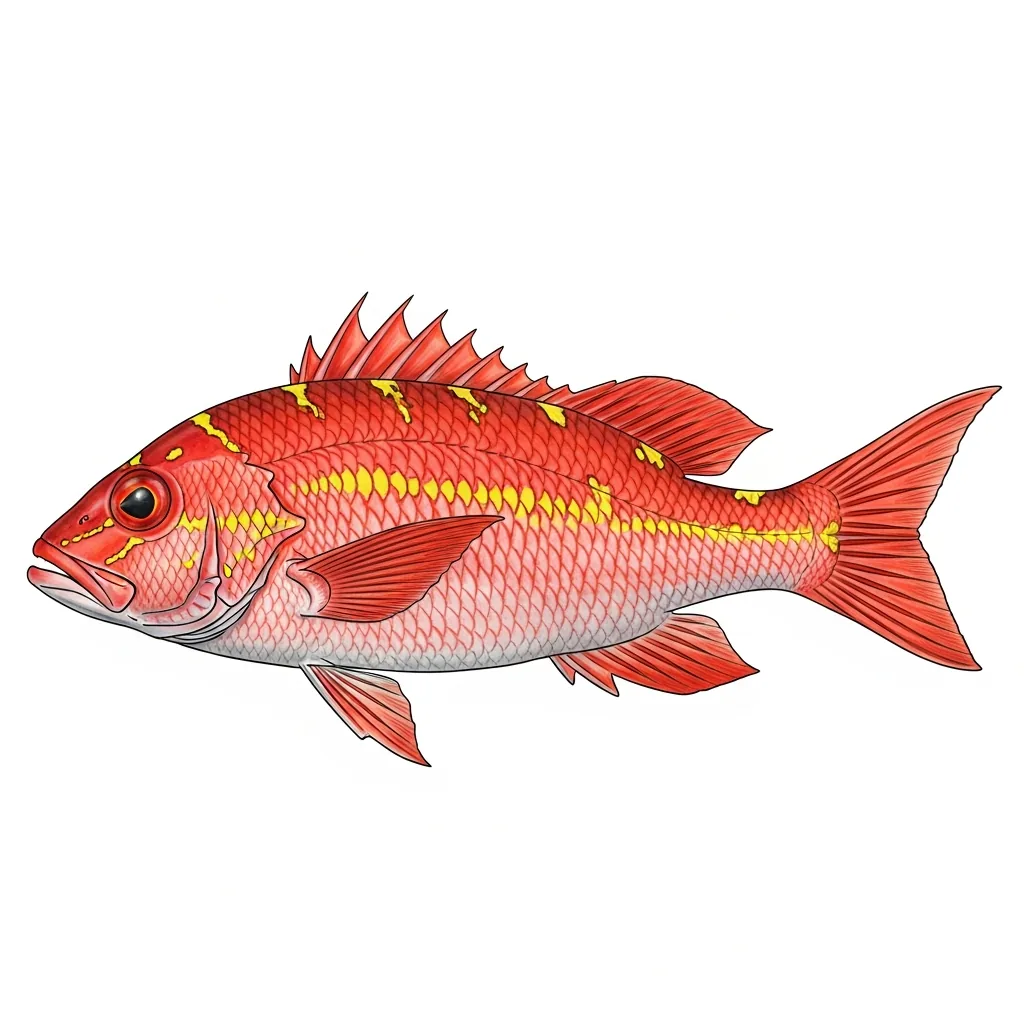

Overview
Known as 'Beeliner', one of the most popular snappers for offshore fishing in the Gulf of Mexico.
Identification
- Body
- Elongated, laterally compressed body.
- Colouration
- Bright red along the back with golden hues on the sides and a white belly.
- Sexual dimorphism
- Absent/not noticeable
- Growth
- Moderate; reaches adult size in a few years.
Taxonomy
- Family
- Lutjanidae
- Order
- Perciformes
- Class
- Actinopterygii
Related species
Habitat & distribution
- Environment
- Coast, Pelagic, Reefs
- Preferred bottom
- Sand, Rock, Reef
- Geographic distribution
- Found in the western Atlantic Ocean, from North Carolina to Brazil, including the Gulf of Mexico.
- Micro-habitat
- Frequently found near reefs and sunken wrecks, seeking shelter in overhangs and crevices.
Prefers clear waters and moderate currents, often found near underwater structures.
Presence by sea area
Diet
- Primary prey
- krill, small fish, squid
- Secondary prey
- shrimp, crustacean larvae, juvenile octopuses
- Occasional prey
- jellyfish, plankton, algae
- Feeding behaviour
- Hunts mainly at dusk and nighttime, taking advantage of small schools of fish and crustaceans near the sea floor.
- Natural predators
- barracuda, groupers, sharks, dolphins
Feeds mainly at night or twilight, using low visibility to surprise prey.
Behaviour
- Activity
- crepuscular
- Social behaviour
- small_groups
- Aggressiveness
- low
- Migration
- Non-migratory; doesn't undertake large migrations, moves mostly for spawning.
- Seasonal behaviour
- Draws closer to the shore and shallow reefs during warmer months.
- Juveniles
- Juveniles hide among seaweeds and corals to avoid predators.
- Adults
- Adults often swim in small groups near reefs and wrecks.
Reproduction
- Spawning season
- May, June, July
- Spawning depth
- between 20 and 60 meters
- Eggs
- Pelagic, small and transparent eggs.
- Larval stage
- Larval stage lasts a few weeks, and the young are carried by currents.
- Sexual maturity
- varies between 2 and 5 years
When to catch Vermilion Snapper
Activity calendar
Activity by season
Best times
This species shows peak fishing activity in spring, summer and autumn, when the productivity index (FPI) reaches its highest values.
Fishing activity decreases in winter, when conditions are less favourable.
Ideal conditions
Water temperature
Where to catch it
Best spots
Bottom preference
Spot type
Fishing techniques
Recommended
Other applicable
Recommended baits
Baits by pressure
How to really catch it
The vermilion snapper is a slender snapper with large red eyes, living where the bottom changes its voice: sand, rock, reefs, and wrecks. It lacks the raw aggression of some predators, but when it starts feeding at dusk it becomes a fish worth truly understanding.
🐟 Good to know
A lesser-noticed biological trait is the combination of large eyes and crepuscular habits: in vermilion snapper, this morphology matches feeding activity focused mainly at dusk and during the night, close to the bottom. It also fits its diet of small fish, squid, krill, and crustaceans.
🌊 Where & when
Look for it in the western Atlantic, from North Carolina to Brazil, including the Gulf of Mexico, from 20 to 200 meters, especially around wrecks, reefs, rocky areas, and submerged ledges with cracks and overhangs. It becomes more catchable in warmer months, when it moves closer to shore and shallower reefs; from May to July it spawns between 20 and 60 meters.
🎣 How to really catch it
If you want to catch it for real, the most concrete method is bottom fishing: send the bait down to the seabed and keep it working tight to wrecks and submerged ledges, where adults move in small groups. Squid and shrimp match its diet very well; live baitfish are another sound option. A 2.10 m medium-heavy rod with 20-30 lb monofilament, a 15-20 lb fluorocarbon leader, 2/0-3/0 circle hooks, and 50-100 g sinkers is a solid, sensible setup.
💡 The detail that makes the difference
The small detail that often matters most is not fishing in open emptiness, but placing your presentation just outside cracks, ledges, and the sharp sides of a wreck. Vermilion snapper shelters in this structure and feeds near the bottom at dusk and night: staying tight to cover, without drifting too far away, makes the bait look far more natural.
Catch & handling tips
- Fight
- Puts up a good fight and can make quick, powerful runs.
- Handling
- Handle carefully to avoid slipping, avoid touching the gills.
- Release
- Release quickly back into the water to minimize stress, preferably using release tools.
Curiosities & culture
- Record catches
- Maximum documented size: up to about 60 cm and 3.2 kg (source: FishBase). IGFA All-Tackle record: 4.20 kg (9 lb 4 oz), caught at Keaton Beach, Florida (USA), in 2022.
- In the kitchen
- Often used for grilling or frying, common in Cajun cuisine.
- Cultural notes
- Considered an excellent table fish in coastal USA regions.
- Historical notes
- This fish has been an important resource for commercial fishermen in the Gulf of Mexico since the 20th century.