
Overview
Amazonian freshwater predator, aggressive with spectacular colors.
Identification
- Body
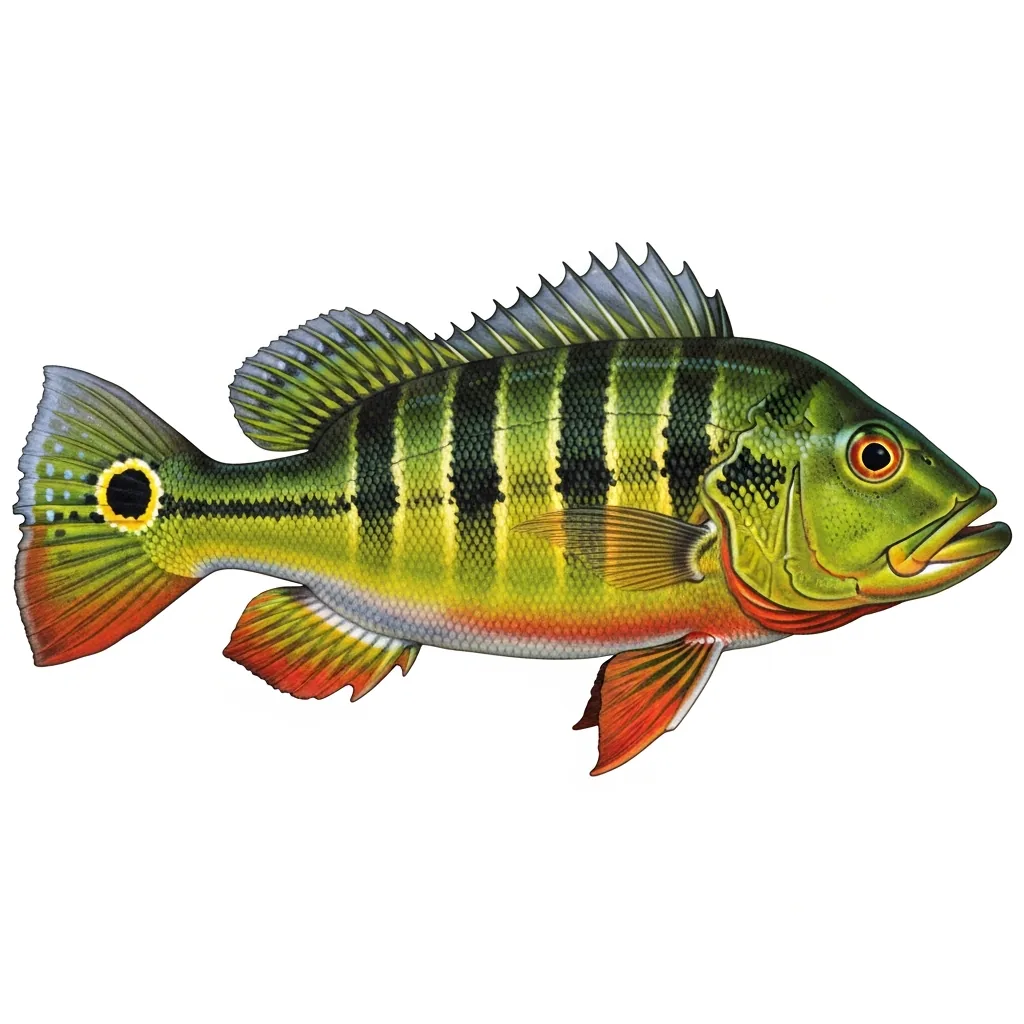
- Long and robust body with a large mouth.
- Colouration
- Brightly colored with dark spots and vertical bands, often with an eye spot on the tail.
- Sexual dimorphism
- Absent/not very noticeable
- Growth
- Fast, especially in the early years of life
Taxonomy
- Family
- Cichlidae
- Order
- Perciformes
- Class
- Actinopterygii
Related species
Habitat & distribution
- Environment
- Coast, Estuaries, Brackish
- Preferred bottom
- Sand, Mud, Gravel
- Geographic distribution
- Native to the Amazon and Orinoco rivers, introduced in other tropical regions.
- Micro-habitat
- Prefers areas rich in vegetation and submerged structures like roots and logs.
Forms complex habitats in tropical rivers with submerged roots and leaves.
Presence by sea area
Diet
- Primary prey
- fish, aquatic insects, crustaceans
- Secondary prey
- amphibians, insect larvae
- Occasional prey
- small reptiles, fallen fruits
- Feeding behaviour
- Voracious predator, mainly hunts at dawn and dusk, attacking prey swiftly.
- Natural predators
- crocodiles, snakes, large water birds
Opportunistic predator, adapts to prey availability.
Behaviour
- Activity
- diurnal
- Social behaviour
- solitary
- Aggressiveness
- high
- Migration
- Non-migratory
- Seasonal behaviour
- Increased predatory activity during the wet season when waters expand.
- Juveniles
- Juveniles stay in groups to protect against predators.
- Adults
- Adults are territorial, hunting and breeding in defined areas.
Reproduction
- Spawning season
- September, October, November
- Spawning depth
- between 3 and 9 feet
- Eggs
- Adhesive eggs laid on hard surfaces, benthic
- Larval stage
- Larvae are pelagic, feeding on plankton in early stages.
- Sexual maturity
- 2-3 years
When to catch Peacock bass
Activity calendar
Activity by season
Best times
This species shows peak fishing activity in spring, summer and autumn, when the productivity index (FPI) reaches its highest values.
Fishing activity decreases in winter, when conditions are less favourable.
Ideal conditions
Atmospheric pressure
Extremely active and aggressive.
Good activity.
Less reactive.
Water temperature
Where to catch it
Best spots
Bottom preference
Spot type
Fishing techniques
Recommended
Other applicable
Recommended baits
Baits by pressure
How to really catch it
The peacock bass is a freshwater predator that never goes unnoticed: a strong body, wide mouth, bold vertical bars, and the unmistakable tail eyespot. When it bursts out from roots and timber to strike, it does so violently and often with spectacular jumps—one of those fish that stays in your memory.
🐟 Good to know
During spawning it lays adhesive eggs on hard surfaces on the bottom in shallow water, and its earliest larval stages are pelagic, feeding on plankton. It is an interesting detail because it combines benthic egg deposition with an early life spent away from the substrate.
🌊 Where & when
It is native to the Amazon and Orinoco basins and has also been introduced to other tropical regions. It favors 1 to 5 meter areas with vegetation, roots, logs, and other cover over sand, mud, or gravel bottoms. It becomes more active in the wet season, when waters expand, with a productive fishing window from March through November; at dawn and dusk its feeding activity increases.
🎣 How to really catch it
To really catch it, spinning is the most practical route: a medium spinning rod, 15-30 lb braid, and a 20 lb fluorocarbon leader let you work close to cover without losing control during the fight. Cast artificial lures or frog imitations tight to roots, dense vegetation, and submerged structure, or fish topwater in low-light periods; when the fish is there, it often strikes decisively.
💡 The detail that makes the difference
The detail that makes a difference is to work small but defined spots thoroughly: adult peacock bass are territorial and non-migratory, so a single log, a band of roots, or a clean edge in the vegetation may hold one specific fish. If it does not respond at once, change your casting angle before changing areas.
Catch & handling tips
- Fight
- Strong and energetic, known for spectacular jumps out of water.
- Handling
- Wear gloves to avoid scratches from teeth and scales.
- Release
- Ensure the fish is well-oxygenated before release.
Curiosities & culture
- Record catches
- Maximum documented size: up to about 74 cm in length (source: FishBase). IGFA All-Tackle record: about 5.7 kg (12 lb 9 oz), caught in Venezuela.
- In the kitchen
- Valued for its firm white meat, often grilled or fried.
- Cultural notes
- Considered a symbol of strength and beauty in Amazonian countries.
- Historical notes
- Introduced in many regions as a sport fish, it has impacted local ecosystems.