
Overview
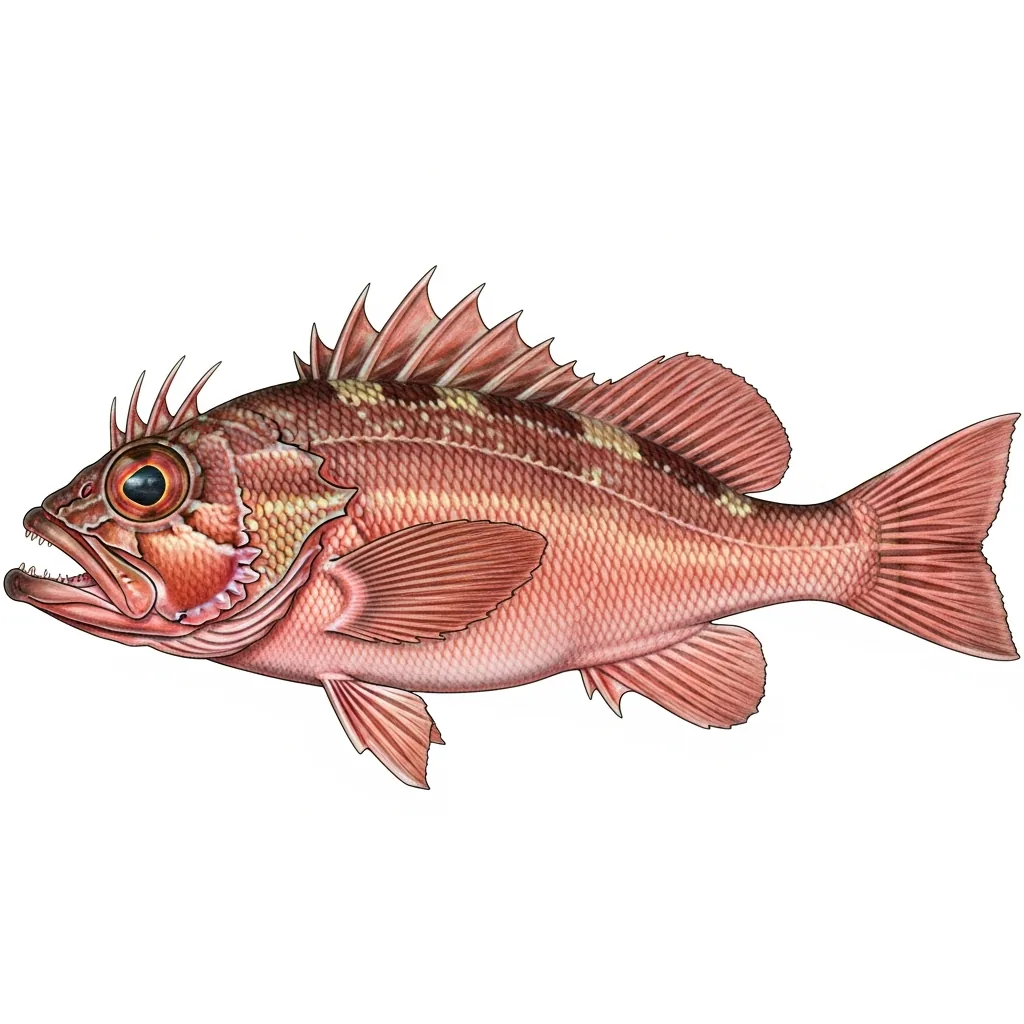
Large rockfish that can exceed 90 cm. Lives in deep water along the entire Pacific coast from Mexico to Alaska.
Identification
- Body
- Robust and elongated body with a large head and prominent eyes.
- Colouration
- Variable coloration from red-orange to brown-rose with lighter or darker spots.
- Sexual dimorphism
- Absent/not very evident
- Growth
- Slow, reaches sexual maturity later than average
Taxonomy
- Family
- Sebastidae
- Order
- Scorpaeniformes
- Class
- Actinopterygii
Related species
Habitat & distribution
- Environment
- Open sea, Deep sea
- Preferred bottom
- Rock, Mud, Reef
- Geographic distribution
- Found along the Pacific coast from Baja California, Mexico to Alaska.
- Micro-habitat
- Prefers rocky bottoms and underwater reefs, often found near crevices and cavities for shelter.
Prefers areas with crevices and hiding spots, thus limiting competition among individuals.
Presence by sea area
Diet
- Primary prey
- small fish, squid, shrimp
- Secondary prey
- plankton, crustaceans, sea snakes
- Occasional prey
- fish eggs, crustacean larvae
- Feeding behaviour
- Opportunistic predator, feeds both near the surface and in deeper waters, often using ambush tactics.
- Natural predators
- sea lions, sharks, other large predatory fish
Exploits its position on the bottom to ambush unsuspecting prey.
Behaviour
- Activity
- diurnal
- Social behaviour
- solitary
- Aggressiveness
- medium
- Migration
- Resident, with small seasonal shifts toward warmer waters
- Seasonal behaviour
- During colder months, often found at greater depths. In spring and summer, moves towards shallower waters.
- Juveniles
- Juveniles tend to form small groups for protection and are found in shallower waters.
- Adults
- Adults are more solitary and are established near rocky bottoms.
Reproduction
- Spawning season
- February, March, April
- Spawning depth
- between 100 and 200 meters
- Eggs
- Pelagic eggs, internally fertilized and released in a gelatinous mass.
- Larval stage
- The larvae are pelagic and go through several metamorphosis stages before settling on the bottom.
- Sexual maturity
- varies between 3 and 5 years
When to catch Bocaccio Rockfish
Activity calendar
Activity by season
Best times
This species shows peak fishing activity in spring, summer and autumn, when the productivity index (FPI) reaches its highest values.
Fishing activity decreases in winter, when conditions are less favourable.
Ideal conditions
Water temperature
Where to catch it
Best spots
Bottom preference
Spot type
Fishing techniques
Recommended
Other applicable
Recommended baits
Baits by pressure
How to really catch it
The bocaccio is a large Pacific rockfish, robust, solitary, and perfectly built for life where the light thins over deep rock, mud, and reef. To catch it consistently, you have to think like an ambush predator: look for structure, work close to the bottom, and be ready for that heavy take that immediately tries to dive back into cover.
🐟 Good to know
One notable biological trait of bocaccio is reproduction by internal fertilization followed by the release of pelagic eggs in a gelatinous mass. The larvae remain pelagic and pass through several metamorphic stages before settling to the bottom, a transition that matches their shift from the water column to deeper structure.
🌊 Where & when
It lives along the Pacific coast from Baja California to Alaska, in open and deep sea, from 50 to 600 meters, especially over rocky bottoms, underwater reefs, and also mud, often near cavities and crevices. In colder months it tends to hold deeper; in spring and summer it moves somewhat shallower and becomes more reachable, with a favorable window from March to November. From February to April it spawns between 100 and 200 meters.
🎣 How to really catch it
The most concrete approach is bottom fishing over rocky ledges, reefs, or wrecks, keeping a natural bait working tight to the bottom. A sturdy bottom rod, 20-30 lb braid, a 40 lb nylon or fluorocarbon leader, 3/0-5/0 circle hooks, and a pyramid or egg sinker provide control and feel. Squid, mackerel, shrimp, and live baits fit its opportunistic diet of small fish, cephalopods, and crustaceans. Once hooked, expect strong downward pulls toward the bottom.
💡 The detail that makes the difference
The practical edge is to maintain bottom contact without drifting your bait too far away from the structure. Adult bocaccio are often solitary, resident fish tied to rock, crevices, and cavities from which they ambush prey: if you fish too high above them, or too far off the contour, you are already removing the most natural strike window.
Catch & handling tips
- Fight
- When hooked, the bocaccio can make strong runs towards the bottom.
- Handling
- Handle carefully due to sharp dorsal spines; use gloves.
- Release
- Release quickly while keeping the fish in water as long as possible.
Curiosities & culture
- Record catches
- Maximum documented size: up to about 91 cm and 9.6 kg (source: FishBase). IGFA All-Tackle record: 12.64 kg (27 lb 14 oz), caught by George Bogen off Elfin Cove, Alaska (USA), in 2011.
- In the kitchen
- White, flavorful meat used in fish soups and main dishes; typical in caldeiradas.
- Cultural notes
- Considered a symbol of longevity due to its lifespan.
- Historical notes
- A species traditionally fished by the natives of the American Pacific coast.