
Overview
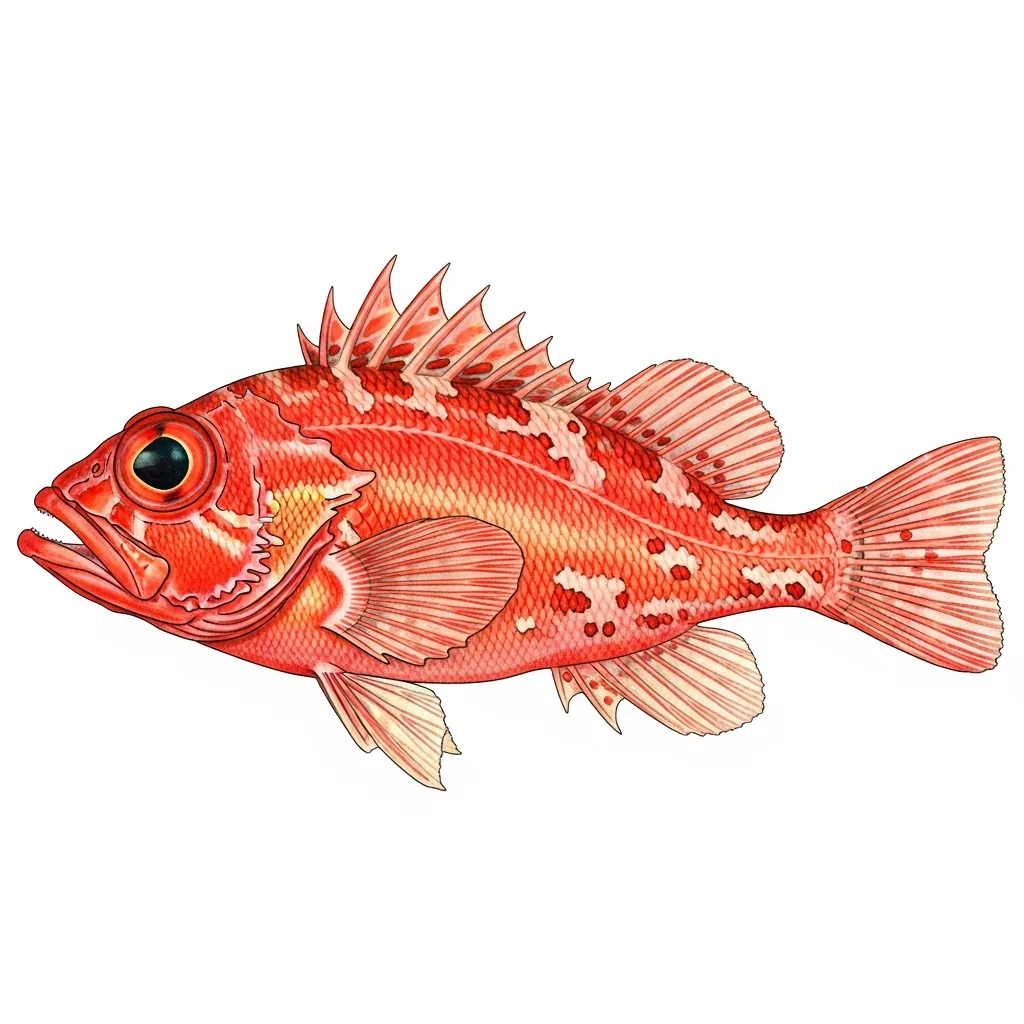
One of the most prized rockfish on the Pacific coast. Lives deep among rocks and structures.
Identification
- Body
- Sturdy, laterally compressed body typical of scorpionfish.
- Colouration
- Bright red with a lighter belly and darker bands on the sides.
- Sexual dimorphism
- Absent/not obvious
- Growth
- slow
Taxonomy
- Family
- Sebastidae
- Order
- Scorpaeniformes
- Class
- Actinopterygii
Related species
Habitat & distribution
- Environment
- Coast, Reefs, Open sea
- Preferred bottom
- Rock, Reef
- Geographic distribution
- Common along the Pacific coast of North America, from Southern California to Alaska.
- Micro-habitat
- Often hides in cracks and rocky crevices, or among artificial structures.
Often, adult individuals occupy the same refuge for long periods.
Presence by sea area
Diet
- Primary prey
- crustaceans, squid, small fish
- Secondary prey
- shrimp, octopus, krill
- Occasional prey
- plankton, jellyfish
- Feeding behaviour
- Predator that feeds mainly in mid-water, using ambush and quick strikes.
- Natural predators
- seals, sharks, large teleost fish
Uses imagination and strategy to catch a variety of prey.
Behaviour
- Activity
- diurnal
- Social behaviour
- solitary
- Aggressiveness
- medium
- Migration
- Sedentary, but might make short seasonal migrations.
- Seasonal behaviour
- In winter, tends to move to deeper waters for more stable temperatures.
- Juveniles
- Young often gather in small schools near the shore.
- Adults
- Adults prefer to position themselves near the seabed, in well-defined territories.
Reproduction
- Spawning season
- April, May, June
- Spawning depth
- between 20 and 60 meters
- Eggs
- Pelagic eggs, kept for a short period before hatching.
- Larval stage
- Pelagic larval stage with rapid growth in early phases.
- Sexual maturity
- 5-7 years
When to catch Vermilion Rockfish
Activity calendar
Activity by season
Best times
This species shows peak fishing activity in spring, summer and autumn, when the productivity index (FPI) reaches its highest values.
Fishing activity decreases in winter, when conditions are less favourable.
Ideal conditions
Water temperature
Where to catch it
Best spots
Bottom preference
Spot type
Fishing techniques
Recommended
Other applicable
Recommended baits
Baits by pressure
How to really catch it
The vermilion rockfish is a fish of rock and shadow, bright red, deep-bodied, with large eyes and a mouth built to seize prey. If you want to catch it for real, you have to think like it: close to the bottom, beside a shelter, where the ambush lasts an instant and silence returns.
🐟 Good to know
Despite its strongly bottom-oriented appearance, it feeds mainly in mid-water with ambushes and quick strikes. That matters a lot in fishing: it does not always feed by scraping the bottom, and often intercepts prey just above rocks, wrecks, and crevices.
🌊 Where & when
It lives along the Pacific coast of North America, from Southern California to Alaska, over rocky bottoms, reefs, cliffs, wrecks, and other structures between 18 and 275 meters. Adults stay territorial near the seabed and crevices; in winter they tend to move deeper, while from March to November they are more catchable. Spawning takes place from April to June, between 20 and 60 meters.
🎣 How to really catch it
The most practical method is bottom fishing over rocky ground and structure, using a sturdy bottom rod, 0.30-0.40 main line, 0.35-0.45 fluorocarbon leader, long-shank hooks, and a round sinker. Drop sardines, shrimp, squid, or octopus close to cracks, ledges, and wrecks, keeping the bait tight to the bottom but ready to work just above it, where this predator often strikes.
💡 The detail that makes the difference
The tip that makes the difference is not to insist over “empty” water: look for hard bottom with clear shelter, because adults hold well-defined territories and often stay linked to crevices and structure. If the bait drops precisely beside the opening, you have a much better chance that the fish will come out, strike, and immediately try to dive back into the rocks.
Catch & handling tips
- Fight
- Combative and resilient, often seeks refuge among rocks.
- Handling
- Handle carefully to avoid dorsal spines.
- Release
- Release slowly into the water, ensuring it's well oxygenated.
Curiosities & culture
- Record catches
- Maximum documented size: up to about 91 cm and 6.8 kg (source: FishBase). IGFA All-Tackle record: 5.45 kg (12 lb), caught at Depoe Bay, Oregon (USA), in 1990.
- In the kitchen
- Highly valued in cooking, roasted or grilled, often used in fish stews.
- Cultural notes
- In Native American culture, an integral part of the diet and a symbol of strength and endurance.
- Historical notes
- Commercial fishing already developed in the 20th century along the Pacific coast.