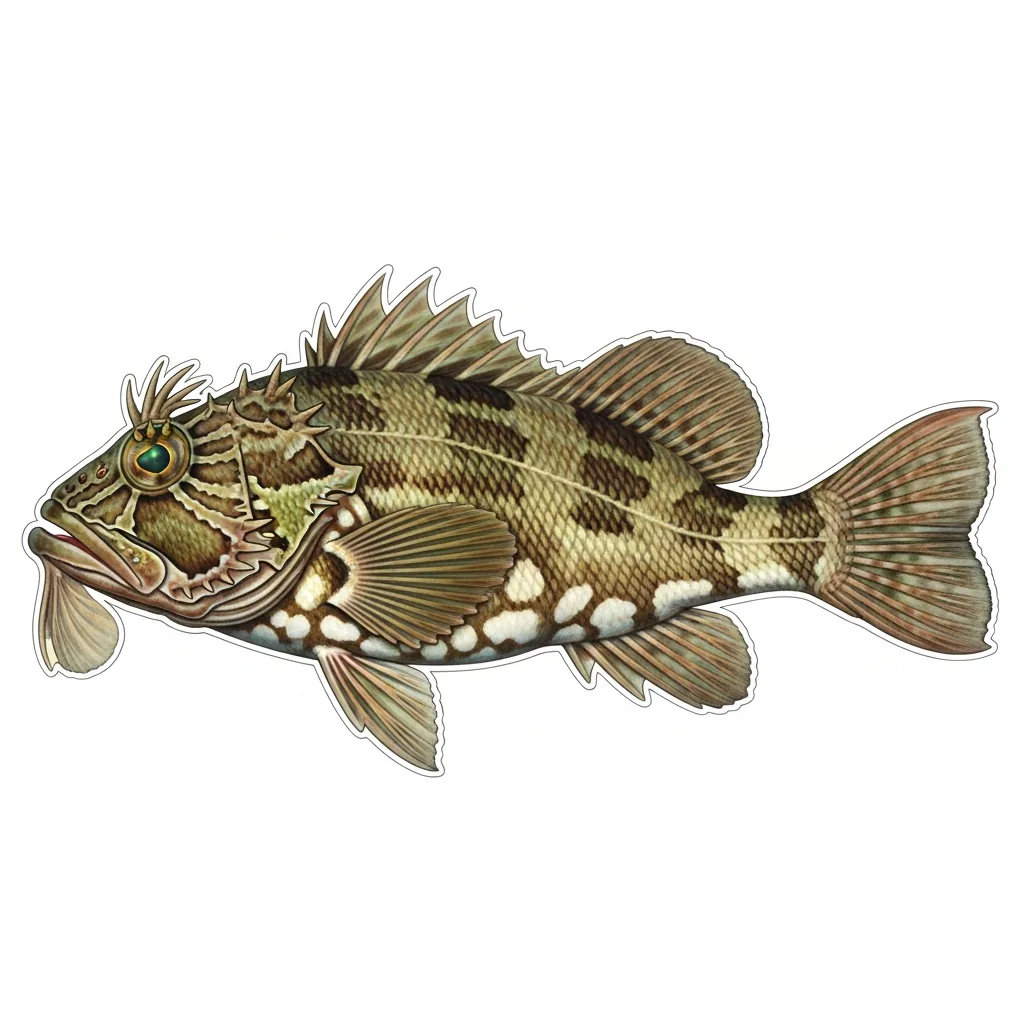

Overview
The largest sculpin on the Pacific coast. Lives in rocky areas and kelp forests. Excellent meat.
Identification
- Body
- Robust and stocky body, with a massive head and equipped with bony ridges.
- Colouration
- Marbled coloration that ranges from olive green to brown, with bluish or reddish spots.
- Sexual dimorphism
- Absent/not very pronounced
- Growth
- Moderate in its natural environment
Taxonomy
- Family
- Cottidae
- Order
- Scorpaeniformes
- Class
- Actinopterygii
Related species
Habitat & distribution
- Environment
- Coast, Reefs, Kelp forests
- Preferred bottom
- Rock, Reef, Kelp
- Geographic distribution
- Widespread along the west coast of North America, from the Gulf of Alaska to Baja California.
- Micro-habitat
- Hides among rocks and kelp, often near crevices and nooks.
Tolerant of a wide range of temperatures, but avoids very deep waters.
Presence by sea area
Diet
- Primary prey
- crustaceans, small fish, mollusks
- Secondary prey
- polychaetes, shrimps, crabs
- Occasional prey
- echinoderms, amphipods
- Feeding behaviour
- Opportunistic and active hunter, prefers prey that venture too close, using a quick lunge to capture them.
- Natural predators
- sea lions, seals, large predatory fish, eagles
Skilled predator that uses its camouflage coloring to surprise prey.
Behaviour
- Activity
- diurnal
- Social behaviour
- solitary
- Aggressiveness
- medium
- Migration
- Resident, does not make significant migrations
- Seasonal behaviour
- Activity increases during the spawning season; more sedentary in other seasons.
- Juveniles
- Young often hide among coastal algae and rocks to avoid predators.
- Adults
- Territorial, defends its space from other individuals and actively preys nearby.
Reproduction
- Spawning season
- January, February, March
- Spawning depth
- between 5 and 10 meters
- Eggs
- Benthic eggs, adhering to the substrate, pink or purple in color.
- Larval stage
- The larvae are planktonic and remain in the pelagic zone until they are large enough to assume a benthic lifestyle.
- Sexual maturity
- 3-4 years
When to catch Cabezon
Activity calendar
Activity by season
Best times
This species shows peak fishing activity in spring, summer and autumn, when the productivity index (FPI) reaches its highest values.
Fishing activity decreases in winter, when conditions are less favourable.
Ideal conditions
Water temperature
Where to catch it
Best spots
Bottom preference
Spot type
Fishing techniques
Recommended
Other applicable
Recommended baits
Baits by pressure
How to really catch it
The cabezon is a rock-dwelling predator that looks carved from the reef: massive head, camouflaged colors, protruding eyes, and a wide mouth ready to clamp down on anything that comes too close. If you want to catch one for real, you have to think like it does: low on the bottom, inside the maze of rock and kelp, where it waits without wasting a movement.
🐟 Good to know
One important biological trait of the cabezon is the absence of a swim bladder. That naturally ties it to the bottom: it lives among rocks, reefs, and kelp forests, and its stout build is perfectly suited to a benthic life built on short ambushes and limited movements.
🌊 Where & when
You’ll find it along the west coast of North America, from the Gulf of Alaska to Baja California, usually over rocky bottoms, reefs, and kelp from 2 to 60 meters, especially near cracks and nooks. It is a diurnal, resident, solitary species; activity increases during the spawning season, from January through March, with a broadly productive period extending from March to November.
🎣 How to really catch it
The most concrete way to target it is bottom fishing in rocky areas and along kelp edges, keeping the bait working right on the bottom where the fish patrols its territory. A medium-heavy spinning rod with 10–20 lb main line, fluorocarbon leader, size 1/0–3/0 hooks, and an egg sinker lets you present shrimp, squid, fresh fish, or crabs directly in its ambush zone.
💡 The detail that makes the difference
The real key is to keep the bait very close to holes, cracks, and sharp structure, not just somewhere on the bottom. The cabezon is territorial and opportunistic: it often strikes what enters its immediate range, but once hooked it tends to head straight for the rocks. That’s why it pays to stay in firm contact and under control from the first moment.
Catch & handling tips
- Fight
- Not particularly combative, but wraps around rocks once hooked.
- Handling
- Use care for sharp teeth and hidden spines.
- Release
- Gently release, supporting the body and avoiding damage to the fish.
Curiosities & culture
- Record catches
- Maximum documented size: up to about 99 cm and 14 kg (source: FishBase). IGFA All-Tackle record: 10.4 kg (23 lb), caught off Washington State (USA) in 1990.
- In the kitchen
- Its meat is prized and used in soups and baked dishes in coastal cuisine.
- Cultural notes
- Considered a symbol of resilience in the culture of Pacific fishing communities.
- Historical notes
- Historically fished by native communities for the high nutritional value of the meat.