
Overview
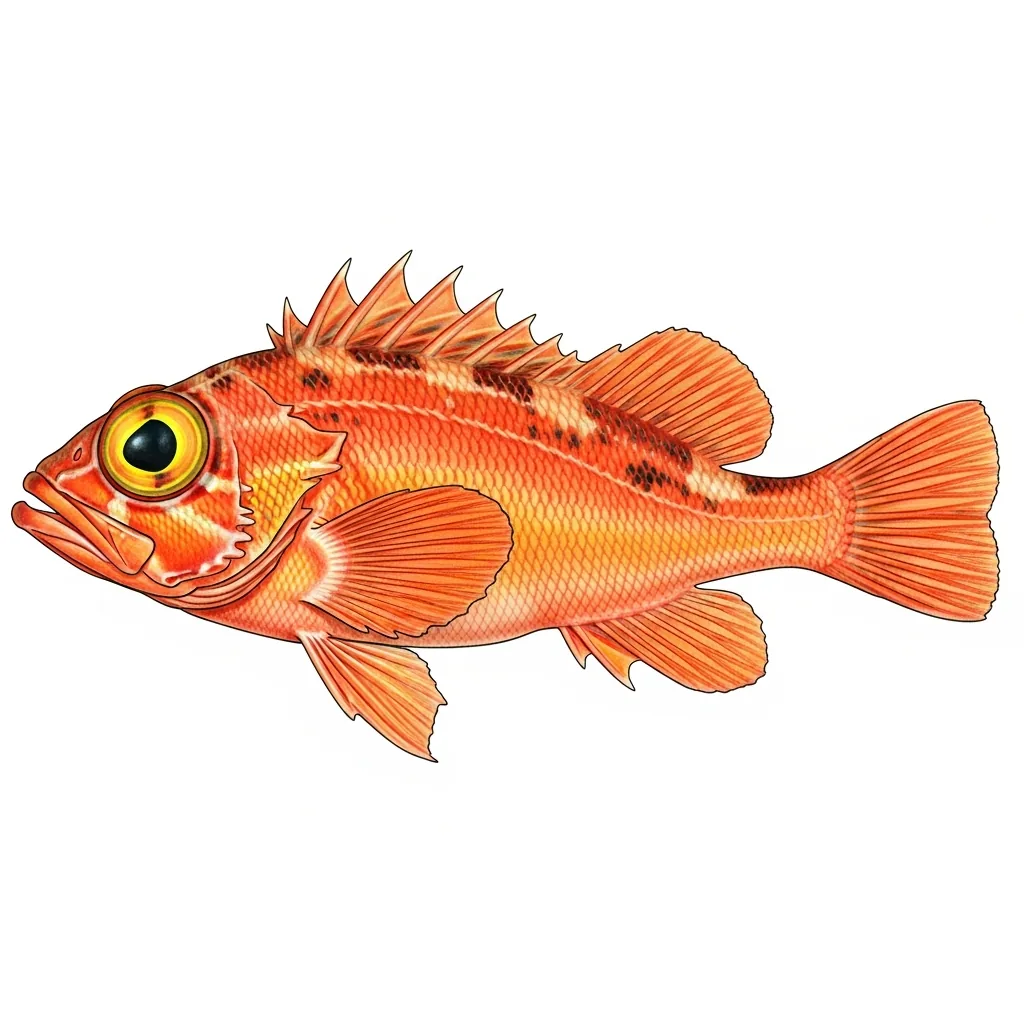
The Pacific 'Red Snapper'. One of the largest and longest-lived rockfish, can live over 100 years.
Identification
- Body
- Has a robust and streamlined body with a prominent head and large eyes.
- Colouration
- Bright yellow and orange coloration with whitish areas on the lower jaw and fins.
- Sexual dimorphism
- Not very noticeable
- Growth
- Slow, typical of long-lived species.
Taxonomy
- Family
- Sebastidae
- Order
- Scorpaeniformes
- Class
- Actinopterygii
Related species
Habitat & distribution
- Environment
- Coast, Reefs
- Preferred bottom
- Rock, Reef
- Geographic distribution
- Found along the Pacific coast of North America, from the Gulf of Alaska to Baja California.
- Micro-habitat
- Often found near rocky substrates, sheltering among rock crevices and corals.
Prefers areas with complex structures where it can easily hide from predators.
Presence by sea area
Diet
- Primary prey
- crustaceans, cephalopods, smaller fish
- Secondary prey
- amphipods, gastropods, krill
- Occasional prey
- octopuses, fish larvae
- Feeding behaviour
- Opportunistic hunter, feeds mainly at night taking advantage of the cover provided by rocky substrates.
- Natural predators
- seals, sea lions, sharks
Adapts its diet based on the availability of local and seasonal prey.
Behaviour
- Activity
- nocturnal
- Social behaviour
- solitary
- Aggressiveness
- medium
- Migration
- Resident, with limited seasonal movements for spawning.
- Seasonal behaviour
- During warmer months, tends to move to deeper waters.
- Juveniles
- Juveniles tend to stay in shallower waters, hidden amongst seaweeds and corals to avoid predators.
- Adults
- Adults are solitary, patrolling near rocks, waiting for prey to pass by.
Reproduction
- Spawning season
- March, April, May
- Spawning depth
- between 150 and 300 feet
- Eggs
- Small pelagic eggs, released en masse.
- Larval stage
- Larvae are planktonic, developing at the mercy of currents until settling in their rocky habitats.
- Sexual maturity
- 5-6 years
When to catch Yelloweye Rockfish
Activity calendar
Activity by season
Best times
This species shows peak fishing activity in spring, summer and autumn, when the productivity index (FPI) reaches its highest values.
Fishing activity decreases in winter, when conditions are less favourable.
Ideal conditions
Water temperature
Where to catch it
Best spots
Bottom preference
Spot type
Fishing techniques
Recommended
Other applicable
Recommended baits
Baits by pressure
How to really catch it
The yelloweye rockfish is a powerful, compact rockfish, the kind of predator that seems carved out of the reef itself. When you look for it over hard Pacific bottom, you quickly realize you are not fishing empty water: you are knocking on the door of a solitary hunter waiting in the shadows.
🐟 Good to know
An important biological trait of this species is its planktonic larval phase: after the release of small pelagic eggs, the larvae drift with the currents before settling into rocky habitat. It is a crucial transition linking open water to the coastal reefs where they live first as juveniles and later as adults.
🌊 Where & when
It lives along the Pacific coast of North America, from the Gulf of Alaska to Baja California, closely tied to rocks, reefs, submerged ledges and coastal outcrops from 20 to 200 meters. Adults hold alone near crevices and cover; from March through November it remains especially relevant, while in warmer months it tends to move deeper. Spawning takes place from March to May, generally between 50 and 100 meters.
🎣 How to really catch it
To target it for real, vertical jigging is the most concrete approach: a medium-heavy spinning rod, 20-30 lb braided line, a 30 lb fluorocarbon leader, and 100-250 g round sinkers to fish vertically over rocky bottom and reefs. Natural baits such as squid, shrimp, small octopus, or cut oily fish match its diet closely. The goal is to stay near bottom without losing contact, because the strike comes where the fish uses cover and ambush.
💡 The detail that makes the difference
A practical secret is to focus your drops on bottom breaks, just off cracks, points, and shelter, rather than over flat uniform rock. This rockfish is solitary and hunts by using the substrate as cover; if your bait drops into a clean area away from shelter, you may be fishing near the fish without ever entering its actual feeding lane.
Catch & handling tips
- Fight
- Tough with strong downward pulls, typical of fish that take refuge among rocks.
- Handling
- Use gloves to protect hands from spines, take care with the sharp dorsal fins.
- Release
- If possible, use barbless hooks to minimize damage during release.
Curiosities & culture
- Record catches
- Maximum documented size: up to about 104 cm and 17.8 kg (source: FishBase). IGFA All-Tackle record: 17.8 kg (39 lb 4 oz), caught in Alaska (USA).
- In the kitchen
- Highly valued for its white and firm flesh, ideal for baking or grilling.
- Cultural notes
- Often depicted in coastal art and used in local narratives for its long life.
- Historical notes
- Historically fished by native populations for centuries along the Pacific coast, using traditional artisanal methods.