
Overview
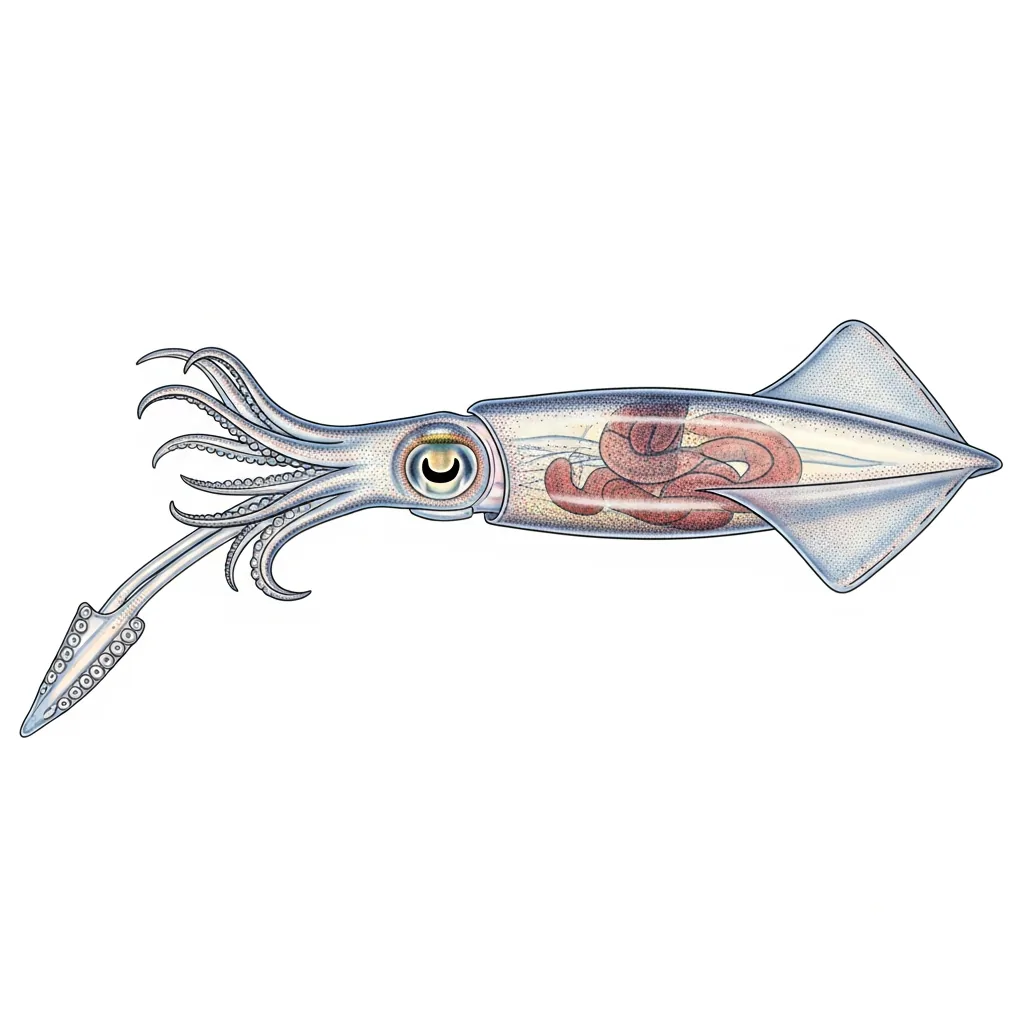
Highly sought cephalopod, comes near shore at night attracted by light. Mainly present in autumn-winter.
Identification
- Body
- Elongated and tapered body, equipped with a lateral fin that covers almost the entire mantle.
- Colouration
- Coloring varies from light pink to brown, with the ability to change color rapidly.
- Sexual dimorphism
- Not very evident, males are slightly larger.
- Growth
- rapid with fast development during favorable seasons
Taxonomy
- Family
- Loliginidae
- Order
- Myopsida
- Class
- Cephalopoda
Related species
Habitat & distribution
- Environment
- Coast, Open sea
- Preferred bottom
- Sand, Mud, Reef
- Geographic distribution
- Found in the Mediterranean, along the western European coasts up to the North Sea.
- Micro-habitat
- Attracted by light at night, it hides among rocks and crevices during the day.
Prefers sandy and muddy bottoms but moves to reefs during reproduction.
Presence by sea area
Diet
- Primary prey
- small fish, crustaceans, other cephalopods
- Secondary prey
- annelids, bivalve mollusks, gastropods
- Occasional prey
- plankton, small octopuses
- Feeding behaviour
- Active predator, primarily hunts at night using its tentacles to grab prey.
- Natural predators
- mackerel, tuna, larger fish, seabirds, dolphins
Ability to adapt its diet to a wide range of prey.
Behaviour
- Activity
- nocturnal
- Social behaviour
- solitary
- Aggressiveness
- medium
- Migration
- Makes seasonal migrations from deep waters to the coast for spawning.
- Seasonal behaviour
- More active during the autumn and winter months when it approaches the shore.
- Juveniles
- Juveniles are found near the surface, easily preyed upon by fish and seabirds.
- Adults
- Adults display complex social behaviors during courtship.
Reproduction
- Spawning season
- October, November, December
- Spawning depth
- between 20 and 60 meters
- Eggs
- Spawns eggs in gelatinous masses attached to the substrate, initially pelagic.
- Larval stage
- Planktonic larvae that drift with marine currents.
- Sexual maturity
- 1-2 years
When to catch European squid
Activity calendar
Activity by season
Best times
This species shows peak fishing activity in winter, when the productivity index (FPI) reaches its highest values.
Fishing activity decreases in spring and summer, when conditions are less favourable.
Ideal conditions
Atmospheric pressure
Low pressure pushes squid towards the coast. Excellent time for eging.
Stable pressure favors approaching shore at night. Regular activity.
With high pressure stays deep. Less active near shore.
Water temperature
Where to catch it
Best spots
Bottom preference
Spot type
Fishing techniques
Recommended
Other applicable
Recommended baits
Baits by pressure
How to really catch it
The European squid is a tense, precise predator, built from large eyes, quick tentacles, and flashes of color across the mantle. When light fades and the shoreline starts reflecting in the dark, it becomes a real presence under the surface: that is where true fishing begins.
🐟 Good to know
A remarkable biological feature of the squid is its chromatophores, cells that allow it to change color quickly. It is not just a striking effect: in cephalopods this system is tied to communication and camouflage, and it is a real part of its behavioral repertoire.
🌊 Where & when
It lives from the coast to open sea over sand, mud, and reef areas, between 10 and 250 meters deep. By day it tends to hide among rocks and crevices, while at night it is attracted to light. In autumn and winter it moves closer to shore; from October to December it migrates from deeper water to spawn, laying eggs between 20 and 60 meters.
🎣 How to really catch it
The most concrete approach is squid jigging, especially at night around reefs, bays, lagoons, and lit areas. Use a light 2-2.5 meter rod, 10-15 lb braid, a fluorocarbon leader in the same class, and colored squid jigs or medium jigs; if current is pushing, add the right sinker and work the lure with clean movements, then let it hang in the water column near the light.
💡 The detail that makes the difference
The tip that often makes the difference is simple: look for squid where the light cuts into the dark, not necessarily in the brightest spot. As a nocturnal predator attracted to light and feeding on small fish and crustaceans, it often holds on the edge of the glow, ready to leave the shadow and seize whatever passes.
Catch & handling tips
- Fight
- When hooked, it darts around trying to escape and releases ink as a defense mechanism.
- Handling
- Handle carefully to avoid the tentacles and lack of ink.
- Release
- Quickly release into water, ensuring it can swim away freely.
Curiosities & culture
- Record catches
- Maximum documented size: mantle length up to about 64 cm (source: SeaLifeBase); indicative weight around 1.5 kg in the largest specimens. As a cephalopod, there is no IGFA All-Tackle record.
- In the kitchen
- A main ingredient in many Mediterranean dishes, including fried dishes and seafood salads.
- Cultural notes
- Often a feature in legends of sea monsters and famous for its intelligence.
- Historical notes
- Fished since ancient times for its nutritional value and as a source of ink.