
Overview
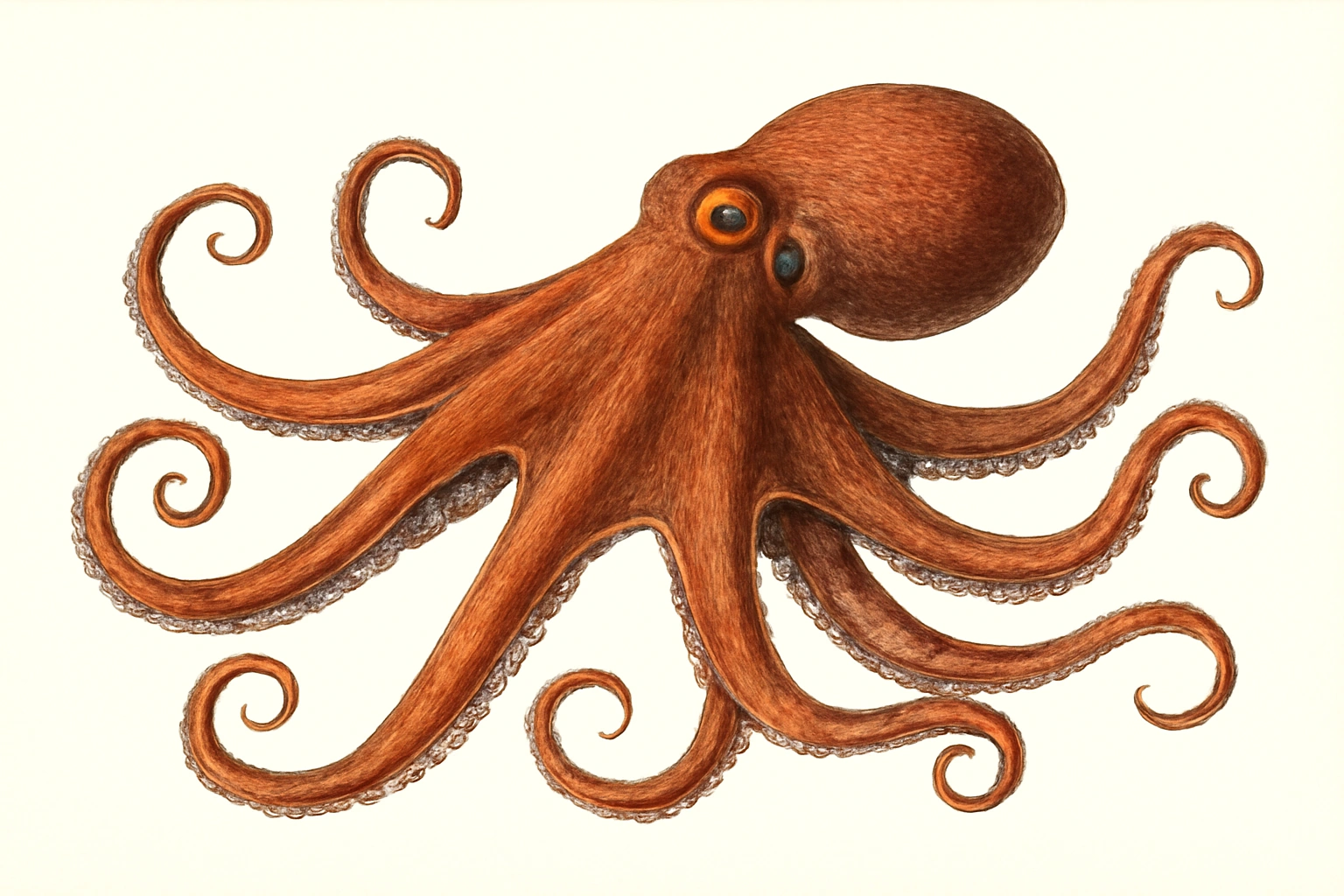
Highly intelligent cephalopod prized by fishermen. Hides in rocky dens and hunts crustaceans and mollusks.
Identification
- Body
- Soft, globular body with eight tentacles equipped with suckers.
- Colouration
- Variable color, often gray-brown, can change color for camouflage.
- Sexual dimorphism
- Absent or not prominent
- Growth
- Moderate, quickly adapts to environment
Taxonomy
- Family
- Octopodidae
- Order
- Octopoda
- Class
- Cephalopoda
Related species
Habitat & distribution
- Environment
- Coast, Reefs, Open sea
- Preferred bottom
- Rock, Sand, Reef
- Geographic distribution
- Common in tropical and temperate seas, especially in the Mediterranean and eastern Atlantic.
- Micro-habitat
- Hides in dens among rocks and crevices in reefs and coral barriers.
Adapts its dens to changing tides and currents.
Presence by sea area
Diet
- Primary prey
- crustaceans, mollusks, fish
- Secondary prey
- crabs, shrimps, sea snails
- Occasional prey
- polychaetes, echinoderms
- Feeding behaviour
- Nocturnal hunter, uses tentacles to catch prey and brings them to the beak to consume, often venomous.
- Natural predators
- sharks, large bony fish, moray eels, dolphins, humans
Excellent nocturnal predator using intelligence to capture prey.
Behaviour
- Activity
- nocturnal
- Social behaviour
- solitary
- Aggressiveness
- medium
- Migration
- Sedentary, with limited movements related to food and shelter search.
- Seasonal behaviour
- Longer, warmer days increase predatory and reproductive activity.
- Juveniles
- Tends to hide and move little, favoring shallow waters.
- Adults
- Increased territoriality and tendency to defend its den.
Reproduction
- Spawning season
- April, May, June
- Spawning depth
- between 10 and 50 meters
- Eggs
- Small eggs laid in clusters under rocks, benthic.
- Larval stage
- Pelagic larvae that disperse at sea for several weeks.
- Sexual maturity
- 1-2 years
When to catch Common octopus
Activity calendar
Activity by season
Best times
This species shows peak fishing activity in winter, when the productivity index (FPI) reaches its highest values.
Fishing activity decreases in spring and summer, when conditions are less favourable.
Ideal conditions
Atmospheric pressure
Very active, leaves den to hunt.
Regular activity.
Stays in den, less active.
Water temperature
Where to catch it
Best spots
Bottom preference
Spot type
Fishing techniques
Recommended
Other applicable
Recommended baits
Baits by pressure
How to really catch it
The common octopus is a silent bottom hunter, soft-bodied and watchful among rocks, sand, and submerged dens. When you truly target it, you are not chasing a passing fish: you are stepping into the territory of a solitary animal, strong and surprisingly tenacious.
🐟 Good to know
One real peculiarity of the octopus is the combination of no skeleton and a very strong beak: it can squeeze into narrow crevices and then hold and tear prey efficiently. Its skin can also change color, a key trait for life on the bottom.
🌊 Where & when
You find it along coasts, rocky ground, reefs, and mixed rock-and-sand bottoms, from the shoreline down to 200 meters, often hidden in cavities and cracks. It is a sedentary and mainly nocturnal species; longer, warmer days increase activity, while the indicated catch peaks fall in winter, from December through January and February. During reproduction, from April to June, it lays eggs under rocks between 10 and 50 meters.
🎣 How to really catch it
To catch it for real, the most concrete approach is to work tight to the bottom in front of dens, crevices, and rocky edges, using handlines or well-placed pots and traps. With a light rod, 10-15 kg monofilament, a 20 kg fluorocarbon leader, small hooks, and light weights, present sardines, shrimp, cuttlefish, or crabs naturally, letting the bait stay within its striking range close to shelter.
💡 The detail that makes the difference
The small detail that changes everything is not to force it immediately. When an octopus grabs on and tries to anchor itself to bottom or rock, steady controlled pressure is more defensible than sharp jerks: it is using suction and its den as leverage, so consistency matters more than haste.
Catch & handling tips
- Fight
- Energetic and capable of clinging tightly to the bottom or boat.
- Handling
- Handle tentacles cautiously to avoid suckers and beak.
- Release
- Handle gently and release near an underwater cave.
Curiosities & culture
- Record catches
- Maximum documented size: up to about 130 cm and 10 kg (source: SeaLifeBase). There is no IGFA All-Tackle record: invertebrates are not covered by IGFA categories.
- In the kitchen
- Used in dishes like octopus salad and grilled octopus, popular in various coastal Italian regions.
- Cultural notes
- A symbol of intelligence and mystery in many marine cultures.
- Historical notes
- Highly valued since ancient times, with references in Greek and Roman literature.