
Overview
Pelagic cephalopod that approaches the coast in autumn and winter. Prefers nighttime hours and artificial lights.
Identification
- Body
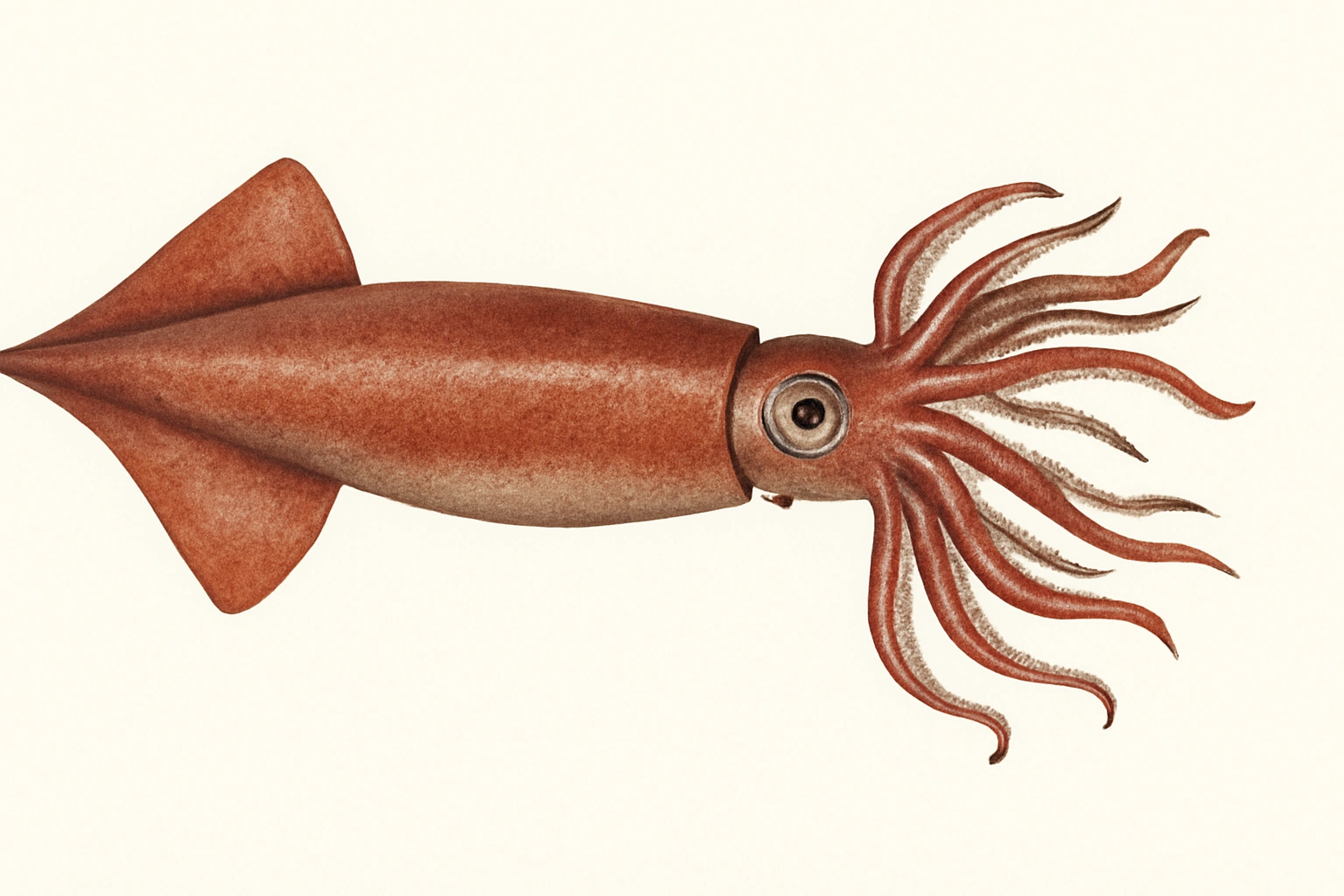
- Slender body with triangular fins and well-developed arms.
- Colouration
- Pink-brown with silvery sheen, often lighter on the back.
- Sexual dimorphism
- Absent/not very noticeable
- Growth
- Fast, particularly in the early months of life when it approaches the coast.
Taxonomy
- Family
- Ommastrephidae
- Order
- Oegopsina
- Class
- Cephalopoda
Related species
Habitat & distribution
- Environment
- Coast, Open sea, Pelagic
- Preferred bottom
- Sand, Mud, Gravel
- Geographic distribution
- Found in the Mediterranean, North Sea, and northeastern Atlantic.
- Micro-habitat
- Tends to frequent shallower areas at night, attracted by nearby lights along the coast.
Prefers sandy or muddy bottoms at varying depths.
Presence by sea area
Diet
- Primary prey
- small fish, crustaceans, other cephalopods
- Secondary prey
- shrimp, mackerel, anchovies
- Occasional prey
- jellyfish, fish larvae
- Feeding behaviour
- Active predator, uses its long arms to catch prey, often at night.
- Natural predators
- tunas, swordfish, dolphins, seabirds, octopuses
Active nocturnal predator, adapted to capture swift prey.
Behaviour
- Activity
- nocturnal
- Social behaviour
- small_groups
- Aggressiveness
- medium
- Migration
- Seasonal migrations, moving closer to the coast in fall and winter.
- Seasonal behaviour
- Tends to be more active in fall and winter when it comes closer to the coast to spawn.
- Juveniles
- Young form schools to protect themselves from predators.
- Adults
- Become more solitary as they grow, though still seen in small groups.
Reproduction
- Spawning season
- October, November, December, January
- Spawning depth
- between 100 and 300 meters
- Eggs
- Small, spherical eggs, produced in gelatinous masses, pelagic.
- Larval stage
- Planktonic larvae that quickly evolve into young cephalopods.
- Sexual maturity
- Varies between 1 and 1.5 years
When to catch European flying squid
Activity calendar
Activity by season
Best times
This species shows peak fishing activity in winter, when the productivity index (FPI) reaches its highest values.
Fishing activity decreases in spring and summer, when conditions are less favourable.
Ideal conditions
Atmospheric pressure
Approaches coast, very active.
Regular nocturnal activity.
Stays deep, away from coast.
Water temperature
Where to catch it
Best spots
Bottom preference
Spot type
Fishing techniques
Recommended
Other applicable
Recommended baits
Baits by pressure
How to really catch it
The European flying squid is a sleek, restless cephalopod built for the night and open water, with prominent eyes and powerful arms that reveal its nature as an active predator. When it rises toward coastal lights, among trembling reflections and liquid darkness, it becomes a quarry that can truly electrify a fishing session.
🐟 Good to know
Like other cephalopods, this squid lays pelagic eggs gathered in gelatinous masses, a reproductive strategy very different from species that attach eggs to the bottom. From these masses develop planktonic larvae, which then quickly grow into young cephalopods.
🌊 Where & when
You can find it from the Mediterranean to the North Sea and the northeastern Atlantic, over sand, mud, and gravel bottoms, from 20 to 800 meters, in both coastal and pelagic waters. At night it tends to move shallower, often near lights; in fall and winter it comes closer to shore, with a peak between December, January, and February, matching its spawning period from October to January.
🎣 How to really catch it
The most practical way to target it is with a squid jig at night, especially around illuminated areas, artificial platforms, river mouths, and open water close to shore. Use a medium-light rod of 2 to 3 meters, 0.25-0.30 mm monofilament, a 0.30-0.35 mm fluorocarbon leader, and 20 to 60 gram sinkers; luminous lures, small artificial fish, and shrimp fit its nocturnal predatory behavior well. Once hooked, expect fast runs and sudden changes of direction.
💡 The detail that makes the difference
If a spot gives you one contact, do not dismiss it after a single pass: this squid often occurs in small groups, especially when feeding or moving inshore. Repeating neat casts or drops through the same cone of light or along the same water layer is a simple adjustment, but one strongly supported by its real behavior.
Catch & handling tips
- Fight
- When hooked, it can make quick escapes underwater in unpredictable directions.
- Handling
- Handle carefully due to its arms, which can be irritating.
- Release
- Release it quickly after a photo, avoiding unnecessary injuries.
Curiosities & culture
- Record catches
- Maximum documented size: mantle up to about 75 cm (source: SeaLifeBase). There is no IGFA All-Tackle record: invertebrates are not covered by IGFA categories.
- In the kitchen
- Widely used in Mediterranean cuisine, especially appreciated fried or in stews.
- Cultural notes
- Present in various sea stories as a symbol of mysterious creatures.
- Historical notes
- Squid fishing has supplied the Italian coasts for centuries, particularly on cold winter nights.