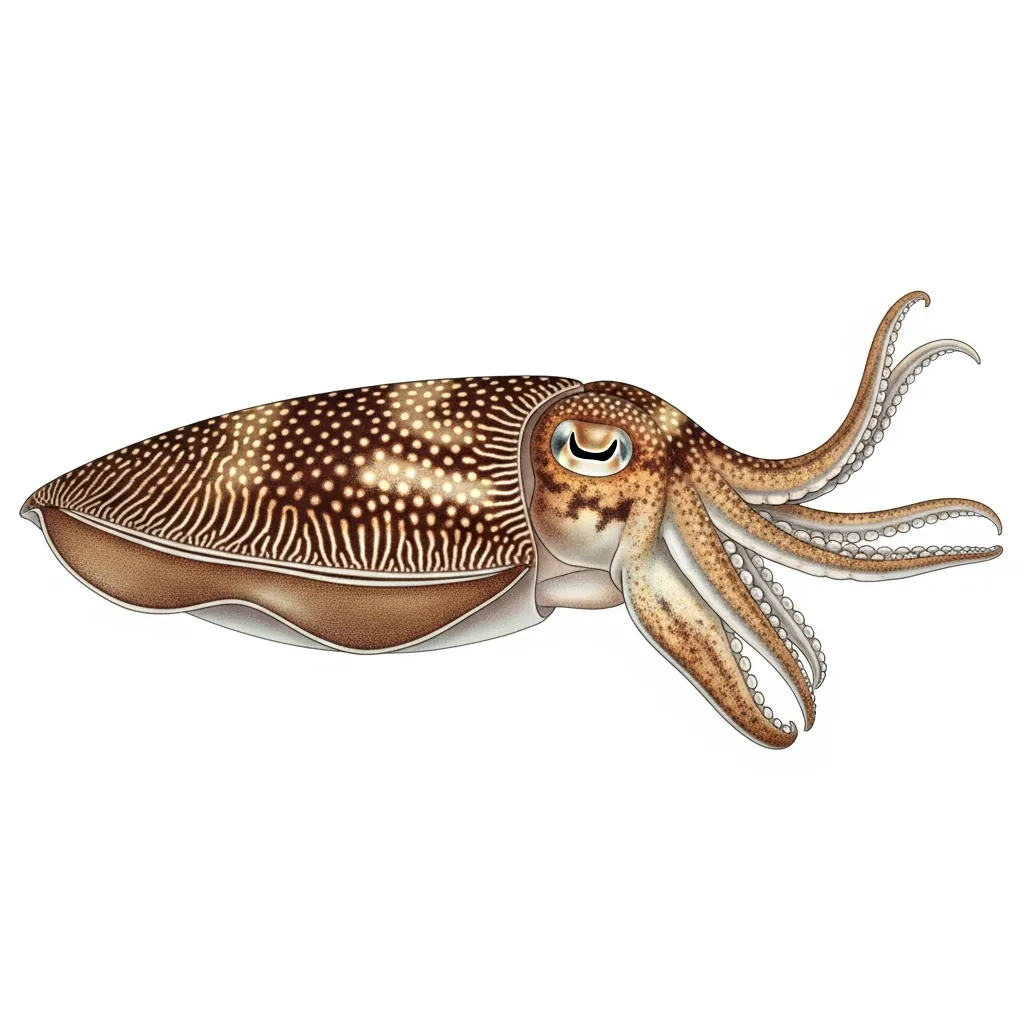

Overview
Very common Mediterranean cephalopod, comes near shore in autumn and spring for reproduction. Prefers sandy and mixed bottoms.
Identification
- Body
- Oval, soft body with a prominent pouch shape and two lateral lobes.
- Colouration
- Color varies greatly, ranging from orange to dark brown and black, often with intricate patterns.
- Sexual dimorphism
- Absent/not very noticeable
- Growth
- Fast, especially in the first months of life
Taxonomy
- Family
- Sepiidae
- Order
- Sepiida
- Class
- Cephalopoda
Related species
Habitat & distribution
- Environment
- Coast, Open sea, Estuarine
- Preferred bottom
- Sand, Mud, Seagrass
- Geographic distribution
- Found in the Mediterranean, Eastern Atlantic from the British Isles to South Africa, and the North Sea.
- Micro-habitat
- Hides on sandy bottoms with low vegetation during the day.
Requires bottoms where it can hide and easily find prey.
Presence by sea area
Diet
- Primary prey
- shrimp, small fish, crustaceans
- Secondary prey
- mollusks, marine worms, crabs
- Occasional prey
- smaller squid, jellyfish
- Feeding behaviour
- Active hunter using its long arms to quickly seize prey.
- Natural predators
- sharks, large predatory fish, seabirds, dolphins
Cuttlefish are opportunistic predators utilizing their camouflage to approach prey.
Behaviour
- Activity
- nocturnal
- Social behaviour
- solitary
- Aggressiveness
- medium
- Migration
- Periodically approaches the coast for spawning.
- Seasonal behaviour
- More active in spring and fall for spawning, often moving to coastal bottoms during these times.
- Juveniles
- Young cuttlefish are more vulnerable and stay closer to the seabed to hide.
- Adults
- Adults are more mobile with larger territories, often solitary.
Reproduction
- Spawning season
- April, May, June
- Spawning depth
- between 10 and 30 meters
- Eggs
- Grape-like clusters of eggs attached to substrates, benthic.
- Larval stage
- Larvae resemble small adults and are very active and independent after hatching.
- Sexual maturity
- 1-2 years
When to catch Common cuttlefish
Activity calendar
Activity by season
Best times
This species shows peak fishing activity in winter, when the productivity index (FPI) reaches its highest values.
Fishing activity decreases in spring and summer, when conditions are less favourable.
Ideal conditions
Atmospheric pressure
Low pressure excellent for cuttlefish. Very active near shore, productive eging.
Regular activity. Feeds normally on sandy and mixed bottoms.
With high pressure stays on deep bottom. Less active near shore.
Water temperature
Where to catch it
Best spots
Bottom preference
Spot type
Fishing techniques
Recommended
Other applicable
Recommended baits
Baits by pressure
How to really catch it
The cuttlefish appears and disappears over the bottom like a living shadow: soft body, large eyes, a fin rippling around the mantle, and two longer arms ready to fire forward. When you truly fish for it, you quickly learn that casting is not enough; you have to read sand, sparse grass, and light the way a nocturnal predator does.
🐟 Good to know
A remarkable biological feature is its large internal calcareous shell, the cuttlebone, a characteristic internal structure of this species. Its eggs are benthic, arranged in grape-like clusters and attached to the substrate.
🌊 Where & when
It lives along coasts, in the open sea, and in estuarine environments, over sand, mud, and seagrass beds, from the surface down to 200 meters. By day it tends to hide on sandy bottoms with low vegetation; it becomes more approachable near shore when it moves in to spawn, especially in spring and autumn, with egg laying between April and June on bottoms from 10 to 30 meters.
🎣 How to really catch it
To really catch it, the most concrete approach is rod fishing over sandy areas, light mud, and the edges of seagrass, especially where the bottom changes near coastal reefs. A medium spinning rod with 6-10 lb monofilament, a 15-20 lb fluorocarbon leader, a circle hook, and a split-shot style weight works well with live shrimp, small baitfish, or pieces of squid, presented close to the bottom with a slow, controlled retrieve.
💡 The detail that makes the difference
The detail that often makes the difference is keeping the bait low and clean, just above the bottom or in light contact with it, because cuttlefish hunt prey such as shrimp, small fish, and crustaceans where they can use camouflage and the quick reach of their long arms. When it bolts and then releases ink, do not rush it: keep steady tension and continue smoothly.
Catch & handling tips
- Fight
- Initially attempts a quick escape, then tends to defend itself by releasing ink.
- Handling
- Handle with care to avoid the beak and prevent injury, be cautious of ink release.
- Release
- If possible, release back into the water to reduce stress, taking care not to damage the arms.
Curiosities & culture
- Record catches
- Maximum documented size: mantle up to about 49 cm and weight up to 4 kg (source: SeaLifeBase). There is no IGFA All-Tackle record: invertebrates are not covered by IGFA categories.
- In the kitchen
- Highly prized in Mediterranean cuisine, used in dishes like risottos and seafood soups.
- Cultural notes
- Featured in numerous stories and myths as a symbol of metamorphosis and adaptability.
- Historical notes
- Cuttlefish fishing is traditional in Mediterranean countries, often also used for ink production.