
Overview
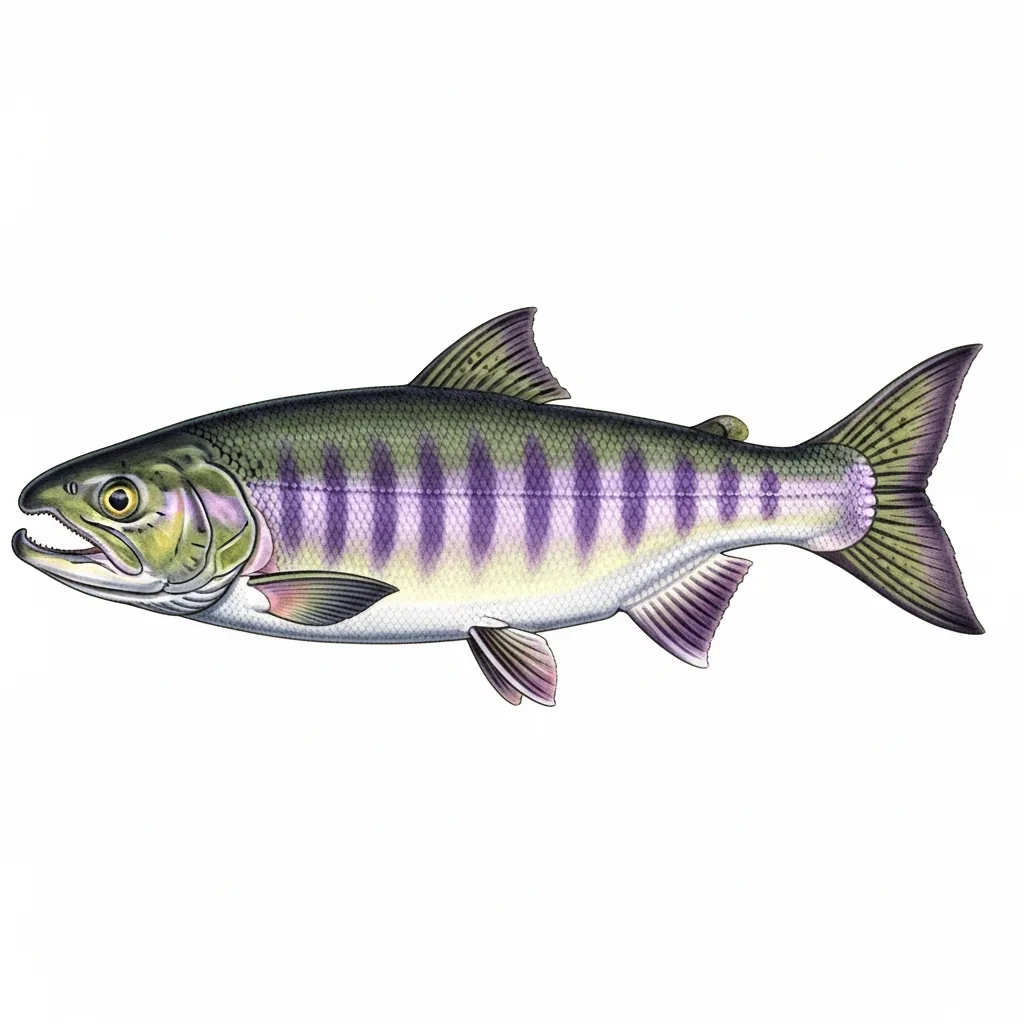
Known as 'Dog Salmon', the largest salmon after Chinook. Powerful fighter, often underrated.
Identification
- Body
- The body is streamlined with a torpedo shape typical of salmon.
- Colouration
- Silvery in the ocean, turns olive green with black markings in rivers during spawning.
- Sexual dimorphism
- Males develop a prominent jaw and more vivid stripes during spawning.
- Growth
- rapid, thanks to their rich diet and growth conditions in the ocean
Taxonomy
- Family
- Salmonidae
- Order
- Salmoniformes
- Class
- Actinopterygii
Related species
Habitat & distribution
- Environment
- Coast, Open sea, Estuaries, Rivers
- Preferred bottom
- Gravel, Sand
- Geographic distribution
- Found in the North Pacific, mainly along the northern coasts of Asia and North America, from Japan to Alaska.
- Micro-habitat
- Prefers river areas with flowing water and gravel beds for spawning.
Prefers well-oxygenated waters and gravelly bottoms for spawning.
Presence by sea area
Diet
- Primary prey
- crustaceans, small fish, capelin
- Secondary prey
- amphipods, zooplankton, krill
- Occasional prey
- polychaetes, jellyfish
- Feeding behaviour
- Primarily an opportunistic predator in open water, feeds by spotting and capturing nearby prey.
- Natural predators
- bears, seals, large predatory fish, seabirds
The variety of prey allows keta salmon to adapt to different environments.
Behaviour
- Activity
- diurnal
- Social behaviour
- large_schools
- Aggressiveness
- medium
- Migration
- Seasonal anadromous migrations, ascending rivers to spawn.
- Seasonal behaviour
- During the spawning season, they move into freshwater and their feeding habits change.
- Juveniles
- Young remain in freshwater for several months before migrating to the sea.
- Adults
- Typically live in open ocean and chase prey in coastal waters.
Reproduction
- Spawning season
- October, November, December
- Spawning depth
- above 20 meters in rivers
- Eggs
- Eggs are large, spherical, benthic, and adhere to the river gravel.
- Larval stage
- Larvae remain hidden among gravel until the fry stage.
- Sexual maturity
- 3-5 years
When to catch Chum Salmon
Activity calendar
Activity by season
Best times
This species shows peak fishing activity in spring, summer and autumn, when the productivity index (FPI) reaches its highest values.
Fishing activity decreases in winter, when conditions are less favourable.
Ideal conditions
Water temperature
Where to catch it
Best spots
Bottom preference
Spot type
Fishing techniques
Recommended
Other applicable
Recommended baits
Baits by pressure
How to really catch it
Chum salmon is a powerful migrant, born among gravel and current before spreading into the vast North Pacific. When you truly meet it—at a river mouth, in an estuary, or pushing upriver—you immediately feel this is no ordinary fish: a restless opponent, mobile and explosive, with bursts and jumps that test both your hands and your nerve.
🐟 Good to know
One notable biological trait of chum salmon is its marked change in appearance during spawning: coloration shifts strongly, and males develop a pronounced jaw. This is a real and well-documented transformation in Pacific salmon, tied to their reproductive migration into freshwater.
🌊 Where & when
You find it in the North Pacific, along the coasts from Japan to Alaska, in open sea, coastal water, estuaries, and rivers. It becomes more approachable from spring into autumn, with a broad window through November; in October, November, and December it moves upriver, seeking flowing sections with gravel or sand bottoms for spawning.
🎣 How to really catch it
To truly fish for it, spinning is the most concrete approach: at river mouths and in estuarine water, work artificial lures cleanly, tracking moving schools and covering water with steady casts. In mid and upper river stretches, flies also work well, and where allowed, natural presentations with worms and a sliding sinker or split shot can be effective, using an 8-10 ft rod, 15-20 lb braid, and a 12-15 lb fluorocarbon leader.
💡 The detail that makes the difference
The practical secret is to read the bottom before the fish: when chum enters freshwater to spawn, it gravitates toward current and gravel, so one precise drift through that lane is worth more than many random casts. At sea and along the coast it feeds on nearby prey in schools, so keeping the offering moving naturally and continuously is often more defensible than forcing erratic retrieves.
Catch & handling tips
- Fight
- Energetic fight with lots of jumps and runs.
- Handling
- Use wet gloves to handle the fish and minimize fin damage.
- Release
- Release into cool, flowing water, avoiding excessive strain.
Curiosities & culture
- Record catches
- Maximum documented size: up to about 100 cm and 18.1 kg (source: FishBase). IGFA All-Tackle record: 15.88 kg (35 lb), caught in British Columbia (Canada) in 1995.
- In the kitchen
- Used for making sushi and sashimi; also popular when smoked.
- Cultural notes
- Seen as a symbol of fertility and abundance in indigenous Pacific cultures.
- Historical notes
- Traditionally caught by Native American populations using trap and net techniques.