
Overview
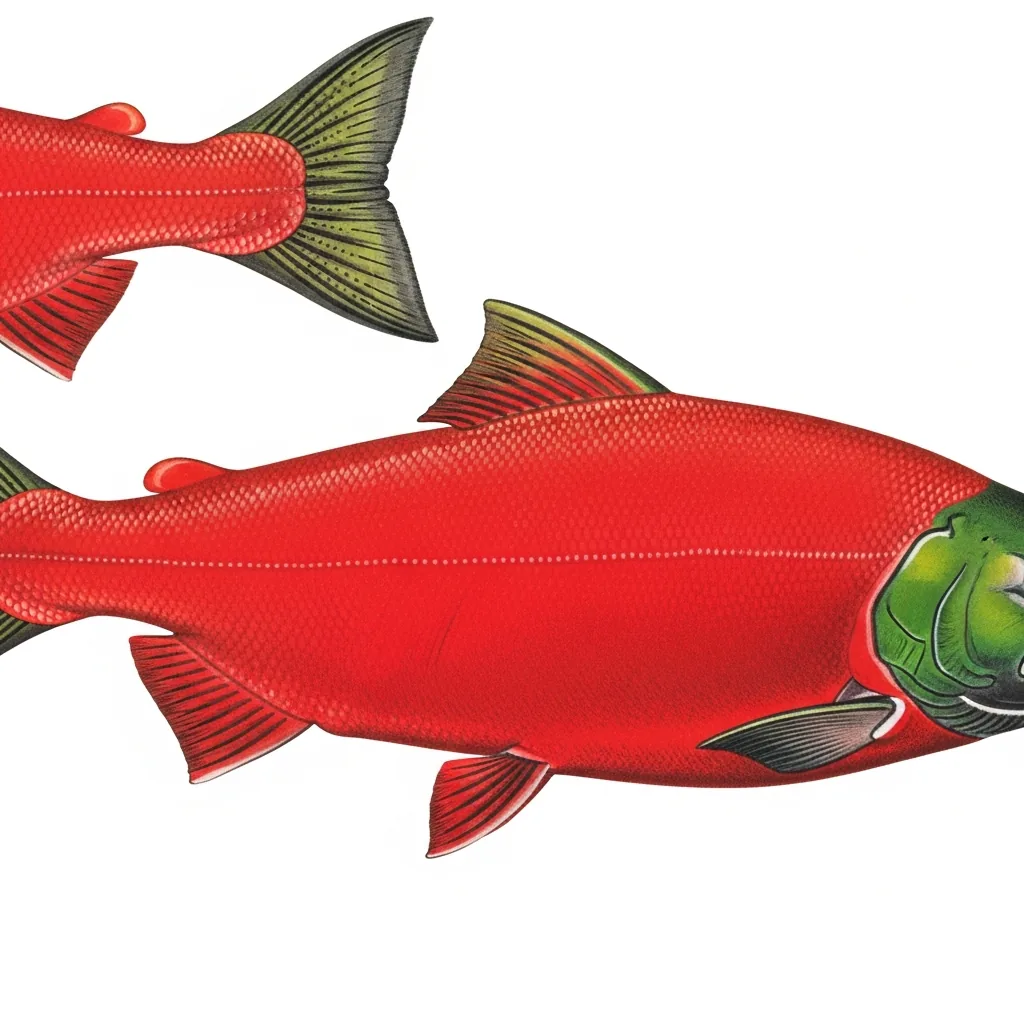
Known as 'Red Salmon', the most prized salmon culinarily. Alaska runs are legendary.
Identification
- Body
- Tapered and well-muscled body, suitable for migration.
- Colouration
- During migration, it takes on a bright red color with a green head.
- Sexual dimorphism
- Males develop a kype and more vibrant colors during the spawning season.
- Growth
- moderate
Taxonomy
- Family
- Salmonidae
- Order
- Salmoniformes
- Class
- Actinopterygii
Related species
Habitat & distribution
- Environment
- Open sea, Coast, Estuaries
- Preferred bottom
- Gravel, Seagrass
- Geographic distribution
- North Pacific, from the shores of Alaska to the northwestern Pacific coasts.
- Micro-habitat
- Seeks refuge among vegetation and rocks during the juvenile stages in rivers.
Requires clean and accessible river habitats during the spawning season.
Presence by sea area
Diet
- Primary prey
- krill, squid, small fish
- Secondary prey
- copepods, shrimp, zooplankton
- Occasional prey
- aquatic insects, larvae, algae
- Feeding behaviour
- With fine teeth, it quickly snatches its prey in open water. Feeds little during the upstream journey.
- Natural predators
- brown bears, eagles, wolves, pinnipeds, sharks
Primarily plankton-feeder at sea, shifting to a limited diet during migration.
Behaviour
- Activity
- diurnal
- Social behaviour
- large_schools
- Aggressiveness
- medium
- Migration
- Undertakes long migrations from the seas to native rivers to spawn.
- Seasonal behaviour
- Prepares in summer for the river ascent for spawning.
- Juveniles
- Young stay in groups in rivers until they are large enough for the sea.
- Adults
- Adults are migratory and form large schools as they head towards spawning grounds.
Reproduction
- Spawning season
- July, August
- Spawning depth
- between 3 and 16 feet
- Eggs
- Benthic and adhesive eggs, about 5-7 mm wide.
- Larval stage
- Young emerge after 6-9 weeks, staying in natal streams for 1-3 years.
- Sexual maturity
- 4-5 years
When to catch Sockeye Salmon
Activity calendar
Activity by season
Best times
This species shows peak fishing activity in spring, summer and autumn, when the productivity index (FPI) reaches its highest values.
Fishing activity decreases in winter, when conditions are less favourable.
Ideal conditions
Water temperature
Where to catch it
Best spots
Bottom preference
Spot type
Fishing techniques
Recommended
Other applicable
Recommended baits
Baits by pressure
How to really catch it
Sockeye salmon is a true migrant: streamlined body, tight muscle, and a life spent between open sea and estuaries before the great return to its natal rivers. When you meet it at the right moment, schooling and moving with purpose, you immediately understand why it remains one of the most sought-after salmon: powerful, nervous, and capable of spectacular jumps and sudden changes of direction.
🐟 Good to know
A key biological trait of sockeye salmon is its strong connection to natal waterways: adults return from the sea to their native rivers to spawn. The eggs are benthic and adhesive, laid over gravel in shallow water; the young then remain in their home streams for one to three years before entering marine life.
🌊 Where & when
You find it in the North Pacific, from Alaska to the northwestern Pacific coasts, across open sea, coast, and estuaries, with a broad active window from March to November. The most concrete opportunity comes from summer into early autumn, when it prepares for the upstream run and then enters rivers; spawning falls in July and August, over gravel bottoms between one and five meters.
🎣 How to really catch it
To catch it for real, the key is to target travel routes in estuaries and river mouths with spinning or drift fishing, letting spoons and artificial lures work in moving water or current. A 7-9 ft medium-heavy rod with 10-20 lb monofilament and an 8-12 lb fluorocarbon leader gives control without making the presentation too stiff; single or double #2-1/0 hooks and light slip sinkers help keep the offering in the right layer as the school moves through.
💡 The detail that makes the difference
The most defensible tip is simple: focus more on the route than on feeding. At sea, sockeye takes krill, squid, and small fish, but during the upstream run it feeds little; because of that, it pays to present the lure where fish pass in compact groups, keeping it clean, visible, and steady in the current instead of relying on overly frantic retrieves.
Catch & handling tips
- Fight
- Fights with spectacular jumps and quick side-to-side movements.
- Handling
- Handle gently, keeping moisture and stability.
- Release
- Release gently into the current, avoiding gill damage.
Curiosities & culture
- Record catches
- Maximum documented size: up to about 84 cm and 7.7 kg (source: FishBase). IGFA All-Tackle record: 7.26 kg (16 lb), caught at the Kenai River, Alaska (USA), in 1974.
- In the kitchen
- Highly prized smoked or grilled, a key component of sushi.
- Cultural notes
- Important cultural symbol for the native peoples of Alaska and the Pacific Northwest.
- Historical notes
- Provided an influential dietary and cultural base for the indigenous Pacific populations.