
Overview
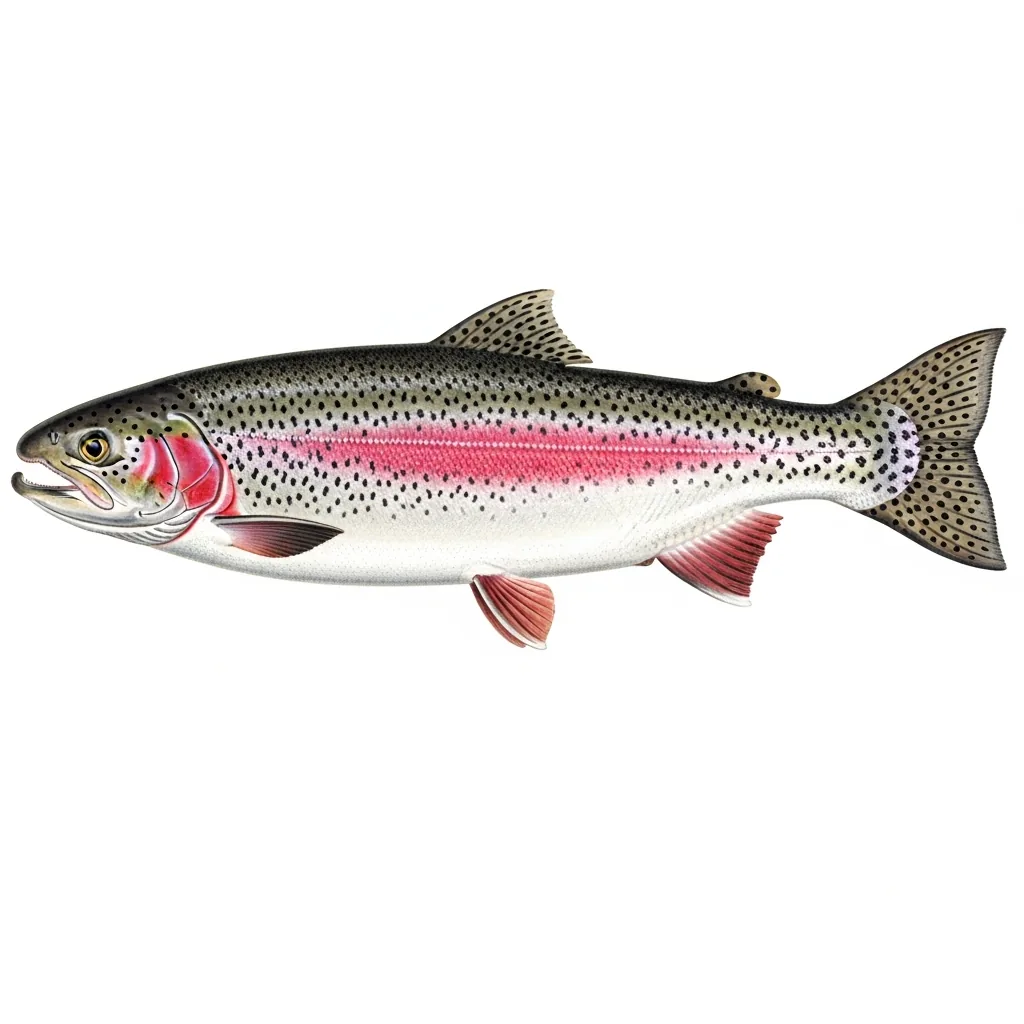
The anadromous form of rainbow trout. Considered one of the noblest sportfish in the Pacific Northwest.
Identification
- Body
- Elongated and slender body with well-developed fins.
- Colouration
- Silvery color with an olive green or bluish back and a bright red lateral line.
- Sexual dimorphism
- Present, males develop more vivid coloration and a humpback during the breeding season.
- Growth
- Rapid, especially in juveniles, favored by a rich diet.
Taxonomy
- Family
- Salmonidae
- Order
- Salmoniformes
- Class
- Actinopterygii
Related species
Habitat & distribution
- Environment
- Estuaries, Coast, Rivers
- Preferred bottom
- Gravel, Sand
- Geographic distribution
- Originates from the Pacific coasts of North America but introduced to many other regions, including Europe.
- Micro-habitat
- Prefers cool currents with gravel bottoms for spawning.
Prefers oxygen-rich, cool waters with plenty of cover.
Presence by sea area
Diet
- Primary prey
- small fish, crustaceans, aquatic insects
- Secondary prey
- zooplankton, larvae, fish eggs
- Occasional prey
- amphibians, small rodents
- Feeding behaviour
- Active predator that hunts both in open sea and freshwater, often near the surface.
- Natural predators
- bears, larger fish, birds of prey, humans
A varied and adaptable diet enables success in different ecosystems.
Behaviour
- Activity
- diurnal
- Social behaviour
- solitary
- Aggressiveness
- low
- Migration
- Performs anadromous migrations, swimming up rivers to spawn.
- Seasonal behaviour
- Moves from the ocean to rivers during spawning months and returns to the ocean post-spawning.
- Juveniles
- Dominate ponds and small streams, staying close to cover to avoid predators.
- Adults
- Gather in larger groups but tend to live independently when not in the spawning period.
Reproduction
- Spawning season
- February, March, April
- Spawning depth
- between 0 and 2 meters
- Eggs
- Small spherical, adhesive, and benthic eggs.
- Larval stage
- Fry remain in their birth river for 1-2 years before migrating to the sea.
- Sexual maturity
- 3-4 years
When to catch Steelhead Trout
Activity calendar
Activity by season
Best times
This species shows peak fishing activity in spring, summer and autumn, when the productivity index (FPI) reaches its highest values.
Fishing activity decreases in winter, when conditions are less favourable.
Ideal conditions
Water temperature
Where to catch it
Best spots
Bottom preference
Spot type
Fishing techniques
Recommended
Other applicable
Recommended baits
Baits by pressure
How to really catch it
Steelhead is a sleek, powerful salmonid, recognizable by its pinkish lateral stripe and a tail ready to turn any hook-up into a hard run. Between estuary, current, and cold water it shifts habitat with ease, and that is exactly where it becomes such a compelling target for anglers who can read movement and season.
🐟 Good to know
Steelhead is the anadromous form of Oncorhynchus mykiss: it is born in freshwater, migrates to the sea, and later returns upriver to spawn. Fry remain in their natal river for 1-2 years before migrating, a key step in its biological cycle.
🌊 Where & when
You find it in estuaries, along the coast, and in rivers, favoring cool currents and gravel or sandy bottoms; during spawning it especially seeks gravelly stretches. It is catchable through much of the year, with peak activity from March to November, while from February to April it moves upriver to spawn in shallow water.
🎣 How to really catch it
To really fish for it, the most concrete approach is drift fishing in current seams and river mouths, letting the bait travel naturally through the flow. A medium-heavy 8-10 foot rod, 6-10 kg line, 0.25-0.35 mm nylon leader, long-shank size 6-10 hooks, and a 4-10 g sliding sinker let you present natural baits or crustaceans with control and feel; when it feeds higher in the water, artificial flies and small metal minnows also make sense.
💡 The detail that makes the difference
One practical edge is to focus where the bottom shifts into gravel and the current stays cool and well oxygenated. That is not a random detail: steelhead uses exactly these sections for movement and spawning, so a clean drift crossing that bottom change stays aligned with its biology and often looks more convincing.
Catch & handling tips
- Fight
- Known for its energetic runs and spectacular jumps.
- Handling
- Gently support the fish with both hands to prevent injury.
- Release
- Minimize time out of the water, releasing gently to avoid excessive stress.
Curiosities & culture
- Record catches
- Maximum documented size: up to about 122 cm and 25.9 kg (source: FishBase). IGFA All-Tackle record: 21.77 kg (48 lb), caught at Lake Diefenbaker, Saskatchewan (Canada), in 2009.
- In the kitchen
- Enjoyed grilled or smoked, it's a staple dish in Pacific coastal regions.
- Cultural notes
- A prominent figure in the culture and cuisine of the Pacific Northwest coastal communities.
- Historical notes
- Introduced to many regions worldwide for its adaptability and sporting value.