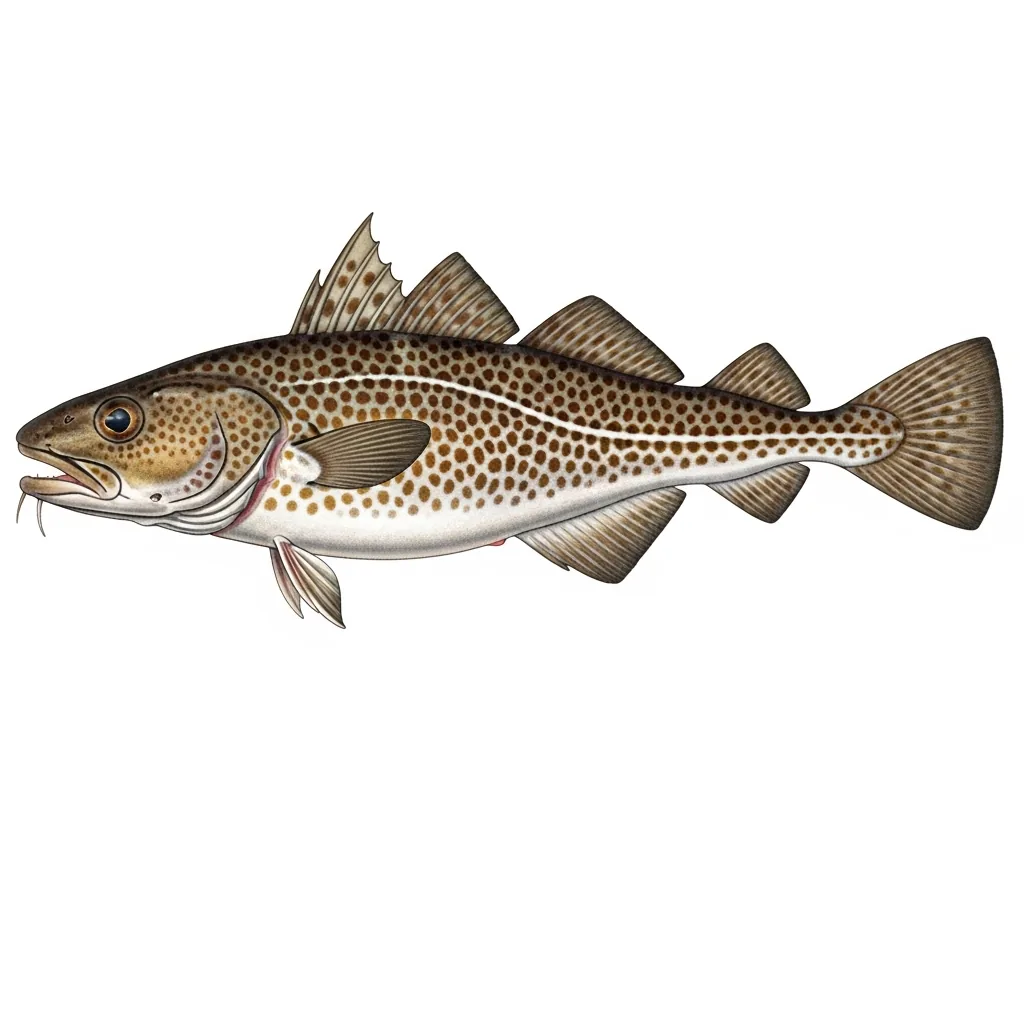

Overview
Fundamental fish for Alaska fishing. Abundant, easy to catch, and excellent to eat.
Identification
- Body
- The body is elongated and slightly compressed on the sides.
- Colouration
- The back is usually brownish-green, while the flanks and belly are lighter.
- Sexual dimorphism
- Absent/not evident
- Growth
- Fast, especially in the first years of life.
Taxonomy
- Family
- Gadidae
- Order
- Gadiformes
- Class
- Actinopterygii
Related species
Habitat & distribution
- Environment
- Coast, Open sea, Reefs
- Preferred bottom
- Sand, Gravel, Mud
- Geographic distribution
- Primarily found in the North Pacific, from Alaska to the Sea of Japan.
- Micro-habitat
- Often hides among rocks and marine ledges.
Prefers areas with an abundance of marine flora and bottom cover.
Presence by sea area
Diet
- Primary prey
- crustaceans, small fish, polychaetes
- Secondary prey
- shrimp, cephalopods, mollusks
- Occasional prey
- echinoderms, other small fish
- Feeding behaviour
- Opportunistic predator, actively hunts day and night.
- Natural predators
- seals, sea lions, orcas
Often utilizes tides and currents to feed more efficiently.
Behaviour
- Activity
- diurnal
- Social behaviour
- small_groups
- Aggressiveness
- medium
- Migration
- Undertakes seasonal migrations for spawning.
- Seasonal behaviour
- In winter it migrates to deeper waters for spawning, while in summer it returns to coastal areas.
- Juveniles
- Young fish school together for protection.
- Adults
- Adults can be solitary or form small groups.
Reproduction
- Spawning season
- January, February
- Spawning depth
- between 50 and 200 meters
- Eggs
- Demersal, adhesive, and small eggs.
- Larval stage
- Pelagic larvae that feed on plankton.
- Sexual maturity
- 3-4 years
When to catch Pacific Cod
Activity calendar
Activity by season
Best times
This species shows peak fishing activity in spring, summer and autumn, when the productivity index (FPI) reaches its highest values.
Fishing activity decreases in winter, when conditions are less favourable.
Ideal conditions
Water temperature
Where to catch it
Best spots
Bottom preference
Spot type
Fishing techniques
Recommended
Other applicable
Recommended baits
Baits by pressure
How to really catch it
Pacific cod is a bottom-dwelling fish with a classic outline and an unmistakable presence: broad head, chin barbel, and an elongated body slipping over sand, gravel, and rock. When you look for it in the right place, you immediately feel you are dealing with a practical predator that uses crevices and bottom edges to its advantage.
🐟 Good to know
A notable biological trait is the combination of demersal, adhesive eggs laid on the bottom and pelagic larvae that later feed on plankton. In the same species, the earliest life stages therefore occupy very different environments, from the seabed to the water column.
🌊 Where & when
It lives in the North Pacific, from Alaska to the Sea of Japan, over sand, gravel, and mud bottoms, along coasts, open sea, and rocky reliefs, often close to rocks and ledges. From summer into autumn it becomes more accessible in coastal waters, while in winter it tends to move deeper to spawn, with spawning taking place between January and February at depths of 50 to 200 meters.
🎣 How to really catch it
The most practical way to target it with a sea rod is to work the bottom with natural baits: fresh small fish, squid, shrimp, or worms. A 4-7 kg rod with 10-15 kg monofilament, a 20 kg fluorocarbon leader, 2/0-4/0 hooks, and a ball or pyramid sinker lets you stay low and precise on reefs, marine canyons, shallow sandy flats, and rocky coasts, where it often bites with firm pulls and then fights with strong lateral surges.
💡 The detail that makes the difference
The truly useful tip is to read the bottom before you even get a bite: Pacific cod uses mixed ground, but readily holds around rocks, ledges, and the margins where hard bottom meets softer substrate as cover and feeding ground. If you place a natural bait right beside those structural changes, rather than over featureless bottom, your approach matches its real behavior much better.
Catch & handling tips
- Fight
- When hooked, it fights vigorously with lateral surges.
- Handling
- Use a cloth to avoid slipping.
- Release
- Release carefully to avoid damage to their fins and gills.
Curiosities & culture
- Record catches
- Maximum documented size: up to about 119 cm and 22.7 kg (source: FishBase). There is no official IGFA All-Tackle record for this species.
- In the kitchen
- Used for making bacalao or dried for direct consumption.
- Cultural notes
- Important in Alaskan culture as staple food.
- Historical notes
- Traditional fishing in Alaska for many generations, crucial for the local economy.