
Overview
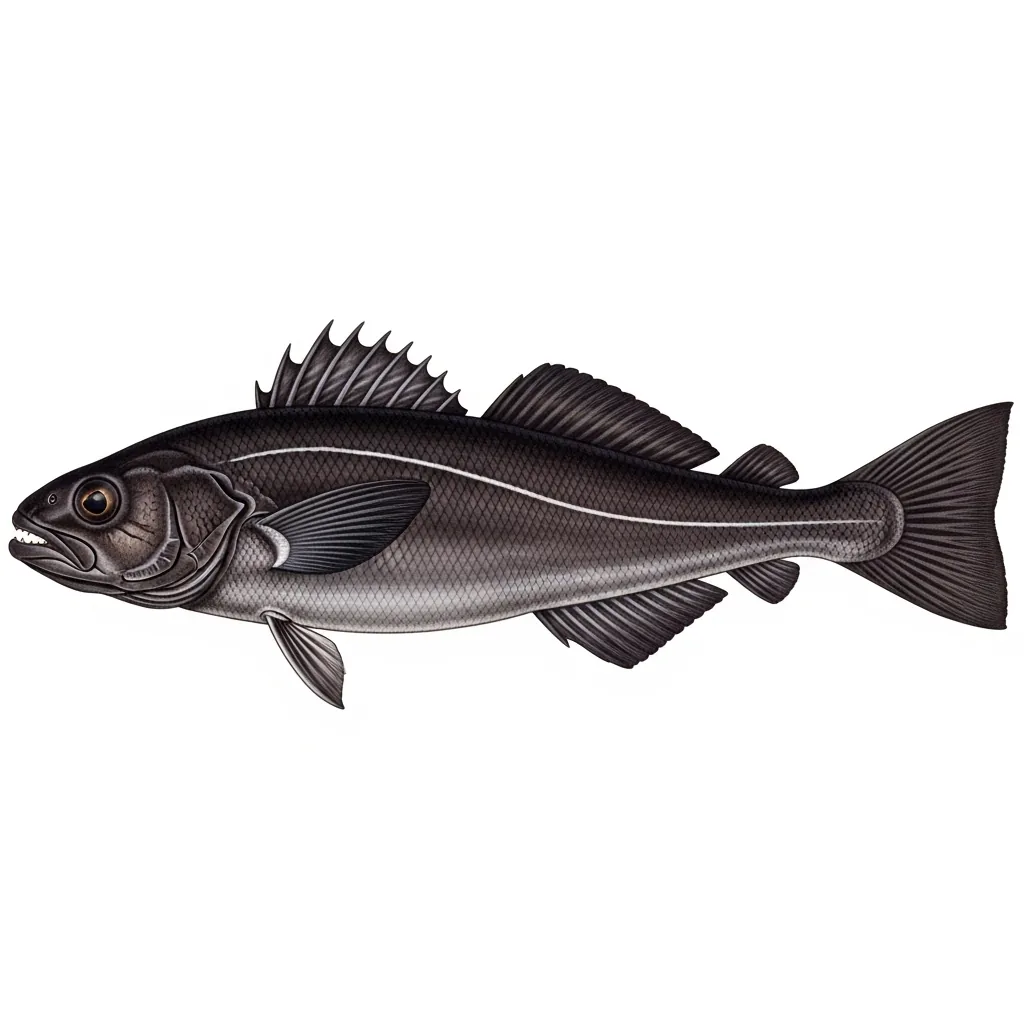
Known as 'Black Cod', one of Alaska's most prized fish. Buttery meat rich in omega-3.
Identification
- Body
- Elongated and spindle-shaped body, with a wide head and tapering tail.
- Colouration
- Predominantly black or dark grey on the back, fading to a dirty white underside.
- Sexual dimorphism
- absent/not noticeable
- Growth
- fast, associated with the abundant food supply in the North Pacific.
Taxonomy
- Family
- Anoplopomatidae
- Order
- Scorpaeniformes
- Class
- Actinopterygii
Related species
Habitat & distribution
- Environment
- Deep sea, Coast
- Preferred bottom
- Mud, Sand
- Geographic distribution
- Distributed along the northern Pacific, from Alaska to southern California, and around Japan.
- Micro-habitat
- Usually found in deep waters in muddy and sandy areas; commonly hides in crevices or under rocks during the day.
Prefers deep muddy areas for its resting and hunting grounds.
Presence by sea area
Diet
- Primary prey
- krill, squids, small fish
- Secondary prey
- crustaceans, octopuses, mollusks
- Occasional prey
- jellyfish, fish eggs
- Feeding behaviour
- Feeds primarily at night, often in deep waters, favoring pelagic prey due to its ability to swim quickly.
- Natural predators
- sharks, whales, seals
Uses its speed to surprise prey dwelling in the seabed and pelagic waters.
Behaviour
- Activity
- nocturnal
- Social behaviour
- small_groups
- Aggressiveness
- low
- Migration
- non-migratory with seasonal vertical movements
- Seasonal behaviour
- During winter months, it migrates to shallower depths for spawning.
- Juveniles
- Young individuals tend to inhabit shallower waters than adults, forming small groups.
- Adults
- Generally lives in scattered groups and exhibits seasonal movements linked to water temperature.
Reproduction
- Spawning season
- January, February, March
- Spawning depth
- between 200 and 500 meters
- Eggs
- Pelagic eggs, small, transparent, and buoyant.
- Larval stage
- Larvae are pelagic and develop rapidly, feeding on plankton.
- Sexual maturity
- 5-7 years
When to catch Sablefish
Activity calendar
Activity by season
Best times
This species shows peak fishing activity in spring, summer and autumn, when the productivity index (FPI) reaches its highest values.
Fishing activity decreases in winter, when conditions are less favourable.
Ideal conditions
Water temperature
Where to catch it
Best spots
Bottom preference
Spot type
Fishing techniques
Recommended
Other applicable
Recommended baits
Baits by pressure
How to really catch it
Sablefish lives where the sea turns quiet, the light fades, and the bottom drops into deep blue. It is a low-aggression but purposeful nocturnal predator, and when it takes a bait from great depth, the pull feels abrupt and heavy, with sudden bursts and resistance helped by the current.
🐟 Good to know
One important biological trait is that it spawns pelagic eggs: small, transparent, and buoyant. The larvae are pelagic as well and feed on plankton, a phase very different from adult life, which takes place close to the bottom in deep muddy and sandy habitats.
🌊 Where & when
You look for it across the northern Pacific, from Alaska to southern California and around Japan, especially over deep trenches, cliff edges, submarine canyons, and offshore muddy ground between 300 and 1500 meters. It is more targetable from March to November; in winter it moves shallower for spawning, which occurs between 200 and 500 meters.
🎣 How to really catch it
The most practical way to target it is very deep drop-shot fishing, using a powerful bottom rod, 20-30 lb braid, a 40 lb fluorocarbon leader, strong 4/0 hooks, and sinkers up to 450 g to stay in contact near the bottom. Squid, sardine, anchovy, and shrimp all match its diet: work muddy areas and rocky margins, because by day it often holds in crevices or under rocks and feeds more actively at night.
💡 The detail that makes the difference
The tip that really matters is to maintain precise bottom contact without fishing too high in the water column. Sablefish uses deep bottom habitat and shelters near low structure during the day; keeping the bait just above mud, sand, or a rocky lip makes it visible and natural without pulling it away from the band where this predator actually moves.
Catch & handling tips
- Fight
- Tends to make sudden bursts and uses the current for resistance.
- Handling
- Use gloves and handle carefully to avoid injury from fins.
- Release
- Release carefully, minimizing time out of the water.
Curiosities & culture
- Record catches
- Maximum documented size: up to about 120 cm and 57 kg (source: FishBase). There is no official global IGFA All-Tackle record for this species.
- In the kitchen
- Highly regarded for its delicate, buttery flesh rich in omega-3s, ideal for smoking and grilling.
- Cultural notes
- In Japan, the black fish is considered a delicacy, often grilled or served in sushi.
- Historical notes
- Historically fished by indigenous communities in Alaska with long culinary traditions.