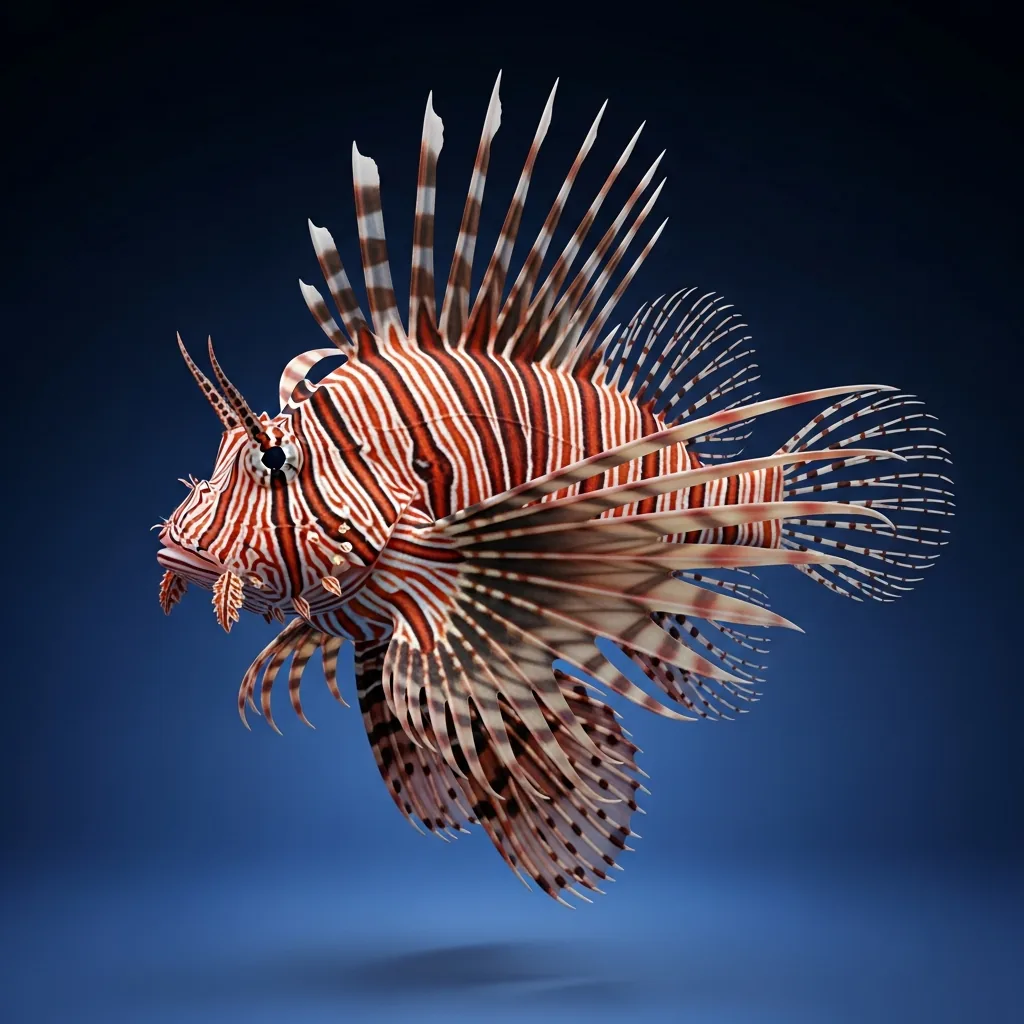

Overview
Very venomous invasive species, aggressive predator living among rocks and crevices.
Identification
- Body
- Features an elongated body with broad, visible pectoral fins.
- Colouration
- Base color is white or beige with red or brown stripes.
- Sexual dimorphism
- Not very evident
- Growth
- Medium, with variations depending on prey availability
Taxonomy
- Family
- Scorpaenidae
- Order
- Scorpaeniformes
- Class
- Actinopterygii
Related species
Habitat & distribution
- Environment
- Coast, Reefs
- Preferred bottom
- Reef, Rock
- Geographic distribution
- Originally from the Indian Ocean and the Red Sea, but has spread to the Mediterranean Sea as an invasive species.
- Micro-habitat
- Hides among rocks and corals, using its fins as cover while hunting.
Prefers shelter among rocks and corals for protection and hunting.
Presence by sea area
Diet
- Primary prey
- small fish, crustaceans, shrimp
- Secondary prey
- mollusks, fish larvae, amphipods
- Occasional prey
- coral polyps, small cephalopods
- Feeding behaviour
- Aggressive and opportunistic predator, primarily hunts at night using fins to trap prey.
- Natural predators
- sharks, large moray eels, big groupers
Uses ambush tactics to surprise prey with venomous fins.
Behaviour
- Activity
- nocturnal
- Social behaviour
- solitary
- Aggressiveness
- high
- Migration
- Resident, with some limited movement for hunting or reproduction
- Seasonal behaviour
- Seeks deeper shelters in winter to avoid colder temperatures. More active near the surface in summer.
- Juveniles
- Juveniles often remain hidden in crevices to evade predators.
- Adults
- Adults may occupy specific territories, exhibiting territorial behaviors.
Reproduction
- Spawning season
- June, July, August
- Spawning depth
- between 5 and 20 meters
- Eggs
- Pelagic eggs, small in size, carried by currents until hatching.
- Larval stage
- Larvae are carried by currents until they find a suitable habitat to settle.
- Sexual maturity
- 2-3 years
When to catch Devil firefish
Activity calendar
Activity by season
Best times
This species shows peak fishing activity in spring, summer and autumn, when the productivity index (FPI) reaches its highest values.
Fishing activity decreases in winter, when conditions are less favourable.
Ideal conditions
Atmospheric pressure
Very active and aggressive.
Regular activity.
Stays hidden in crevices.
Water temperature
Where to catch it
Best spots
Bottom preference
Spot type
Fishing techniques
Recommended
Other applicable
Recommended baits
Baits by pressure
How to really catch it
The lionfish is not a fish you forget: bold bands, fins spread like a fan, and a way of holding still among rock and coral that makes it obvious and deceptive at the same time. If you want to target it effectively, you have to think like a predator working tight to the bottom, in the narrow places it treats as its own.
🐟 Good to know
One important biological trait is that its eggs are pelagic: after spawning they are carried by currents, and the larvae also drift until they find suitable habitat to settle. This is one of the factors that helps the species spread efficiently into new areas.
🌊 Where & when
It lives along coasts, rocky reefs and coral areas from 2 to 50 meters, with a clear preference for rocks, crevices and reef structure where it can hide and hunt. It is more targetable from spring through autumn, with more evident activity in summer, even closer to the surface; in winter it tends to shelter deeper. Spawning occurs from June to August, often between 5 and 20 meters.
🎣 How to really catch it
The most concrete approach is underwater capture, searching slowly through coastal crevices, rocky reefs and coral structure. It should be approached near the bottom, where it tends to hold and where it withdraws decisively once alarmed. If using fishing tackle, baits such as shrimp, live baitfish or squid make sense because they match its natural diet; use strong nylon, a fluorocarbon leader, and a light but controlled setup.
💡 The detail that makes the difference
The most defensible tip is not to present the bait in open water, but to work it tight to rock and cover. Lionfish are ambush predators that use shelter and their fins to confine prey: the closer the bait passes to a crevice, the more it matches the fish’s real feeding pattern. Always remember its spines are venomous and must be handled with extreme care.
Catch & handling tips
- Fight
- Tends to retreat towards the bottom with nervous movements, using spines for defense.
- Handling
- Use protective gloves to avoid venomous stings.
- Release
- Release quickly to reduce stress, avoiding direct contact with spines.
Curiosities & culture
- Record catches
- Maximum documented size: up to about 43 cm and 0.8 kg (source: FishBase). There is no official IGFA All-Tackle record: it is an invasive species, not a traditional game fish.
- In the kitchen
- Used in cuisine after careful preparation to remove the venom.
- Cultural notes
- Often displayed in public aquariums for its exotic beauty.
- Historical notes
- Originally from the Indian Ocean, it has spread into the Mediterranean in recent decades.