
Overview
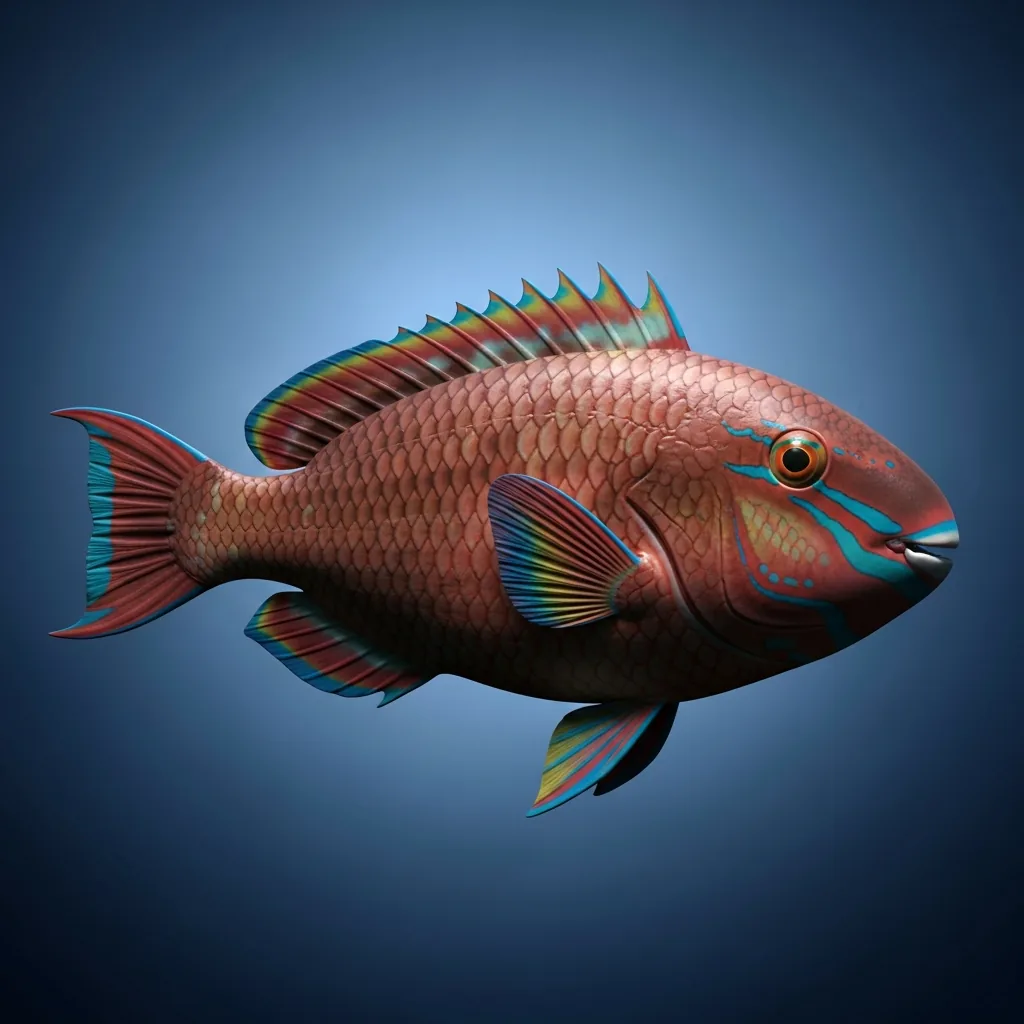
Colorful and robust herbivorous fish, very common on warm Mediterranean reefs.
Identification
- Body
- Sturdy, elongated body with a characteristic beak like a parrot's.
- Colouration
- Vivid colors, often orange-red with blue and green patches.
- Sexual dimorphism
- Absent/not noticeable
- Growth
- Moderate, grows quickly in early years then slows down.
Taxonomy
- Family
- Scaridae
- Order
- Perciformes
- Class
- Actinopterygii
Related species
Habitat & distribution
- Environment
- Coast, Reefs
- Preferred bottom
- Rock, Reef, Seagrass, Coralligenous
- Geographic distribution
- Found in the Mediterranean Sea and parts of the African Atlantic coast.
- Micro-habitat
- Prefers to roam around rocks and algae-rich seabeds, where it finds shelter and food.
Favors environments rich in algae where it can easily feed and hide.
Presence by sea area
Diet
- Primary prey
- algae, marine grasses, small invertebrates
- Secondary prey
- plankton, organic debris, small crustaceans
- Occasional prey
- small mollusks, insect larvae
- Feeding behaviour
- Feeds by inspecting rocks and corals, scraping algae with its unique beak.
- Natural predators
- groupers, moray eels, sharks, lionfish
Primarily herbivorous diet determines its distribution in vegetation-rich seabeds.
Behaviour
- Activity
- diurnal
- Social behaviour
- small_groups
- Aggressiveness
- low
- Migration
- Non-migratory
- Seasonal behaviour
- More active and visible during the summer, stays hidden in winter.
- Juveniles
- Young often form small groups to protect against predators.
- Adults
- Adults tend to live in small groups or alone, guarding their territory.
Reproduction
- Spawning season
- June, July, August
- Spawning depth
- between 5 and 25 meters
- Eggs
- Pelagic eggs, small and translucent.
- Larval stage
- Larvae are pelagic, transparent, transitioning to benthic life within days.
- Sexual maturity
- 3-4 years
When to catch Mediterranean parrotfish
Activity calendar
Activity by season
Best times
This species shows peak fishing activity in spring, summer and autumn, when the productivity index (FPI) reaches its highest values.
Fishing activity decreases in winter, when conditions are less favourable.
Ideal conditions
Atmospheric pressure
Very active and less suspicious.
Regular activity.
Stays near the bottom.
Water temperature
Where to catch it
Best spots
Bottom preference
Spot type
Fishing techniques
Recommended
Other applicable
Recommended baits
Baits by pressure
How to really catch it
The Mediterranean parrotfish is a lively presence around rocky shores and seagrass beds, where its unmistakable beak gives it away as it grazes among rocks and algae. It is not an explosive predator, but a fish of steady habits: that is exactly why, once you learn to read its movements, it becomes a very realistic target.
🐟 Good to know
Its most distinctive feature is not just visual: the beak is truly used to scrape food from the substrate. It feeds by inspecting rocks and corals and removing mainly algae, along with small invertebrates and other organic material available on the bottom.
🌊 Where & when
You will find it along coasts, rocky reefs, coralligenous areas and seagrass beds from 2 to 50 meters, especially where rocks are covered with algae. It is a resident, diurnal species: more active and visible in summer, more hidden in winter. From June to August it spawns between 5 and 25 meters.
🎣 How to really catch it
If you really want to catch it, light bottom fishing is the most concrete approach. Fish a light bottom rod with a 0.20-0.25 mm main line, 0.18 mm fluorocarbon leader, small size 4-6 hooks and light weights, keeping the bait close to rocks, weed beds and crevices. Shrimp, fish pieces, marine algae and bread all make sense because this fish patrols the bottom steadily in search of food.
💡 The detail that makes the difference
The practical secret is not to lift the bait too far off the bottom: this fish feeds by examining the substrate and scraping among rocks and vegetation. If your bait stays low and natural, close to algae-rich patches, you have a much better chance of intercepting a feeding fish before it slips back into the rocks.
Catch & handling tips
- Fight
- Usually offers little resistance but tries to hide among rocks.
- Handling
- Handle carefully to avoid damaging the beak and fins.
- Release
- Release quickly to ensure survival, avoiding excessive handling.
Curiosities & culture
- Record catches
- Maximum documented size: up to about 50 cm and 2.2 kg (source: FishBase). There is no official IGFA All-Tackle record for this species.
- In the kitchen
- Used in some traditional baked fish or fish soup recipes.
- Cultural notes
- Featured in many local Mediterranean legends as a symbol of marine beauty.
- Historical notes
- Traditionally fished since ancient times for its tasty meat.