
Overview
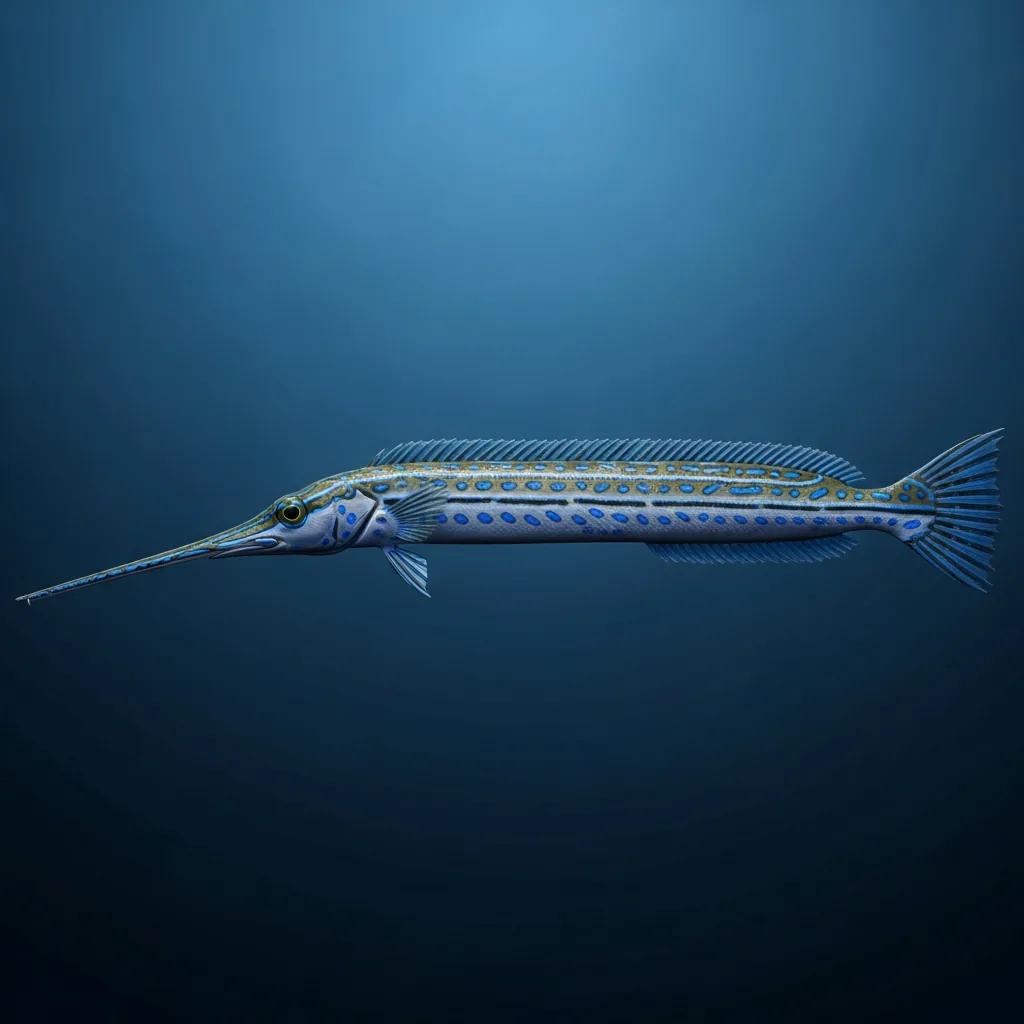
Elongated tropicalized predator, very fast and often near the surface.
Identification
- Body
- Very elongated and slender body, similar to a trumpet.
- Colouration
- Predominantly blue-green with scattered blue spots on a silvery background.
- Sexual dimorphism
- Absent/not prominent
- Growth
- medium, typical of coral reef species
Taxonomy
- Family
- Fistulariidae
- Order
- Syngnathiformes
- Class
- Actinopterygii
Related species
Habitat & distribution
- Environment
- Coast, Reefs, Pelagic
- Preferred bottom
- Reef, Sand
- Geographic distribution
- Found in most tropical and subtropical seas; recently spotted in the Mediterranean Sea.
- Micro-habitat
- Often found near coral reefs and seagrass beds, where it hides to hunt.
Prefers warm, shallow waters near coral formations.
Presence by sea area
Diet
- Primary prey
- small fish, crustaceans, shrimp
- Secondary prey
- cephalopods, fish larvae, small marine invertebrates
- Occasional prey
- jellyfish, planktonics
- Feeding behaviour
- Actively feeds by hunting prey near the water's surface or close to the coral bottom.
- Natural predators
- sharks, large groupers, barracuda
Feeds mainly on small fish and crustaceans, which it hunts in its natural environment.
Behaviour
- Activity
- diurnal
- Social behaviour
- solitary
- Aggressiveness
- low
- Migration
- resident
- Seasonal behaviour
- Remains active throughout all seasons, with increased activity in warmer months.
- Juveniles
- Juveniles tend to hide among algae and corals to avoid predators.
- Adults
- Adults swim freely and hunt actively in shallow waters.
Reproduction
- Spawning season
- July, August
- Spawning depth
- between 20 and 40 meters
- Eggs
- small pelagic eggs
- Larval stage
- Larvae are planktonic and quickly develop into the juvenile stage.
- Sexual maturity
- 2-3 years
When to catch Bluespotted cornetfish
Activity calendar
Activity by season
Best times
This species shows peak fishing activity in spring, summer and autumn, when the productivity index (FPI) reaches its highest values.
Fishing activity decreases in winter, when conditions are less favourable.
Ideal conditions
Atmospheric pressure
Very active on surface.
Regular activity.
Moves away from shore.
Water temperature
Where to catch it
Best spots
Bottom preference
Spot type
Fishing techniques
Recommended
Other applicable
Recommended baits
Baits by pressure
How to really catch it
The trumpetfish is a long, slender predator with a tubular mouth and blue-spotted patterning, able to vanish from sight among reefs, sand, and submerged seagrass. When you find it hunting in shallow water, it looks like a living line suspended in the sea: catching it takes observation, precision, and a lure placed exactly where it matters.
🐟 Good to know
Its tubular mouth is more than an odd feature: it is a real feeding specialization, suited to capturing small prey such as small fish, crustaceans, and shrimp. Its clearly visible lateral line matters too, because in fishes it is used to detect water movement and vibration during hunting.
🌊 Where & when
You find it along coasts, reefs, sandy bottoms, coastal lagoons, and estuary mouths, from very shallow water down to 50 meters, often near coral reefs and seagrass beds where it can hide and ambush prey. It stays active year-round, but becomes more catchable in warmer months, with a peak from March to November; between July and August it spawns at 20 to 40 meters.
🎣 How to really catch it
The most concrete approach is light spinning, because this fish actively hunts small prey near the surface or close to the coral bottom. Picture a small fish imitation sliding over pale sand or along the reef edge, worked steadily without excess; light trolling also works, as do small live baits, shrimp, or squid, with a light to medium spinning rod, 4-8 kg monofilament, a 0.3 mm fluorocarbon leader, small sharp single hooks, and only a light weight if needed.
💡 The detail that makes the difference
One solid trick is to focus on the edges between open sand and cover, not in the empty middle and not buried deep in structure. The trumpetfish hunts near coral bottom but also in open shallow water, so that transition line concentrates both prey and strike opportunities; once hooked, expect sharp lateral runs and keep your pressure steady rather than forcing it.
Catch & handling tips
- Fight
- Tends to resist with strong lateral thrashing, trying to shake off the hook.
- Handling
- Handle with care to avoid damage to its delicate skin.
- Release
- Gently release underwater to avoid excessive stress.
Curiosities & culture
- Record catches
- Maximum documented size: up to about 160 cm and 4 kg (source: FishBase). There is no official IGFA All-Tackle record for this species.
- In the kitchen
- Rarely used in cooking due to its threadlike structure, but occasionally consumed grilled.
- Cultural notes
- Known for its atypical shape, the trumpet fish often appears in underwater photographs.
- Historical notes
- Recently introduced into the Mediterranean through the Suez Canal, its presence symbolizes the invasion of Lessepsian species.