
Overview
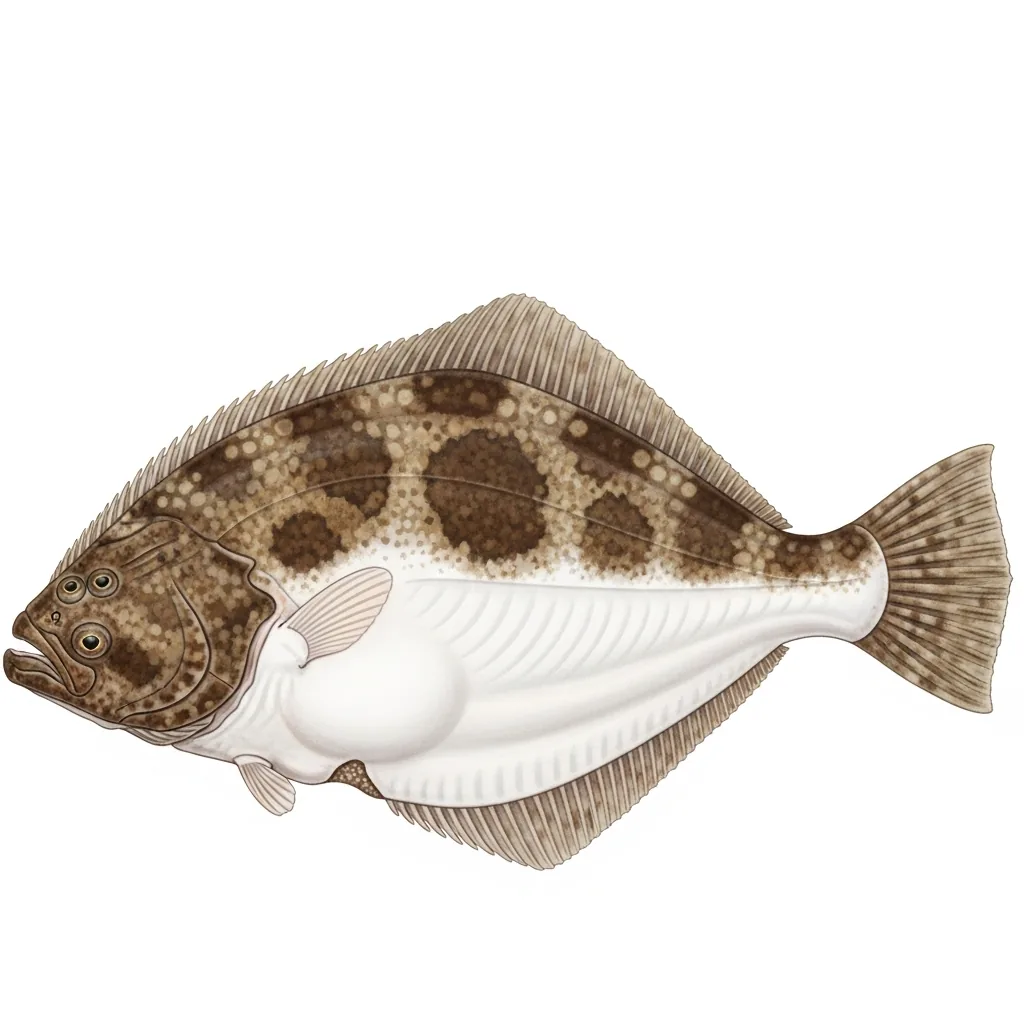
The largest flatfish, can reach enormous weights.
Identification
- Body
- Flattened body with eyes on one side. Very wide and sturdy.
- Colouration
- Dark brown upper side with lighter shades, white belly.
- Sexual dimorphism
- Absent/barely noticeable
- Growth
- Rapid in the first years then stabilizes
Taxonomy
- Family
- Pleuronectidae
- Order
- Pleuronectiformes
- Class
- Actinopterygii
Related species
Habitat & distribution
- Environment
- Open sea, Reefs, Deep sea
- Preferred bottom
- Sand, Gravel
- Geographic distribution
- Found along the northern Pacific coasts, from Alaska to Japan and California.
- Micro-habitat
- Hides in sandy or gravelly bottoms, often sheltered among rocks.
Prefers sandy or muddy bottoms where it can easily hide.
Presence by sea area
Diet
- Primary prey
- fish, squid, octopus
- Secondary prey
- shrimp, crabs, starfish
- Occasional prey
- plankton, seaweed, sea urchins
- Feeding behaviour
- Actively hunts on the seabed, using its camouflage to ambush prey.
- Natural predators
- sharks, orca, sea lions
Mainly feeds at night, benefiting from its sharp vision.
Behaviour
- Activity
- diurnal
- Social behaviour
- solitary
- Aggressiveness
- medium
- Migration
- Undergoes seasonal migrations to deeper waters for spawning.
- Seasonal behaviour
- Moves closer to shore during warmer months and further out in colder ones.
- Juveniles
- Feeds mainly on small crustaceans and inhabits shallower waters.
- Adults
- Tends to descend deeper and hunt larger prey.
Reproduction
- Spawning season
- November, December, January, February
- Spawning depth
- between 200 and 600 meters
- Eggs
- Pelagic eggs, about 3-4 mm in diameter.
- Larval stage
- Larvae are pelagic and float freely until metamorphosis.
- Sexual maturity
- 8-15 years
When to catch Pacific halibut
Activity calendar
Activity by season
Best times
This species shows peak fishing activity in spring, summer and autumn, when the productivity index (FPI) reaches its highest values.
Fishing activity decreases in winter, when conditions are less favourable.
Ideal conditions
Atmospheric pressure
More active, moves more.
Regular activity.
Buried in the bottom.
Water temperature
Where to catch it
Best spots
Bottom preference
Spot type
Fishing techniques
Recommended
Other applicable
Recommended baits
Baits by pressure
How to really catch it
Pacific halibut is a giant of cold bottoms, broad, rough-skinned, almost invisible when it lies over sand and gravel. It can look motionless, then that large, sharp-toothed mouth opens and the seabed turns into an ambush: fishing it well means reading the bottom before you even read the rod.
🐟 Good to know
Like other large flatfish, it does not begin life with both eyes on the same side: during metamorphosis one eye migrates, and in the adult both are on the right side. It is a real and essential transformation for a fish that spends its life resting on the bottom.
🌊 Where & when
You find it across the North Pacific, from Alaska to Japan and California, over sandy or gravelly bottoms, often near rocks, deep reefs, and submarine canyons. In warmer months it moves closer to shore; in colder periods it shifts farther offshore, and from November to February it migrates into deeper water, between 200 and 600 meters, to spawn.
🎣 How to really catch it
The most concrete way to target it is a heavy bottom presentation, lowered precisely where the bottom changes from sand or gravel to sheltered rock. A heavy trolling rod, 50 lb monofilament, 80 lb stainless steel leader, a 7/0 long-shank hook, and a 500 g sinker keep herring, mackerel, cuttlefish, or shrimp tight to the seabed, right in the lane where it hunts fish, squid, and octopus.
💡 The detail that makes the difference
The practical edge is to avoid fishing “empty” bottom and focus on edges instead: the lip of a sandy patch, the mouth of a crack, the shelter beside a boulder. Pacific halibut actively hunts along the seabed using camouflage, so the places where it can stay hidden and intercept prey are the ones worth working hardest.
Catch & handling tips
- Fight
- Fights on the bottom, stubbornly resisting with its flat body.
- Handling
- Handle with gloves due to rough skin and sharp teeth.
- Release
- Ensure quick release to avoid harm to the halibut.
Curiosities & culture
- Record catches
- Maximum documented size: up to about 274 cm and 227 kg (source: FishBase). IGFA All-Tackle record: 208.2 kg (459 lb), caught by Jack Tragis at Dutch Harbor, Alaska (USA), in 1996.
- In the kitchen
- Delicacy in many cuisines, often grilled or used for sushi.
- Cultural notes
- Symbol of abundance among northwestern Pacific indigenous peoples.
- Historical notes
- Traditionally fished by Native American tribes, considered a vital resource.