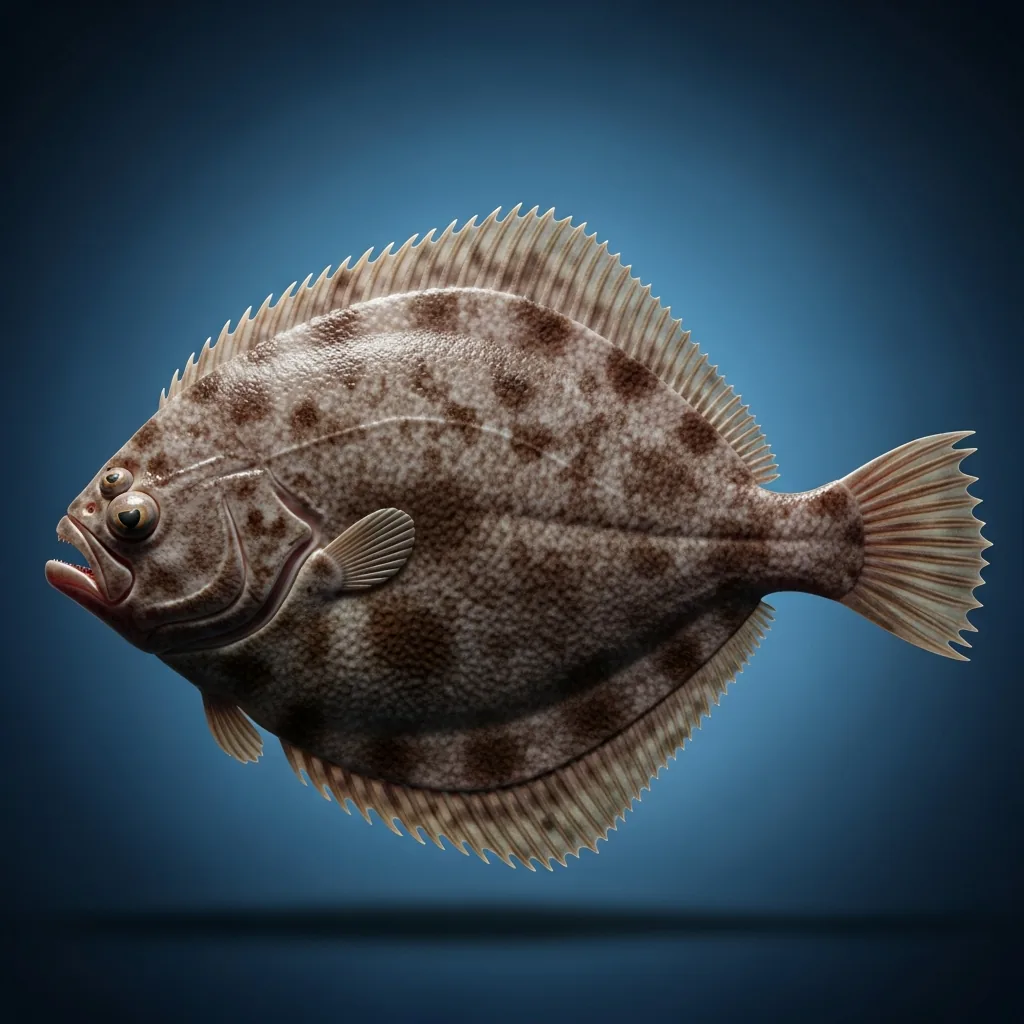

Overview
Very camouflaged flatfish, bottom predator that hides in sand waiting for prey.
Identification
- Body
- The Turbot is a flatfish with an elongated disc-shaped body and lacks scales over most of its surface.
- Colouration
- The coloring is brown with dark spots, capable of camouflaging with the seabed.
- Sexual dimorphism
- Absent/not prominent
- Growth
- medium
Taxonomy
- Family
- Scophthalmidae
- Order
- Pleuronectiformes
- Class
- Actinopterygii
Related species
Habitat & distribution
- Environment
- Coast, Open sea, Reefs
- Preferred bottom
- Sand, Mud
- Geographic distribution
- Found along the northeastern Atlantic coasts, from European seas to the island of Iceland and in the waters of the Baltic and Mediterranean Seas.
- Micro-habitat
- Hides in the sand or mud, often partially buried, waiting for prey on the seafloor.
Prefers well-oxygenated waters without strong turbulence.
Presence by sea area
Diet
- Primary prey
- smaller fish, crustaceans, mollusks
- Secondary prey
- cephalopods, annelids, echinoderms
- Occasional prey
- algae, organic debris
- Feeding behaviour
- The Turbot prefers ambush hunting, quickly darting from its hidden position to capture prey.
- Natural predators
- sharks, large predatory fish, seals, dolphins
The diet varies significantly with age, from small planktonic organisms to larger fish.
Behaviour
- Activity
- nocturnal
- Social behaviour
- solitary
- Aggressiveness
- low
- Migration
- residential
- Seasonal behaviour
- Does not migrate significantly but moves to deeper waters in winter.
- Juveniles
- Juveniles tend to stay in shallower, more protected waters.
- Adults
- Adults prefer deeper waters where they hide waiting for prey.
Reproduction
- Spawning season
- April, May, June
- Spawning depth
- between 20 and 60 meters
- Eggs
- Pelagic and floating eggs, invisible due to transparency, about 1 mm in diameter.
- Larval stage
- Larvae are pelagic and drift with currents until developing their characteristic flat body.
- Sexual maturity
- 4-5 years
When to catch Turbot
Activity calendar
Activity by season
Best times
This species shows peak fishing activity in spring, autumn and winter, when the productivity index (FPI) reaches its highest values.
Ideal conditions
Atmospheric pressure
Very active, moves to hunt small fish.
Regular activity on the bottom.
Stays still and camouflaged.
Water temperature
Where to catch it
Best spots
Bottom preference
Spot type
Fishing techniques
Recommended
Other applicable
Recommended baits
Baits by pressure
How to really catch it
The turbot is a flat, silent predator, able to vanish into the seabed until it seems like living sand. When you truly target it, you are not chasing a cruising fish: you are tempting an ambush hunter that waits motionless and strikes from below, and that is exactly what makes it so compelling.
🐟 Good to know
One real biological peculiarity of turbot is that its larvae are pelagic and only later develop the characteristic flat shape of the adult fish. Its eggs are also pelagic and floating, almost invisible because of their transparency, a little-known but very distinctive trait of the species.
🌊 Where & when
Look for it over sandy and muddy bottoms from the coast to open sea, also near rocky formations and underwater routes, across a broad range from 10 to 200 meters. It is mainly nocturnal and solitary, most worth targeting during peak months from January to May and from September to December; in winter it tends to move deeper, while from April to June it spawns between 20 and 60 meters.
🎣 How to really catch it
The most concrete approach is bottom fishing with a rod kept steady on the seabed, 20-30 lb braided line, a 0.50 mm fluorocarbon leader, size 2 to 3/0 hooks, and 100-200 g sinkers to stay pinned to the substrate. The most fitting baits are shrimp, small cuttlefish, squid rings, and fish pieces: present them tight to the bottom, where turbot lies partially buried in wait, and expect a fight that feels more like weight and current than long runs.
💡 The detail that makes the difference
The tip that truly makes a difference is to think about exact placement more than lure movement: turbot hunts from a fixed position and blends into sand or mud, so a bait laid precisely in bottom corridors, along the edge of a rocky area, or on an underwater route is often more convincing than an overly restless presentation.
Catch & handling tips
- Fight
- When hooked, the Turbot puts up moderate resistance, using the current and its flattened shape to oppose the angler.
- Handling
- Use wet cloths to hold it steady and avoid damaging its scaleless skin.
- Release
- Ensure the fish is intact and lively; gently release near the seabed.
Curiosities & culture
- Record catches
- Maximum documented size: up to about 100 cm and 25 kg (source: FishBase). The IGFA All-Tackle record for this species is currently vacant.
- In the kitchen
- Used in numerous traditional recipes like baked Turbot with potatoes and Mediterranean herbs.
- Cultural notes
- The Turbot is often featured in fairy tales and stories as a magical fish that grants wishes.
- Historical notes
- The Turbot has been fished since ancient times for its prized flesh, highly valued by Roman nobles.