
Overview
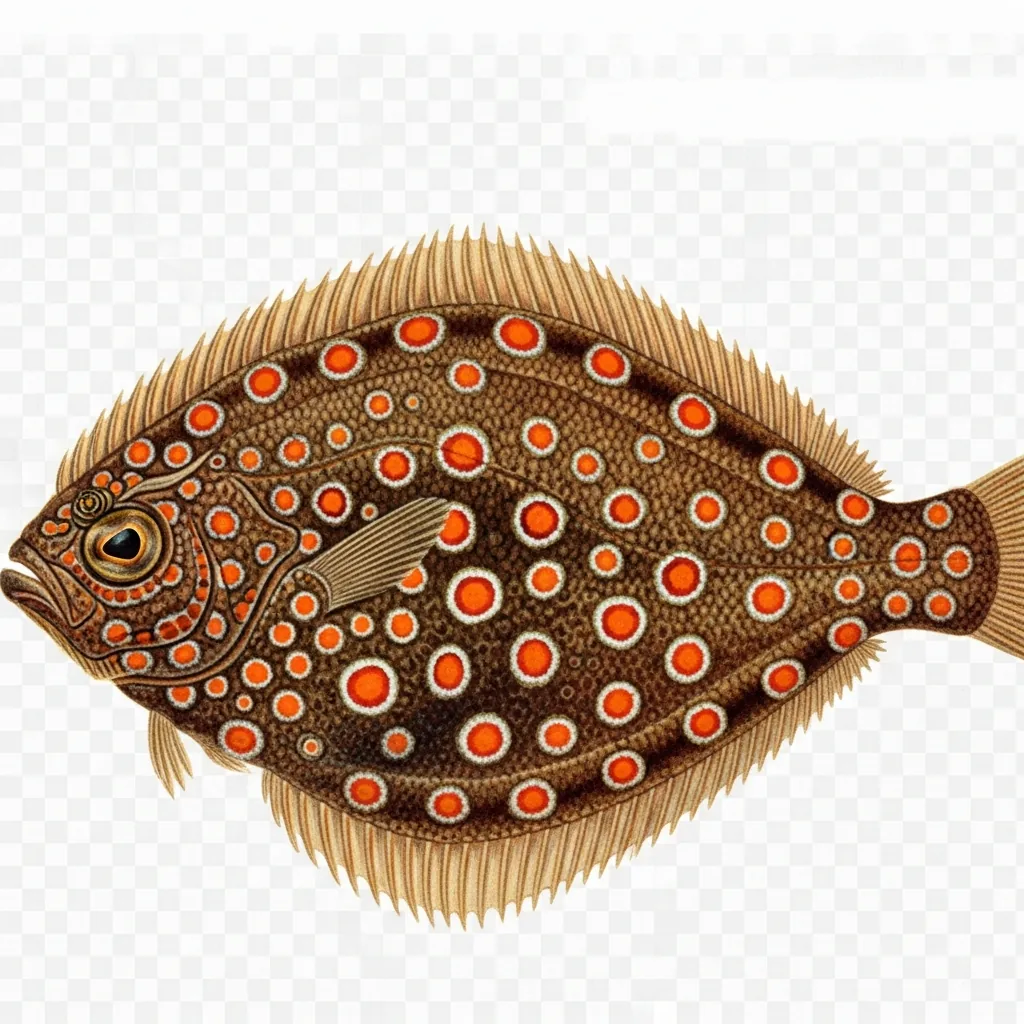
Common flatfish of temperate European waters, lives on sandy bottoms.
Identification
- Body
- Flat and oval body, very thin and adapted for life on sandy bottoms.
- Colouration
- Brownish back with orange spots, white belly.
- Sexual dimorphism
- Absent/not noticeable
- Growth
- Medium, growing steadily during the first years of life.
Taxonomy
- Family
- Pleuronectidae
- Order
- Pleuronectiformes
- Class
- Actinopterygii
Related species
Habitat & distribution
- Environment
- Coast, Open sea, Estuaries
- Preferred bottom
- Sand, Gravel, Mud
- Geographic distribution
- Primarily found in the northeastern Atlantic, from the Barents Sea to northern Spain, including the North Sea and the Irish Sea.
- Micro-habitat
- Partially buries itself in the sand during the day to avoid predators.
Prefers sandy bottoms where it can easily blend in to avoid predators.
Presence by sea area
Diet
- Primary prey
- crustaceans, gastropods, polychaetes
- Secondary prey
- annelids, echinoderms, small fish
- Occasional prey
- plankton, benthic algae
- Feeding behaviour
- Feeds primarily at night, actively searching for food on the seabed thanks to its developed eyesight.
- Natural predators
- Atlantic cod, grey seals, seabirds
Relies on excellent eyesight and flat body to hunt unsuspecting prey on the seabed.
Behaviour
- Activity
- nocturnal
- Social behaviour
- solitary
- Aggressiveness
- low
- Migration
- Non-migratory, with limited movements mainly related to food search.
- Seasonal behaviour
- Mostly active in warmer months, moving to shallower waters to feed and spawn.
- Juveniles
- Young plaice stay in coastal sands, growing in shallow waters until maturity.
- Adults
- Adults move to deeper waters, staying on the seabed for feeding and reproduction.
Reproduction
- Spawning season
- January, February, March, April
- Spawning depth
- between 20 and 60 meters
- Eggs
- Pelagic, transparent eggs, approximately 2 mm in diameter.
- Larval stage
- Larvae are carried by currents until they reach coastal waters where they develop.
- Sexual maturity
- 4-6 years
When to catch European plaice
Activity calendar
Activity by season
Best times
This species shows peak fishing activity in spring, autumn and winter, when the productivity index (FPI) reaches its highest values.
Ideal conditions
Atmospheric pressure
More active, moves on sand.
Regular activity.
Buried in sand.
Water temperature
Where to catch it
Best spots
Bottom preference
Spot type
Fishing techniques
Recommended
Other applicable
Recommended baits
Baits by pressure
How to really catch it
The European plaice is a flatfish that lives tight to the bottom, understated in appearance yet unmistakable for the orange spots on its upper side. To catch it consistently, you have to step into its world: sand, dim light, and a bait working close to the seabed, exactly where it moves when it comes out to feed.
🐟 Good to know
Like all flatfish, it undergoes a remarkable metamorphosis during development: from a more symmetrical larval stage it shifts to the adult form with both eyes on one side of the body. This is a real and essential adaptation to life resting on the seabed.
🌊 Where & when
You find it over sand, gravel, and mud bottoms, along coasts, offshore, and in estuaries, from 10 to 200 meters. By day it tends to bury itself partly in the sand; in the warmer months it moves more readily into shallower water to feed and spawn, while from January to April it spawns between 20 and 60 meters.
🎣 How to really catch it
The most practical approach is a light boat line fished in constant contact with the bottom over sand or mixed sand-mud ground. A light boat rod, 10-15 lb line, a 1 m clear nylon leader, size 6-10 hooks, and 30-60 g sinkers are well suited; the best baits are mainly sea worms and shrimp, with good alternatives in squid strips or small fish, always presented low and clean on the seabed.
💡 The detail that makes the difference
The detail that often changes the session is not lifting the bait too quickly off the bottom: plaice feeds by searching the substrate and often stays pressed to the seabed like a living patch of sand. If you feel weight more than a sharp tap, keep contact and strike with measure, because the mouth is small and asymmetrical.
Catch & handling tips
- Fight
- Generally offers little resistance, staying on the bottom simulating a rock.
- Handling
- Be cautious of dorsal bones, handle gently to prevent skin damage.
- Release
- Release quickly into the water, avoiding prolonged air exposure.
Curiosities & culture
- Record catches
- Maximum documented size: up to about 100 cm and 5.7 kg (source: FishBase). There is no official IGFA All-Tackle record for this species.
- In the kitchen
- Used in traditional dishes such as British 'Fish and Chips' and Mediterranean fry-ups.
- Cultural notes
- Often cited in literature for its delicate taste, considered a symbol of abundance in European markets.
- Historical notes
- Plaice fishing has been a traditional activity along the North Sea coasts since the Middle Ages.