
Overview
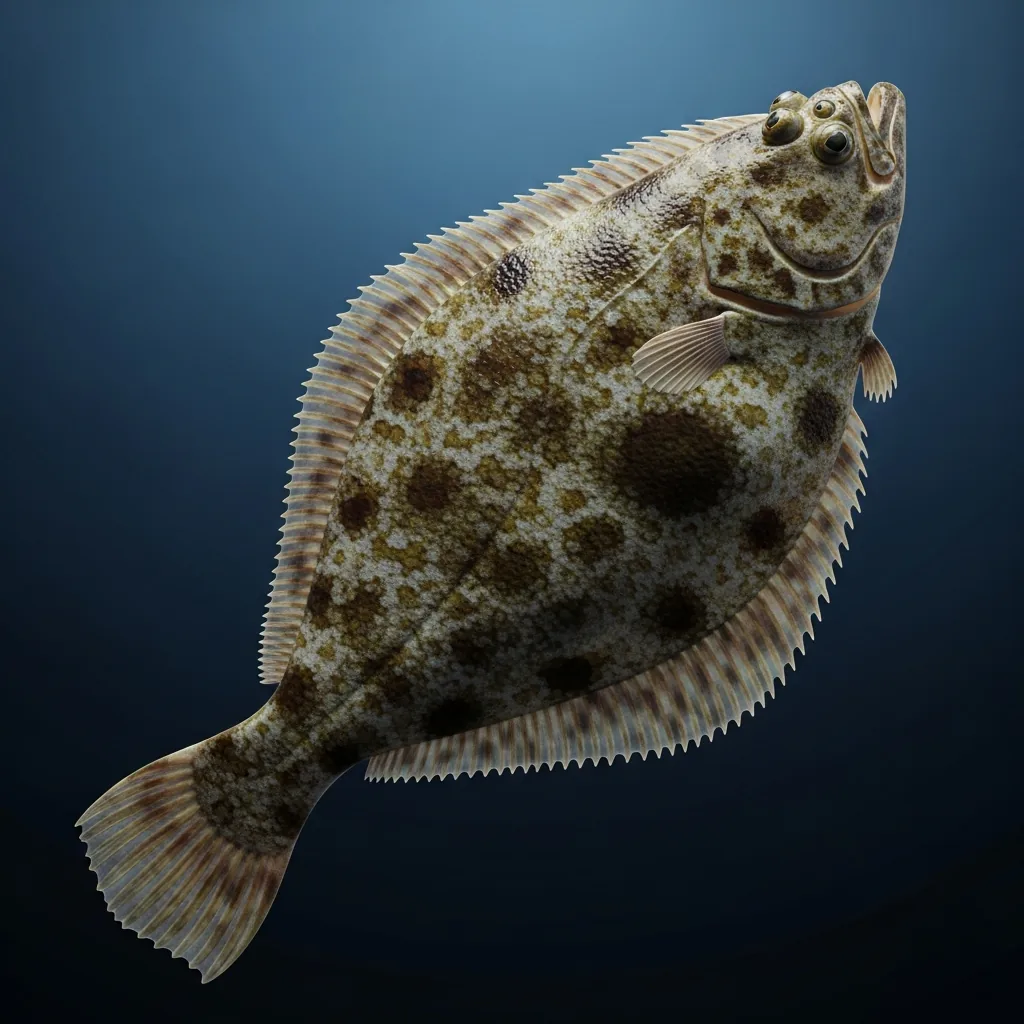
Very resistant flatfish, lives on sandy and muddy bottoms, often near estuaries.
Identification
- Body
- Flat and broad body suitable for life on the seabed.
- Colouration
- Brown or greenish coloration with light spots, whitish underside.
- Sexual dimorphism
- Absent/barely noticeable
- Growth
- Medium, faster growth in early years.
Taxonomy
- Family
- Pleuronectidae
- Order
- Pleuronectiformes
- Class
- Actinopterygii
Related species
Habitat & distribution
- Environment
- Coast, Estuaries, Brackish
- Preferred bottom
- Sand, Mud
- Geographic distribution
- Found along the European coasts of the Atlantic, the North Sea, and the Baltic Sea.
- Micro-habitat
- Often close to river mouths, using sandy bottoms for camouflage.
Prefers habitats with rich food resources on soft substrates.
Presence by sea area
Diet
- Primary prey
- worms, crustaceans, small mollusks
- Secondary prey
- aquatic insect larvae, small fish
- Occasional prey
- algae, organic debris
- Feeding behaviour
- Bottom-feeding predator that scrapes the substrate with its mouth to find food.
- Natural predators
- sharks, large predatory fish, seabirds
Uses the snout and mouth to dig and scrape in search of prey.
Behaviour
- Activity
- nocturnal
- Social behaviour
- solitary
- Aggressiveness
- low
- Migration
- Undergoes seasonal migrations to shallower waters for spawning.
- Seasonal behaviour
- Moves to deeper waters in winter, frequents shallow coastal waters in summer.
- Juveniles
- Young prefer staying closer to the shore.
- Adults
- Adults are more wary and easily hide in sandy substrates.
Reproduction
- Spawning season
- March, April, May
- Spawning depth
- between 20 and 60 meters
- Eggs
- Pelagic and transparent eggs, small in size.
- Larval stage
- Larvae develop in plankton before becoming young flatfish.
- Sexual maturity
- 3-4 years
When to catch European flounder
Activity calendar
Activity by season
Best times
This species shows peak fishing activity in spring, autumn and winter, when the productivity index (FPI) reaches its highest values.
Ideal conditions
Atmospheric pressure
Very active and less suspicious.
Regular activity.
Stays still on the bottom.
Water temperature
Where to catch it
Best spots
Bottom preference
Spot type
Fishing techniques
Recommended
Other applicable
Recommended baits
Baits by pressure
How to really catch it
The European flounder is a flatfish that lives pressed to the bottom, almost invisible over sand and mud, with both eyes on the right side and camouflage built to disappear. It does not strike with the violence of pelagic predators; its challenge is subtler, because to catch it consistently you must read the bottom and fish where it is already feeding.
🐟 Good to know
Like other flatfish, its larvae first develop in the plankton and only later take on the typical flattened bottom-dwelling form. It is a real and remarkable transition: from a planktonic early stage to a fish perfectly adapted to living hidden on the seabed.
🌊 Where & when
It is found along the European coasts of the Atlantic, the North Sea, and the Baltic, especially over sandy or muddy bottoms near shore, around river mouths, and in brackish estuaries. In summer it frequents shallow coastal water more readily; in winter it tends to move deeper. It is most interesting from January to May and again from September to December, with spawning from March to May.
🎣 How to really catch it
The most practical way to target it is with a rod and natural bait fished on the bottom, keeping the rig working tight to the substrate. A sturdy medium-light rod, 10–15 lb main line, 8–10 lb fluorocarbon leader, size 1/0 to 2/0 hooks, and 30–60 g bottom weights make a coherent setup. Worms, shrimp, mussels, and fish strips all fit its biology because it feeds on benthic prey along the bottom.
💡 The detail that makes the difference
The detail that changes everything is not lifting the bait off the bottom: the European flounder finds food by scraping the substrate with its mouth and often camouflages itself exactly where it feeds. If you are fishing sand or mud, especially near a river mouth, keep the presentation stable and natural; that is where a wary adult stops being just part of the bottom and becomes a catch.
Catch & handling tips
- Fight
- Fights moderately, may try to burrow for resistance.
- Handling
- Handle carefully to avoid damaging fins.
- Release
- Ensure it returns to the bottom slowly to prevent decompression shock.
Curiosities & culture
- Record catches
- Maximum documented size: up to about 60 cm and 2.9 kg (source: FishBase). IGFA All-Tackle record: 2.95 kg (6 lb 7 oz), caught at Maurangerfjorden (Norway) in 2004.
- In the kitchen
- Used in European cuisine, excellent grilled or pan-fried with butter.
- Cultural notes
- Often a symbol of adaptation in marine symbolism.
- Historical notes
- Traditionally fished in European seas for centuries, it has been an important food source for coastal communities.