
Overview
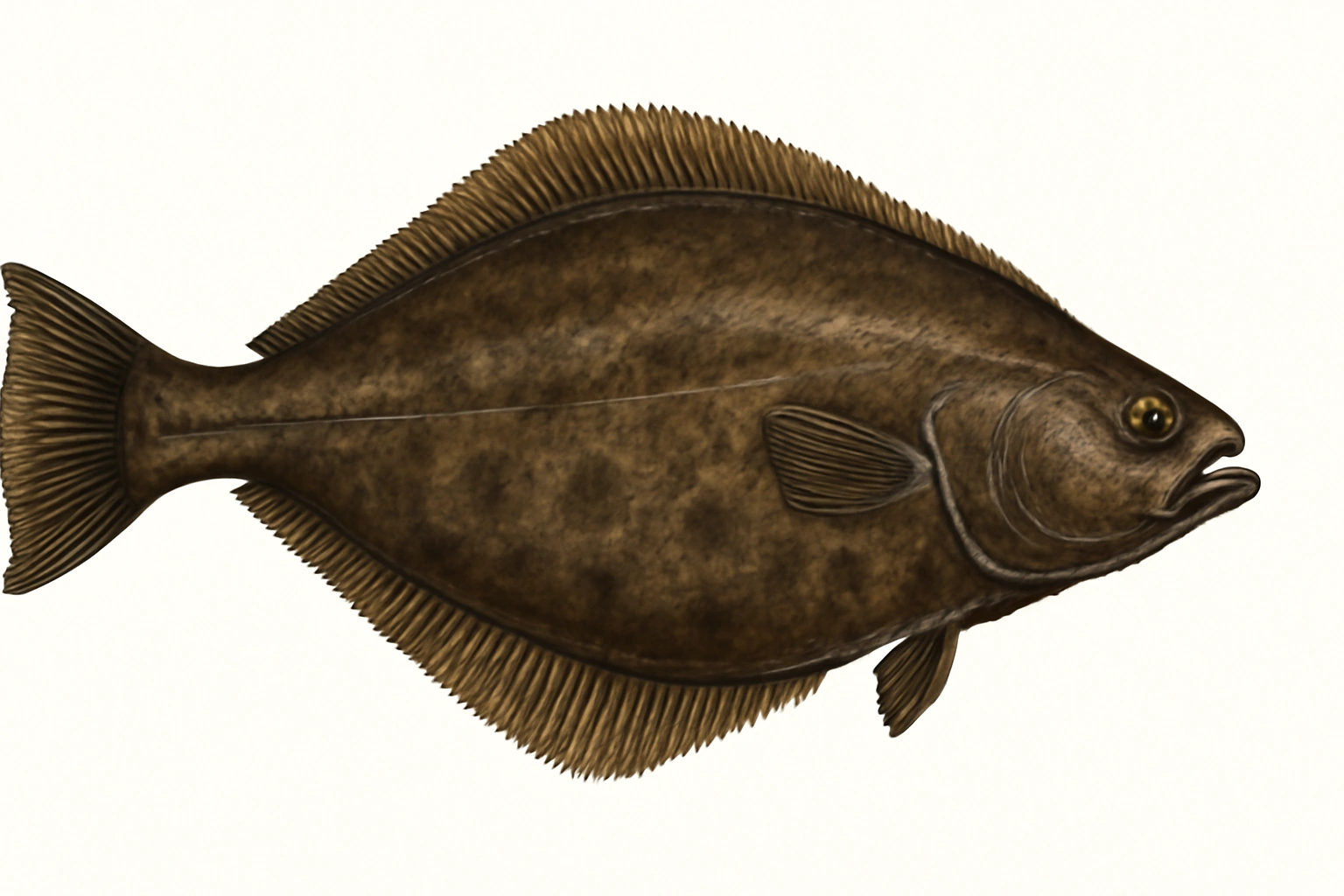
The largest flatfish in the world. Powerful predator of northern bottoms, can reach enormous sizes.
Identification
- Body
- Flat, oval body with eyes on one side.
- Colouration
- Dark brown on top, whitish underneath.
- Sexual dimorphism
- Absent/not noticeable
- Growth
- Slow, grows significantly only after several years.
Taxonomy
- Family
- Pleuronectidae
- Order
- Pleuronectiformes
- Class
- Actinopterygii
Related species
Habitat & distribution
- Environment
- Deep sea, Pelagic
- Preferred bottom
- Rock, Sand, Mud
- Geographic distribution
- Northern Atlantic coasts, from the Arctic Ocean to the Gulf of Maine, up to Northern Europe.
- Micro-habitat
- Prefers rocky and sandy bottoms, where it hides to ambush prey from below.
Prefers mixed rocky and sandy bottoms to easily camouflage.
Presence by sea area
Diet
- Primary prey
- fish, squid, crustaceans
- Secondary prey
- cod, herring, capelin
- Occasional prey
- octopus, crabs
- Feeding behaviour
- Ambush predator, waits camouflaged on the seabed before striking passing prey.
- Natural predators
- seals, killer whales, sharks
Prefers large prey, hunting by surprise.
Behaviour
- Activity
- diurnal
- Social behaviour
- solitary
- Aggressiveness
- medium
- Migration
- Resident, with limited movement for reproduction.
- Seasonal behaviour
- Moves closer to the coast during the breeding season.
- Juveniles
- Juveniles stay near coastal bottoms in shallower waters.
- Adults
- Adults prefer deeper, more open areas.
Reproduction
- Spawning season
- May, June
- Spawning depth
- between 200 and 500 meters
- Eggs
- Pelagic eggs, small and numerous.
- Larval stage
- Planktonic larvae that develop before settling on the bottom.
- Sexual maturity
- Between 10 and 14 years
When to catch Atlantic halibut
Activity calendar
Activity by season
Best times
This species shows peak fishing activity in spring, autumn and winter, when the productivity index (FPI) reaches its highest values.
Ideal conditions
Atmospheric pressure
More active, moves to hunt.
Regular bottom activity.
Still on the bottom.
Stays on bottom.
Feeds regularly.
More active, moves to search for prey.
Water temperature
Where to catch it
Best spots
Bottom preference
Spot type
Fishing techniques
Recommended
Other applicable
Recommended baits
Baits by pressure
How to really catch it
The Atlantic halibut is a giant flatfish of the North Atlantic: broad-headed, wide-mouthed, with both eyes on the right side and a body that can nearly vanish on the bottom. In open water it seems absent, until you pass over its ground and that silence turns into a heavy, sudden strike.
🐟 Good to know
A remarkable biological trait of the Atlantic halibut is its early development: the eggs are pelagic and the larvae live in the plankton, then as they grow they transform into bottom fish and settle on the seabed. This is a real and typical transition in flatfishes.
🌊 Where & when
You look for it along the northern Atlantic coasts, from the Arctic Ocean to the Gulf of Maine and Northern Europe, over rock, sand, or mud bottoms, including very deep water. Adults favor deeper, more open areas, while juveniles stay closer to coastal bottoms. It becomes more appealing in the listed peak months, and in May-June it may move closer to shore for spawning.
🎣 How to really catch it
To really catch it, the key is a solid bottom presentation, because it hunts by ambush tight to the substrate. Among the techniques in the context, longline is the most consistent with its biology: natural baits such as fish, herring, or squid set close to bottom along rock edges, sand flats, and depth changes. Use heavy gear: a sturdy bottom rod, 30-50 lb line, 80 lb stainless steel leader, 10/0 circle hooks, and 500 g sinkers.
💡 The detail that makes the difference
The detail that changes everything is not to think only about depth, but about contact with the right bottom. Halibut camouflage themselves and attack from below: that is why it pays to work where sand meets rock, or along the contour of the bottom, keeping the bait low, natural, and clearly inside the lane where the fish can spot it passing overhead.
Catch & handling tips
- Fight
- Powerful fight with strong lateral thrashing.
- Handling
- Handle with care to avoid injury, maintain a good grip due to its size.
- Release
- Release carefully, avoiding damage to gills and fins.
Curiosities & culture
- Record catches
- Maximum documented size: up to about 470 cm and 320 kg (source: FishBase). IGFA All-Tackle record: 190 kg (418 lb 13 oz), caught by Thomas Nielsen at Vannøya, Troms (Norway), in 2004.
- In the kitchen
- Highly prized smoked or baked, an ingredient in many traditional Nordic dishes.
- Cultural notes
- In Nordic legends, considered a symbol of strength and endurance.
- Historical notes
- Hunted since the Viking era for its nutritional value.