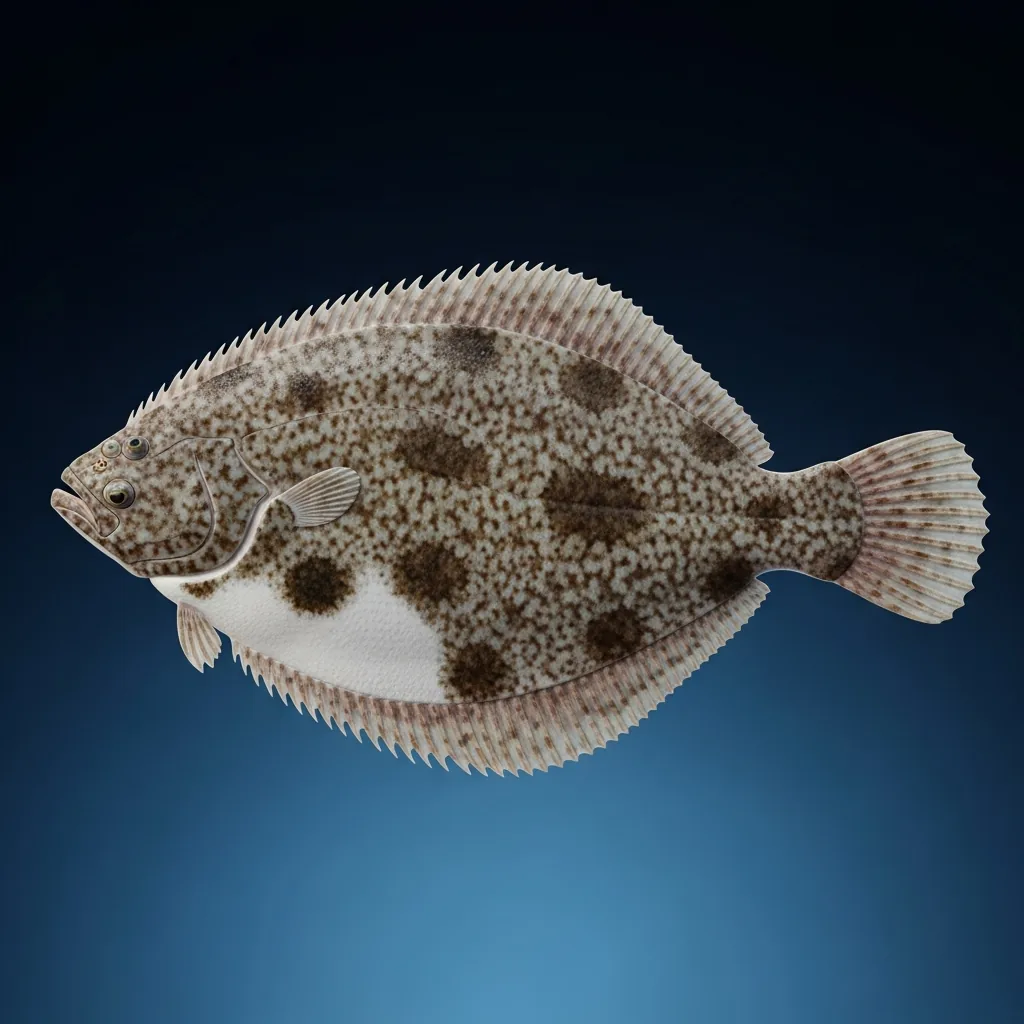

Overview
Very camouflaged flatfish, mainly active at night, loves sandy and muddy bottoms.
Identification
- Body
- Flat and elongated body, with eyes on one side.
- Colouration
- Brown coloration with darker spots for effective camouflage.
- Sexual dimorphism
- Absent/not very noticeable.
- Growth
- Moderate, with significant growth in early years.
Taxonomy
- Family
- Soleidae
- Order
- Pleuronectiformes
- Class
- Actinopterygii
Related species
Habitat & distribution
- Environment
- Coast, Open sea, Estuaries
- Preferred bottom
- Sand, Mud
- Geographic distribution
- Found in the Northeast Atlantic, from the Baltic Sea to the coasts of Morocco, and in the Mediterranean Sea.
- Micro-habitat
- Hides in sandy or muddy bottoms to avoid predators.
Prefers stable bottoms where it can easily camouflage and feed.
Presence by sea area
Diet
- Primary prey
- crustaceans, annelids, small mollusks
- Secondary prey
- shrimp, polychaetes, organic detritus
- Occasional prey
- fish larvae, plankton
- Feeding behaviour
- Foreages on sandy bottoms, capturing prey living in sediment.
- Natural predators
- congers, cuttlefish, eel pouts
Feeding is limited in winter due to decreased prey availability.
Behaviour
- Activity
- nocturnal
- Social behaviour
- solitary
- Aggressiveness
- low
- Migration
- Sedentary, but undergoes seasonal vertical migrations.
- Seasonal behaviour
- More active at night during warmer months, less active in colder months.
- Juveniles
- Young prefer shallow waters and coastal cover.
- Adults
- Adults tend to remain in deeper, open areas.
Reproduction
- Spawning season
- April, May, June
- Spawning depth
- between 30 and 130 feet
- Eggs
- Pelagic, small eggs that float in surface waters.
- Larval stage
- Larvae initially bilateral, undergo metamorphosis with eyes shifting to one side.
- Sexual maturity
- 3-4 years
When to catch Common sole
Activity calendar
Activity by season
Best times
This species shows peak fishing activity in spring, autumn and winter, when the productivity index (FPI) reaches its highest values.
Ideal conditions
Atmospheric pressure
Very active and less suspicious.
Regular activity.
Stays still on the bottom.
Water temperature
Where to catch it
Best spots
Bottom preference
Spot type
Fishing techniques
Recommended
Other applicable
Recommended baits
Baits by pressure
How to really catch it
The common sole is a wary flatfish built to vanish into the bottom before your eye can truly separate it from the seabed. To target it properly, you are not chasing an open-water predator: you are reading sand, mud, and the quiet language of the bottom, where this nocturnal hunter moves with restraint.
🐟 Good to know
The sole begins life as a bilaterally symmetrical larva, and only during metamorphosis do the eyes shift to one side of the body. It is one of the most striking biological traits of flatfish and explains its adult life pressed to the seabed and perfectly camouflaged.
🌊 Where & when
It lives over sandy and muddy bottoms along coasts, in open sea, and in estuaries, from shallow water down to much greater depths, hiding mainly in the sediment. It becomes more approachable on warm-season nights, while in colder months it reduces activity; from April to June it spawns between 10 and 40 meters.
🎣 How to really catch it
To catch it for real, handlining or a light bottom-fishing rod is the most concrete approach: 8-10 lb line, 12-15 lb fluorocarbon leader, size 4-6 hooks, and 20-50 g weights to stay glued to the bottom. Work sandy areas, sandbars, river mouths, and mud, presenting marine worms, shrimp, or pieces of mollusk in a clean, low presentation.
💡 The detail that makes the difference
The detail that changes the session is simple: fish tight to the bottom, always. Sole feeds on crustaceans, annelids, and small mollusks in the sediment, with a small curved mouth; because of that, a bait working just above the bottom, or resting naturally on sand or mud, matches its real feeding behavior far better.
Catch & handling tips
- Fight
- Usually does not put up much of a fight when caught.
- Handling
- Handle carefully to avoid damaging delicate skin.
- Release
- Release gently near the bottom to minimize predation risk.
Curiosities & culture
- Record catches
- Maximum documented size: up to about 70 cm and 3 kg (source: FishBase). There is no official IGFA All-Tackle record for this species.
- In the kitchen
- Celebrated in Italian cuisine, often cooked à la Meunière or stewed with potatoes.
- Cultural notes
- The Sole is often referenced in literature as a symbol of camouflage and adaptability.
- Historical notes
- Historically fished since ancient times, the Sole has always been valued for its delicate flesh.