
Overview
The most accessible tuna on the US Pacific coast. Arrives in summer with warm currents and is the primary target of offshore trips.
Identification
- Body
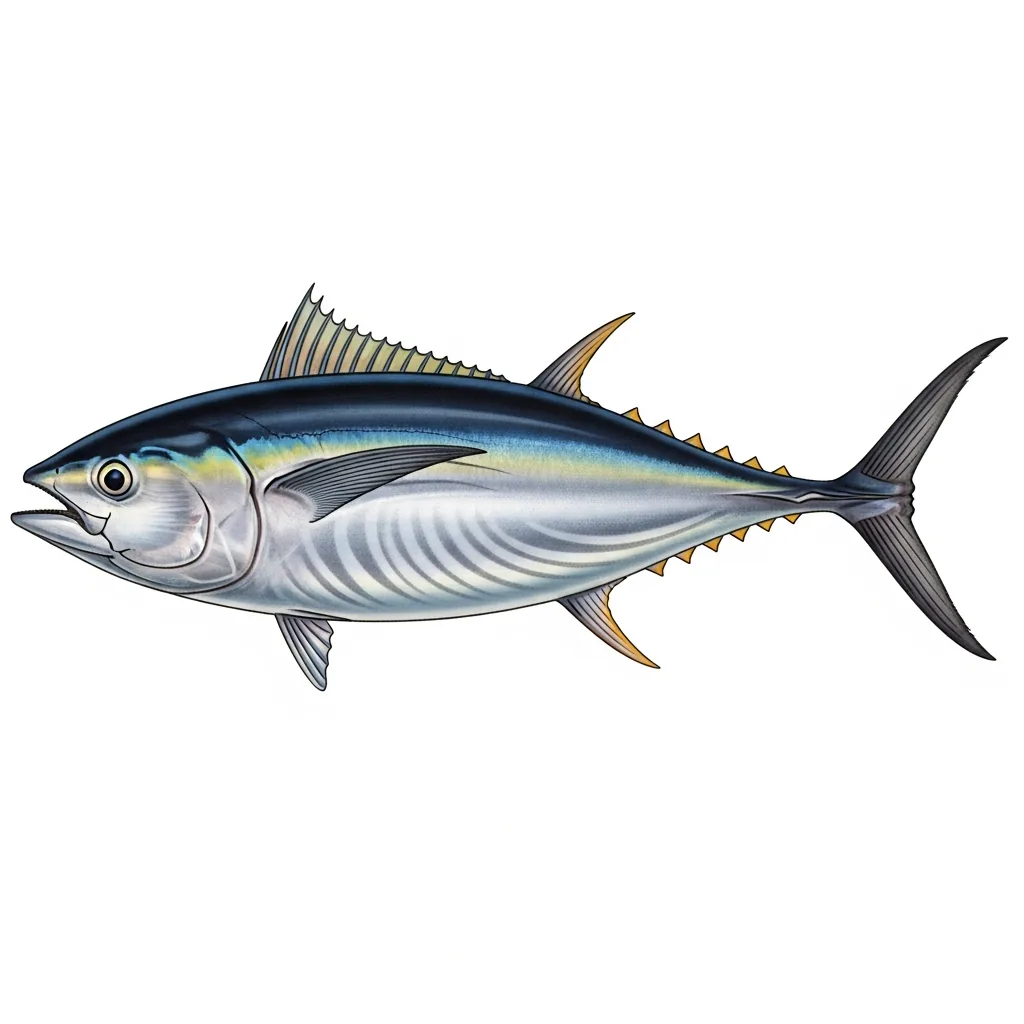
- It has a long, streamlined body that contributes to its great speed.
- Colouration
- The back is dark blue, while the sides and belly are silvery with golden reflections.
- Sexual dimorphism
- Absent/not very evident
- Growth
- Fast, especially in the early years of life when it disperses into the open ocean.
Taxonomy
- Family
- Scombridae
- Order
- Perciformes
- Class
- Actinopterygii
Related species
Habitat & distribution
- Environment
- Open sea, Pelagic
- Preferred bottom
- Pelagic
- Geographic distribution
- Found in all temperate and tropical oceans. More common in the Pacific and North Atlantic.
- Micro-habitat
- Prefers pelagic waters far from the coast, often near warm currents.
Prefers open oceans, often approaching the coast only when temperature conditions permit.
Presence by sea area
Diet
- Primary prey
- cephalopods, small pelagic fish, mackerels
- Secondary prey
- shrimp, anchovies, sardines
- Occasional prey
- squid, fish larvae
- Feeding behaviour
- A fast predator that forms large schools while searching for food. Uses speed to suddenly attack schools of prey.
- Natural predators
- mako shark, orca, sailfish
Follows the movements of schools of small fish and cephalopods, adapting the diet based on local availability.
Behaviour
- Activity
- diurnal
- Social behaviour
- large_schools
- Aggressiveness
- medium
- Migration
- Makes transoceanic migrations for reproduction and food searching.
- Seasonal behaviour
- During summer, it moves towards temperate coasts following warm currents, in winter tends to seek deeper and warmer waters.
- Juveniles
- Juvenile albacore form schools with other species for protection and mainly feed at the surface.
- Adults
- Adults prefer more open waters and often move to follow prey availability.
Reproduction
- Spawning season
- June, July
- Spawning depth
- Between 20 and 200 meters
- Eggs
- Pelagic eggs, small in size, freely floating in the water.
- Larval stage
- The larvae are pelagic and feed on zooplankton until they grow large enough to hunt small fish.
- Sexual maturity
- 3-4 years
When to catch Albacore Tuna
Activity calendar
Activity by season
Best times
This species shows peak fishing activity in spring, summer and autumn, when the productivity index (FPI) reaches its highest values.
Fishing activity decreases in winter, when conditions are less favourable.
Ideal conditions
Water temperature
Where to catch it
Best spots
Bottom preference
Spot type
Fishing techniques
Recommended
Other applicable
Recommended baits
Baits by pressure
How to really catch it
Albacore is a true pelagic fish: a fusiform body, large eyes, and those extremely long pectoral fins that make it unmistakable when it rises in open light. It gives nothing away at sea, but when a school slides into feeding water or cuts across a warm current, its fast, orderly hunting can turn waiting into a sudden strike.
🐟 Good to know
A truly distinctive feature of albacore is its exceptionally long pectoral fin, far more evident than in many other tunas. It is one of the most reliable morphological traits for recognizing the species even at a distance, especially when the fish circles under the boat or breaks the surface in clear water.
🌊 Where & when
Look for it far from shore, in the open sea, in pelagic zones and especially near warm currents, often around schools of sardines and other small fish. It is most fishable from spring through autumn; in summer it moves toward temperate coasts following favorable water, while in winter it tends to seek deeper, warmer layers. Between June and July it spawns between 20 and 200 meters.
🎣 How to really catch it
To really fish for it, trolling is the most concrete technique: cover water in open pelagic areas, along the edges of warm currents and near bait concentrations, presenting fish-shaped artificial lures or live sardines with a clean, natural setup. A 30-50 lb rod, line in the same class, and a 50 lb fluorocarbon leader give balance; if the fish are feeding deeper, a 100 g ball sinker helps keep the bait in the right band. When there is surface activity, surface fishing and drifting with fresh cephalopods are also credible options.
💡 The detail that makes the difference
The most defensible tip is this: do not lock onto a spot, lock onto moving life. Albacore follows pelagic prey and currents, and adults often shift with food availability; if you find packed sardines, active bait, or water that clearly looks alive, your odds are better there than over water that seems perfect but empty.
Catch & handling tips
- Fight
- Combative and fast, it presents many challenges for the angler; it pulls hard and swims in circles near the boat.
- Handling
- Use gloves to avoid cuts from sharp fins; handle carefully to avoid stressing the fish.
- Release
- Release quickly while trying to minimize the time out of the water; keep the fish horizontal and gently move it back and forth while in water.
Curiosities & culture
- Record catches
- Maximum documented size: up to about 140 cm and 60.3 kg (source: FishBase). IGFA All-Tackle record: 39.97 kg (88 lb 2 oz), caught at Gran Canaria (Spain) in 1977.
- In the kitchen
- Commonly used for making canned tuna; also highly valued raw as sashimi.
- Cultural notes
- Often symbolizes speed and strength in seafaring cultures; features in many sport fishing stories.
- Historical notes
- Commercial fishing for albacore began in the early 1900s, establishing itself as a key resource for coastal nations.