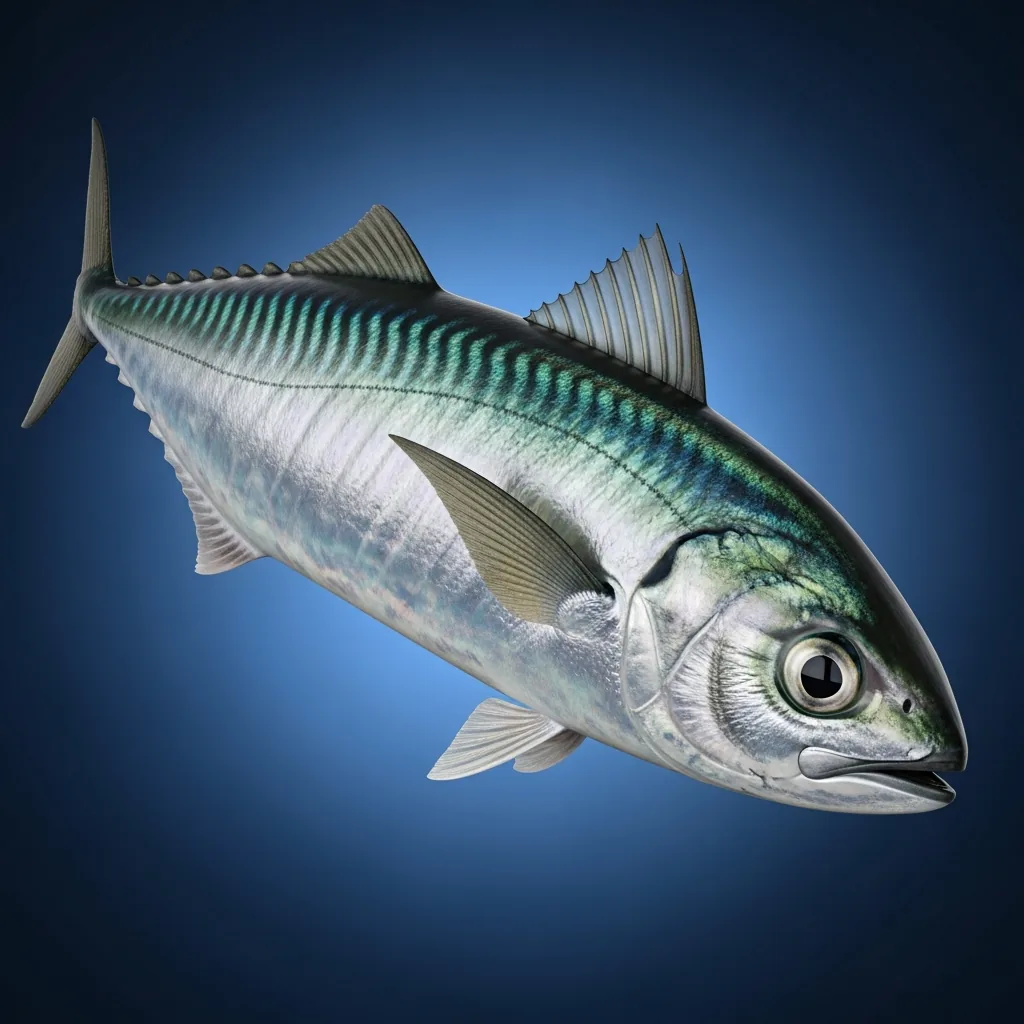

Overview
Similar to horse mackerel but stockier, with pronounced lateral scutes. Common in Mediterranean, often in mixed schools.
Identification
- Body
- Similar to the Atlantic horse mackerel but more stocky, with a streamlined body and pronounced lateral scutes.
- Colouration
- Silvery with blue hues, darkened lateral scutes, transparent fins with dark edges.
- Sexual dimorphism
- Absent/Not noticeable
- Growth
- Moderate, growing steadily to maximum size
Taxonomy
- Family
- Carangidae
- Order
- Perciformes
- Class
- Actinopterygii
Related species
Habitat & distribution
- Environment
- Coast, Open sea
- Preferred bottom
- Sand, Rock, Gravel
- Geographic distribution
- Common in the Mediterranean, also found in the eastern Atlantic up to the coasts of Norway.
- Micro-habitat
- Often found in schools, near the coast or in open sea, at various depths.
Prefers coastal areas and open sea, moving according to food availability.
Presence by sea area
Diet
- Primary prey
- copepods, planktonic crustaceans, small fish
- Secondary prey
- mollusk larvae, annelids, other marine invertebrates
- Occasional prey
- polychaetes, jellyfish
- Feeding behaviour
- Primarily feeds at night, catching moving pelagic prey.
- Natural predators
- tuna, dolphins, seabirds, sharks
Shows a preference for pelagic prey, adapting to seasonal availability.
Behaviour
- Activity
- nocturnal
- Social behaviour
- large_schools
- Aggressiveness
- low
- Migration
- Non-migratory, with limited movements to follow food sources.
- Seasonal behaviour
- Approaches the coast during warmer periods; tends to inhabit deeper waters in winter.
- Juveniles
- Juveniles form smaller schools near the surface.
- Adults
- Adults are found in large schools, sometimes associated with similar species.
Reproduction
- Spawning season
- June, July, August
- Spawning depth
- between 50 and 150 meters
- Eggs
- Pelagic eggs, small in size, suspended in the water column.
- Larval stage
- Larvae are transparent and develop quickly, feeding on zooplankton.
- Sexual maturity
- 2-3 years
When to catch Mediterranean horse mackerel
Activity calendar
Activity by season
Best times
This species shows peak fishing activity in summer and autumn, when the productivity index (FPI) reaches its highest values.
Fishing activity decreases in winter, when conditions are less favourable.
Ideal conditions
Atmospheric pressure
On surface, active schools.
Normal activity at mid-water.
Deeper and less reactive.
Water temperature
Where to catch it
Best spots
Bottom preference
Spot type
Fishing techniques
Recommended
Other applicable
Recommended baits
Baits by pressure
How to really catch it
The Mediterranean horse mackerel is a small schooling pelagic, quick in its swimming yet predictable in its movements, with large eyes and a protrusible mouth built for hunting in open water. As the light fades and the school tightens between the coast and offshore water, it becomes an accessible and surprisingly enjoyable target on light tackle.
🐟 Good to know
One of its defining features is the row of rigid lateral scutes along the lateral line, a typical carangid trait that makes it recognizable even by touch. Its eggs are pelagic and remain suspended in the water column, while the transparent larvae feed on zooplankton.
🌊 Where & when
It lives over sand, rock and gravel bottoms, from 10 to 200 meters, near the coast or offshore, most often in schools. In warmer periods it moves closer to shore, and from June to November it is especially worth targeting; in summer, from June to August, it spawns between 50 and 150 meters.
🎣 How to really catch it
The most practical way to catch it is light nighttime bottom fishing, especially from breakwaters, harbors, piers, or above sandy areas and artificial reefs where schools pass through mid and lower water. A 2.10-2.70 m rod, 0.20-0.30 nylon, 0.18-0.22 fluorocarbon leader, small size 6-10 hooks, and 10-30 g sinkers are enough to present shrimp, sardine, squid strips, or marine worms naturally.
💡 The detail that makes the difference
The most useful tip is to fish after dark and keep the bait with just a slight movement rather than completely still. This species feeds mainly at night on moving pelagic prey: a controlled drift or tiny lifts of the rig make the offering more consistent with the way it actually hunts.
Catch & handling tips
- Fight
- Puts up moderate resistance and moves quickly side-to-side.
- Handling
- Handle with gloves to avoid the sharp lateral scutes.
- Release
- Release quickly into the water to reduce stress, preferably using a barbless hook.
Curiosities & culture
- Record catches
- Maximum documented size: up to about 60 cm in length (source: FishBase). There is no official IGFA All-Tackle record for this species.
- In the kitchen
- Commonly used in mixed fry and fish soup, valued for its flavorful meat.
- Cultural notes
- Symbol of abundance in many Mediterranean communities.
- Historical notes
- Traditionally caught with trawl nets in the Mediterranean since ancient times.