
Overview
Very common coastal fish, lives in large schools near ports and estuaries.
Identification
- Body
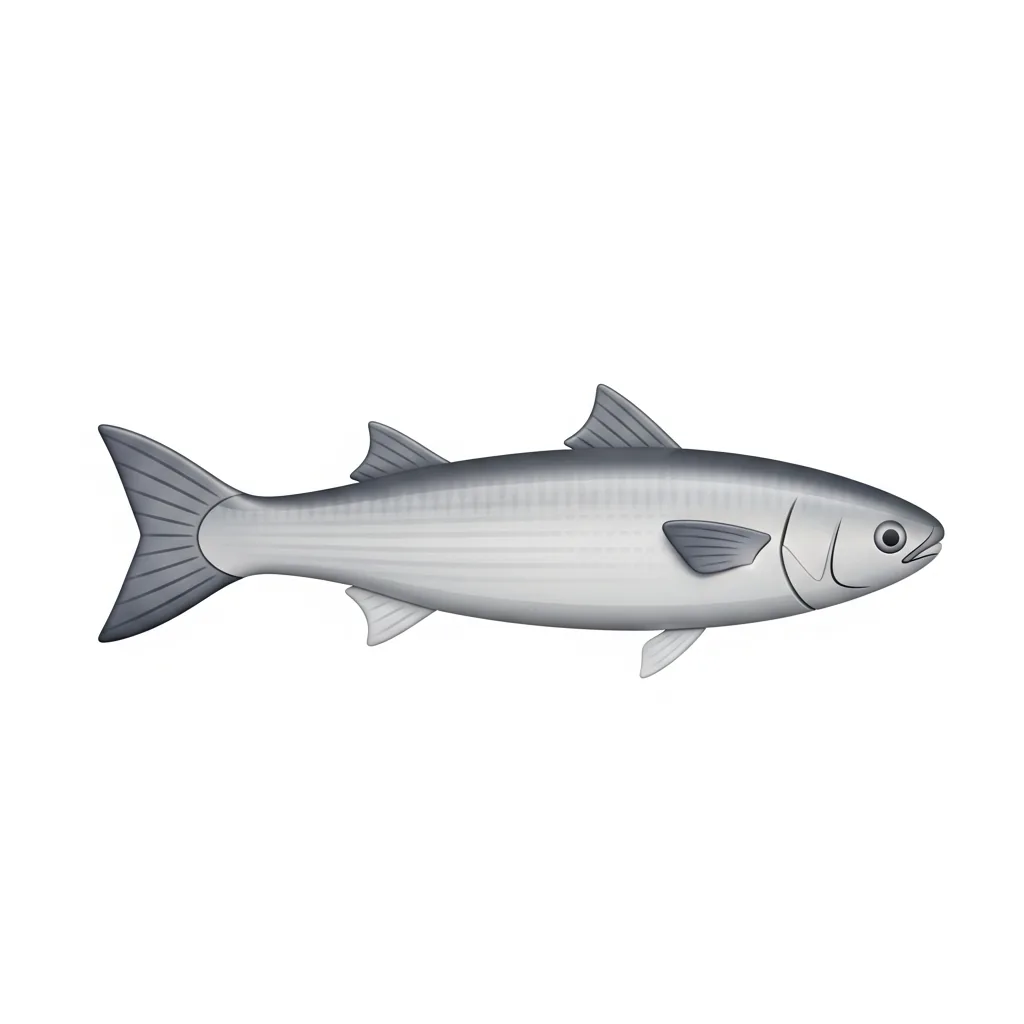
- Elongated body with a flat head.
- Colouration
- Gray-silver with darker shades on the back and a yellow stripe along the sides.
- Sexual dimorphism
- Absent/not obvious
- Growth
- Medium, grows rapidly in the early years of life.
Taxonomy
- Family
- Mugilidae
- Order
- Mugiliformes
- Class
- Actinopterygii
Related species
Habitat & distribution
- Environment
- Coast, Estuaries, Brackish
- Preferred bottom
- Sand, Mud, Seagrass, Estuarine
- Geographic distribution
- Common in coastal and estuarine waters of all warm and temperate regions worldwide.
- Micro-habitat
- Prefers shallow waters near river mouths and ports where it hides and feeds.
Prefers surface waters of the coastline and estuaries for easy access to food.
Presence by sea area
Diet
- Primary prey
- algae, organic debris, small crustaceans
- Secondary prey
- mollusks, small aquatic invertebrates
- Occasional prey
- small fish, insect larvae
- Feeding behaviour
- Feeds by filtering the substrate and scraping surfaces with its mouth to extract food particles.
- Natural predators
- groupers, barracuda, mackerel, sharks
Scrape the substrate for algae and organic matter, playing an important role in the aquatic ecosystem.
Behaviour
- Activity
- diurnal
- Social behaviour
- large_schools
- Aggressiveness
- low
- Migration
- Migrates seasonally from cold waters to warmer ones for spawning.
- Seasonal behaviour
- Forms large schools in spring and summer to migrate to breeding areas.
- Juveniles
- Juveniles inhabit shallow waters, often in large groups to evade predators.
- Adults
- As adults, they form large schools and migrate seasonally.
Reproduction
- Spawning season
- May, June, July
- Spawning depth
- between 10 and 30 meters
- Eggs
- Pelagic, very small eggs that cling to plankton.
- Larval stage
- Larvae are pelagic and move towards shallow coastal waters as they grow.
- Sexual maturity
- 2-4 years
When to catch Flathead grey mullet
Activity calendar
Activity by season
Best times
This species shows peak fishing activity in spring, summer and autumn, when the productivity index (FPI) reaches its highest values.
Ideal conditions
Atmospheric pressure
Very active on surface.
Regular activity.
Moves away from shore.
Water temperature
Where to catch it
Best spots
Bottom preference
Spot type
Fishing techniques
Recommended
Other applicable
Recommended baits
Baits by pressure
How to really catch it
The mullet cuts through shallow water like a silver blade, moving in large schools that look calm yet turn elusive the instant something feels wrong. Catching it for real means reading bottom, soft current and living surface water, stepping into its rhythm rather than forcing the moment.
🐟 Good to know
One real but often overlooked feature of mullet is the membrane protecting the eyes, a useful adaptation in coastal, brackish waters rich in suspended particles. It fits its life around river mouths, ports and shallow water, where it feeds by filtering the substrate and scraping surfaces.
🌊 Where & when
You find it along coasts, in estuaries and brackish shallows over sand, mud and seagrass, especially near river mouths and ports where it finds shelter and food. It becomes more approachable from spring into autumn, with strong presence from March to November; in spring and summer it forms large schools and migrates toward spawning areas, spawning between May and July.
🎣 How to really catch it
The most concrete approach is light rod fishing, working close to the bottom or just above it, where mullet search for algae, organic debris and small crustaceans. Bread, algae and small crustaceans are perfectly consistent baits for its diet; use a light rod, 8-10 lb braided line, a 15 lb fluorocarbon leader, small circle hooks and a light sinker to keep the presentation natural.
💡 The detail that makes the difference
The real trick is not to chase the school, but to wait for it along slow travel lanes near river mouths, ports or seagrass edges. With its small mouth and filter-and-scrape feeding style, mullet responds better to a still bait or one just eased by the current than to a nervous retrieve; once hooked, expect a lively fight with jumps out of the water.
Catch & handling tips
- Fight
- When hooked, fights vigorously with jumps out of the water.
- Handling
- Handle carefully to avoid damaging scales and return to water quickly.
- Release
- Release gently into the water, ensuring it is fully revived before letting go.
Curiosities & culture
- Record catches
- Maximum documented size: up to about 100 cm and 8 kg (source: FishBase). There is no official IGFA All-Tackle record for this species.
- In the kitchen
- Highly valued for dishes like bottarga and fish soups in Mediterranean cuisines.
- Cultural notes
- Traditionally used in Mediterranean cuisine, important in the local fish market.
- Historical notes
- Mullet fishing has been practiced since ancient Rome for the production of bottarga.