
Overview
Very common gregarious pelagic fish in the Mediterranean. Fast and combative, excellent live bait for predators.
Identification
- Body
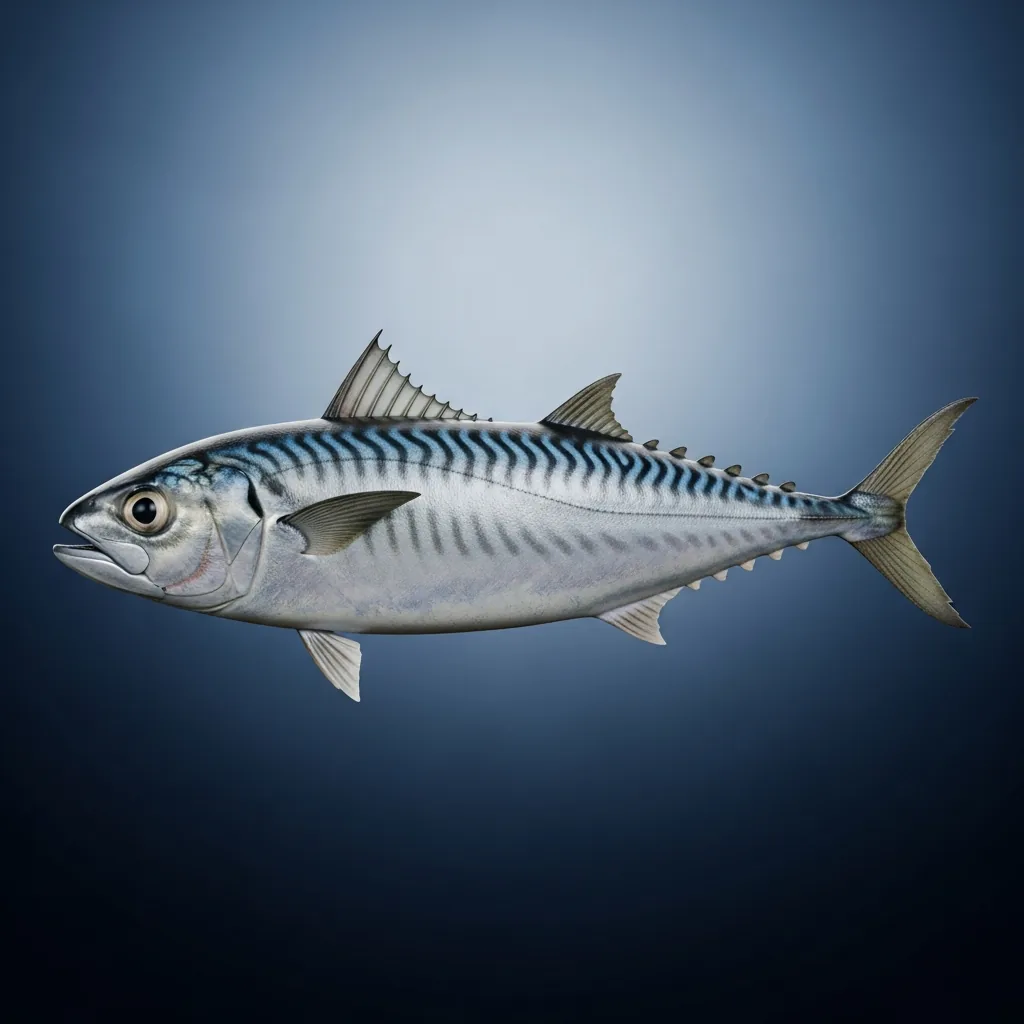
- Elongated and laterally compressed body with a forked tail fin.
- Colouration
- Blue-green back, silver sides, and white belly with reflective scales.
- Sexual dimorphism
- Absent/not noticeable.
- Growth
- Medium, reaches maturity in a few years.
Taxonomy
- Family
- Carangidae
- Order
- Carangiformes
- Class
- Actinopterygii
Related species
Habitat & distribution
- Environment
- Coast, Open sea, Reefs
- Preferred bottom
- Sand, Rock, Gravel
- Geographic distribution
- Wide distribution in the Mediterranean, Northeast Atlantic from Norway to Senegal, and the Black Sea.
- Micro-habitat
- Often found in open waters near the coast and over mixed seabeds.
Prefers well-oxygenated and nutrient-rich waters.
Presence by sea area
Diet
- Primary prey
- small crabs, shrimp, annelids
- Secondary prey
- small cephalopods, fish larvae, plankton
- Occasional prey
- other small fish, fish eggs
- Feeding behaviour
- Gregarious and active predator, hunts in groups by quickly darting at schools of prey.
- Natural predators
- tuna, bass, bonito, dolphins
Opportunistic feeder, focuses on abundant organisms.
Behaviour
- Activity
- diurnal
- Social behaviour
- large_schools
- Aggressiveness
- low
- Migration
- Performs seasonal migrations for breeding and feeding.
- Seasonal behaviour
- Approaches coastal areas during warm seasons and forms large schools.
- Juveniles
- Young form dense schools for protection and hunting in the upper layers of water.
- Adults
- Adults can form large schools and migrate depending on food availability.
Reproduction
- Spawning season
- May, June, July
- Spawning depth
- between 20 and 60 meters
- Eggs
- Pelagic, small, and transparent eggs.
- Larval stage
- Larvae are planktonic and gradually develop pigmentation and adult features.
- Sexual maturity
- Varies between 2 and 4 years
When to catch Atlantic horse mackerel
Activity calendar
Activity by season
Best times
This species shows peak fishing activity in summer and autumn, when the productivity index (FPI) reaches its highest values.
Fishing activity decreases in winter, when conditions are less favourable.
Ideal conditions
Atmospheric pressure
Rises to surface, active and easy to locate schools.
Moderate activity at mid-water.
Stays deeper and less active.
Water temperature
Where to catch it
Best spots
Bottom preference
Spot type
Fishing techniques
Recommended
Other applicable
Recommended baits
Baits by pressure
How to really catch it
The Atlantic horse mackerel is a sleek schooling pelagic fish, with a streamlined body, large eye, and a marked lateral line that flashes as soon as light touches it. When it pushes close to shore in the warm season, a stretch of water that looks empty can suddenly come alive with fast chases and abrupt strikes.
🐟 Good to know
Horse mackerel eggs are pelagic, small, and transparent, and the larvae also live as plankton before gradually developing pigmentation and adult features. It is a revealing detail: this is a species built to live suspended in the water column from its earliest life stages.
🌊 Where & when
You find it in the Mediterranean, the Northeast Atlantic, and the Black Sea, in open coastal waters, near reefs, along rocky edges, and over mixed bottoms of sand, rock, or gravel, from 20 meters down to much greater depths. It becomes more approachable from June to November, especially in the warm season when it moves closer inshore and forms large schools; from May to July it spawns between 20 and 60 meters.
🎣 How to really catch it
To catch it for real, light bottom fishing is the most concrete approach: picture the boat drifting over clean water, a thin fluorocarbon leader, small hooks, and a simple bait such as live shrimp, a strip of squid, or a piece of sardine working just above the bottom or through the layer where the school is moving. With a fast 2.40-3.00 m rod, 0.20-0.30 mm main line, and 5-15 g weights, the take comes sharp, nervous, and sideways.
💡 The detail that makes the difference
The practical edge is not to stay glued to the bottom if the school does not answer at once. Horse mackerel hunt in groups through the water column and feed on shrimp, fish larvae, and other small pelagic prey: around rocky ledges, harbor mouths, or open coastal water, work the bait slightly lifted as well and repeat tidy passes through the same layer, because the fish is often there rather than deeper.
Catch & handling tips
- Fight
- Combative and responsive, makes quick jerky pulls and tries to swim sideways.
- Handling
- Use a wet cloth to avoid damaging the scales when handling.
- Release
- Release gently back into the water quickly to reduce animal stress.
Curiosities & culture
- Record catches
- Maximum documented size: up to about 70 cm and 2 kg (source: FishBase). IGFA All-Tackle record: 8.16 kg (18 lb), set in 1990.
- In the kitchen
- Widely used in fish soups and mixed fry, popular in Mediterranean cuisine.
- Cultural notes
- In popular culture, the sugarello is often used as a symbol of marine abundance.
- Historical notes
- Historically, mackerel have been caught with traditional methods like traps and trawl nets.