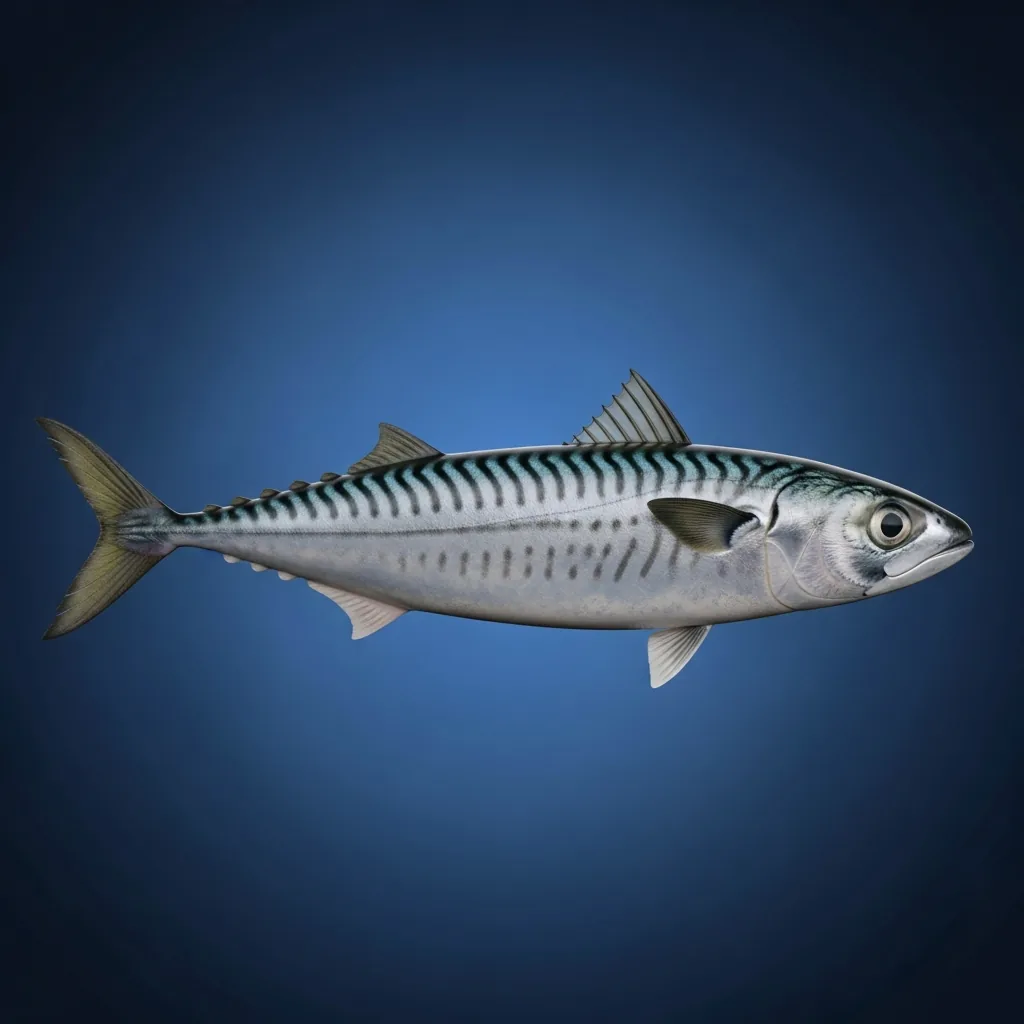

Overview
Close relative of the mackerel, with larger eyes and spots on flanks. Fast and gregarious pelagic fish.
Identification
- Body
- Slim and streamlined body with a conical head and large mouth.
- Colouration
- Blue-green back with a silver belly and irregular spots on the sides.
- Sexual dimorphism
- Absent/not very pronounced
- Growth
- Fast, reaching maturity in a few years
Taxonomy
- Family
- Scombridae
- Order
- Perciformes
- Class
- Actinopterygii
Related species
Habitat & distribution
- Environment
- Coast, Open sea, Reefs, Pelagic
- Preferred bottom
- Sand, Rock, Reef
- Geographic distribution
- Found in all temperate seas, especially the Mediterranean and along the eastern Atlantic coasts.
- Micro-habitat
- Often swims in open waters and is found near plankton schools for feeding.
Prefers relatively shallow and warm waters.
Presence by sea area
Diet
- Primary prey
- plankton, krill, small fish
- Secondary prey
- fish larvae, small crustaceans, squid
- Occasional prey
- jellyfish, annelids
- Feeding behaviour
- Feeds by filtering plankton while swimming or attacking small fish in schools.
- Natural predators
- tunas, dolphins, sharks, seabirds
Tends to feed mainly in surface waters.
Behaviour
- Activity
- diurnal
- Social behaviour
- large_schools
- Aggressiveness
- medium
- Migration
- Performs seasonal migrations to more temperate areas.
- Seasonal behaviour
- More active in summer when waters are warmer and food is abundant.
- Juveniles
- Youngsters tend to form smaller schools compared to adults.
- Adults
- Adults move in large, well-coordinated schools.
Reproduction
- Spawning season
- June, July
- Spawning depth
- between 20 and 60 meters
- Eggs
- Pelagic, translucent small eggs.
- Larval stage
- Larvae are planktonic and develop rapidly within weeks.
- Sexual maturity
- 2-3 years
When to catch Chub mackerel
Activity calendar
Activity by season
Best times
This species shows peak fishing activity in summer and autumn, when the productivity index (FPI) reaches its highest values.
Fishing activity decreases in winter, when conditions are less favourable.
Ideal conditions
Atmospheric pressure
Rises to surface with mackerel schools.
Activity at mid-water.
Stays deep.
Water temperature
Where to catch it
Best spots
Bottom preference
Spot type
Fishing techniques
Recommended
Other applicable
Recommended baits
Baits by pressure
How to really catch it
The chub mackerel is a tight, restless pelagic fish built for open water: a streamlined body, forked tail, and large schools that can suddenly flare beneath the surface. When it starts feeding on plankton or small fish, everything changes within a few meters of water, and catching it becomes an exercise in reading the sea.
🐟 Good to know
Although it is often targeted as a small predator, chub mackerel does not feed only by chasing baitfish: it can also feed by filtering plankton while swimming. This double feeding strategy helps explain why it may be found both in hectic attacks on small fish and in open water near plankton concentrations.
🌊 Where & when
It lives between the coast and the open sea, over sandy or rocky bottoms and near reefs, usually from 10 to 200 meters. It is found in temperate seas, especially the Mediterranean and the eastern Atlantic coasts, and becomes more active from the warm season into autumn, peaking from June to November; in June and July it spawns between 20 and 60 meters.
🎣 How to really catch it
To truly catch it, trolling is the most concrete approach: picture a natural bait working cleanly through the water, a sardine or anchovy passing where currents rise, along coastal areas or in open water near feeding schools. A medium-light rod with 10-15 lb main line, a fluorocarbon leader, size 4-6 hooks, and a small olive sinker keeps the presentation subtle and believable; when it hits, expect quick bursts and an agile fight.
💡 The detail that makes the difference
The soundest tip is to look for chub mackerel where the sea shows suspended life more than structure: open water, upwelling currents, plankton presence, and baitfish. Biologically this makes sense, because it is a diurnal, schooling species tied to group feeding; if you intercept the school, you often do not meet one fish but a whole moving wave.
Catch & handling tips
- Fight
- Active and agile, tends to make quick bursts.
- Handling
- Handle carefully to avoid damaging the scales.
- Release
- Support the body and release quickly into the water.
Curiosities & culture
- Record catches
- Maximum documented size: up to about 55 cm and 1.6 kg (source: FishBase). IGFA All-Tackle record: 0.75 kg (1 lb 10 oz), caught off Brielle, New Jersey (USA), in 2021.
- In the kitchen
- Used for canned preserves in oil, grilled, or stewed.
- Cultural notes
- Often found in markets and appreciated for its tasty flesh.
- Historical notes
- A species known and fished since ancient times in the Mediterranean.