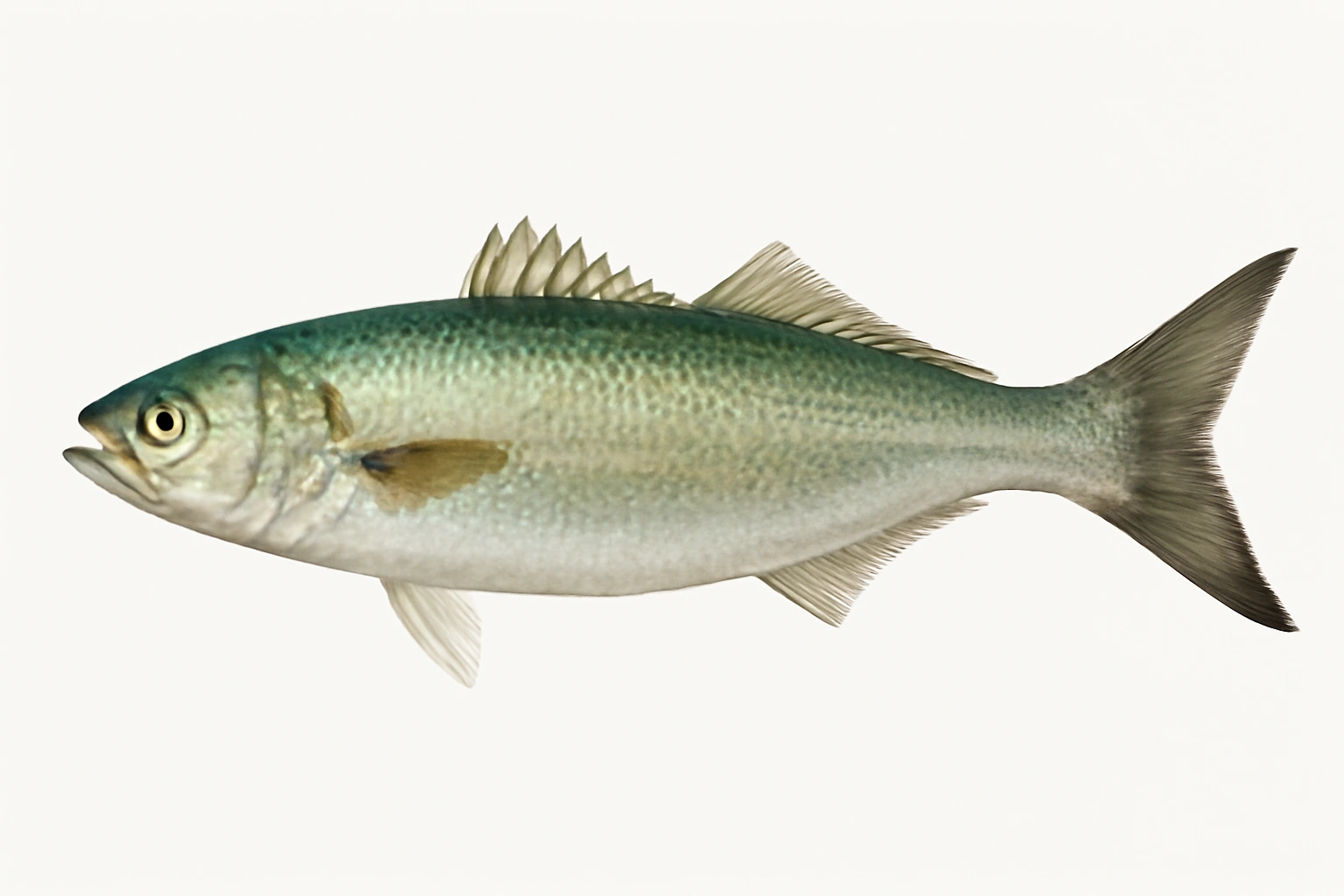

Overview
The Australian Herring is one of the most abundant fish in Western and South Australian waters. Easy to catch, perfect for families and beginners. Gathers in large schools near shore and provides continuous fun on light tackle.
Identification
- Body
- The body is elongated and slightly compressed laterally.
- Colouration
- It has a silvery coloration with a greenish tint on the back and darker lateral bands.
- Sexual dimorphism
- Absent/low evidence
- Growth
- medium, growing rapidly in the first years of life
Taxonomy
- Family
- Arripidae
- Order
- Perciformes
- Class
- Actinopterygii
Related species
Habitat & distribution
- Environment
- Coast, Open sea
- Preferred bottom
- Sand, Rock, Reef
- Geographic distribution
- Widespread along the southern coasts of Australia, primarily in Western Australia and South Australia.
- Micro-habitat
- Forms large schools near the coast, often around marine reefs and sandbanks.
They prefer shallow, well-oxygenated waters, ideal for consistent schooling.
Presence by sea area
Diet
- Primary prey
- shrimp, small fish, squid
- Secondary prey
- crustaceans, fish larvae, seaweed
- Occasional prey
- plankton, octopuses, jellyfish
- Feeding behaviour
- Feeds mainly in groups, visually hunting and swiftly chasing prey through the water column.
- Natural predators
- sharks, large pelagic fish, seabirds
Tends to diversify its diet based on the season and prey availability.
Behaviour
- Activity
- diurnal
- Social behaviour
- large_schools
- Aggressiveness
- low
- Migration
- They must migrate to seasonal breeding areas along the coast.
- Seasonal behaviour
- Tends to group more during the breeding season and in autumn, when they form large schools.
- Juveniles
- Juveniles are often found closer to the shore and form schools for protection.
- Adults
- Adults migrate to seasonal breeding zones, forming large schools.
Reproduction
- Spawning season
- April, May
- Spawning depth
- between 20 and 50 meters
- Eggs
- Pelagic eggs, small and round, floating in open waters.
- Larval stage
- Larvae are initially found in surface waters and widely distributed by currents.
- Sexual maturity
- 2-4 years
When to catch Australian Herring
Activity calendar
Activity by season
Best times
This species shows peak fishing activity in spring, summer and autumn, when the productivity index (FPI) reaches its highest values.
Fishing activity decreases in winter, when conditions are less favourable.
Ideal conditions
Water temperature
Where to catch it
Best spots
Bottom preference
Spot type
Fishing techniques
Recommended
Other applicable
Recommended baits
Baits by pressure
How to really catch it
The Australian herring is a fast, bright coastal predator, always moving inside tight schools that light up the water close to shore. When it starts feeding over sand, rock, or the edge of a reef, it becomes one of the liveliest and most enjoyable targets in light tackle fishing.
🐟 Good to know
An important biological trait is its pelagic spawning: the eggs are small, round, and drift in open water. The larvae also begin life in surface layers and are then widely dispersed by currents, a pattern that fits a coastal species that moves and schools extensively.
🌊 Where & when
It lives along the southern coasts of Australia, especially in Western Australia and South Australia, from the shoreline down to about 50 meters, over sand, rock, and reefs. It often gathers close to shore around piers, bays, artificial rock walls, and sandbanks, and is most approachable from autumn into late spring, with strong schooling from March to November and during spawning in April and May.
🎣 How to really catch it
The most practical way to catch it is light spinning: a light spinning rod, 8-12 lb nylon, a 6-10 lb fluorocarbon leader, and either artificials or natural baits presented with a light sinker through the water column. Look for feeding schools from sandy beaches, piers, or artificial rock walls and retrieve steadily, because this species feeds by day, in groups, and mainly by sight on shrimp, small fish, and squid.
💡 The detail that makes the difference
The small edge that really matters is not to stay pinned to the bottom when the school is active: Australian herring chase prey through the water column. If you see silver flashes, surface ripples, or working seabirds, keep your offering high and moving, because strikes often come while the school is compressing bait close to shore.
Catch & handling tips
- Fight
- Shows an initial vigorous resistance with quick lateral movements.
- Handling
- Handle carefully to avoid removing the silvery scales.
- Release
- Release quickly to preserve the population, avoiding excessive exposure to air.
Curiosities & culture
- Record catches
- Maximum documented size: up to about 41 cm in length (source: FishBase); maximum weight is not officially reported. There is no IGFA All-Tackle record for this species.
- In the kitchen
- Popular when fried or grilled. Often consumed fresh and appreciated for its delicate flavor.
- Cultural notes
- An iconic species sought after by anglers for its catchability and frequency.
- Historical notes
- It has been a significant food source for Australian coastal communities since ancient times.