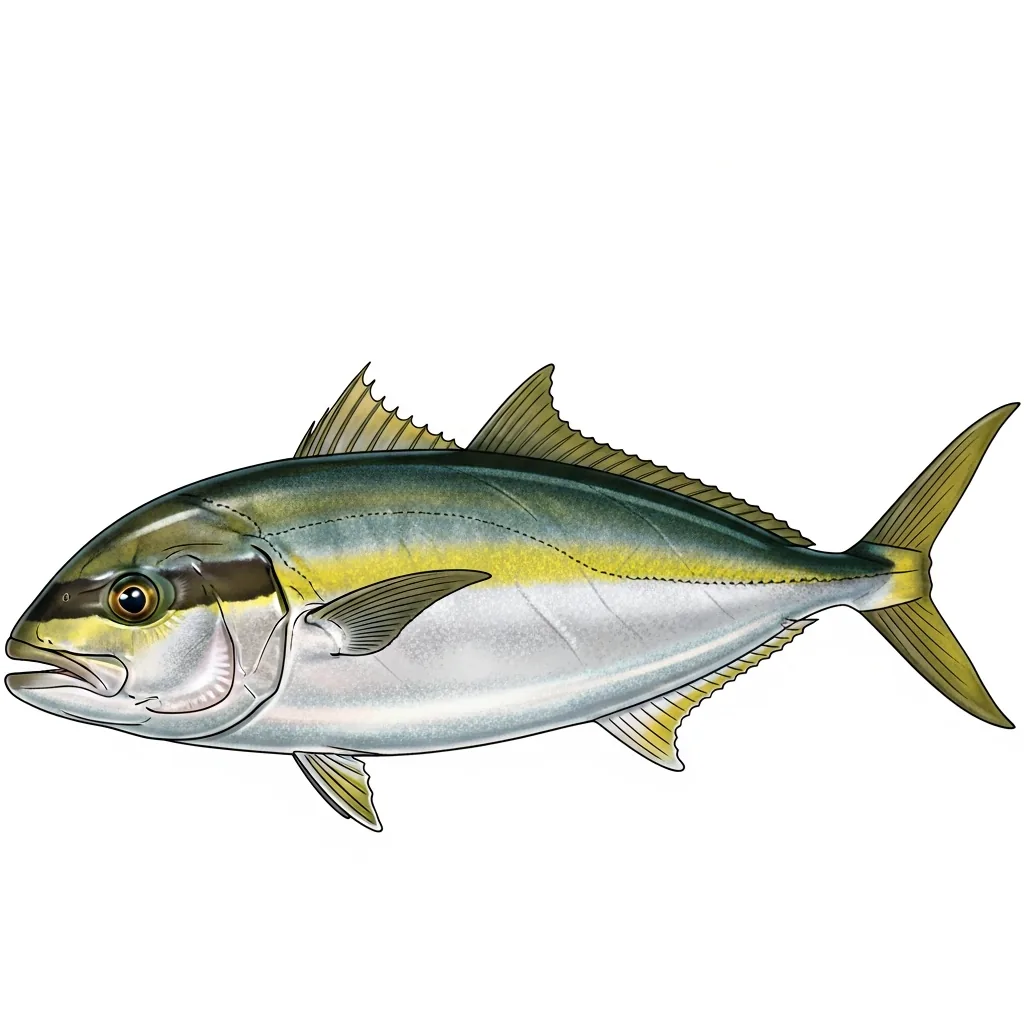

Overview
Large pelagic predator, extremely powerful fighter, often in schools over reefs and wrecks.
Identification
- Body
- The body is elongated and streamlined, with a pointed snout.
- Colouration
- The color is typically blue-silver on the back, fading to white on the sides and belly.
- Sexual dimorphism
- Absent/not very pronounced
- Growth
- Moderate, with faster growth in the early years.
Taxonomy
- Family
- Carangidae
- Order
- Perciformes
- Class
- Actinopterygii
Related species
Habitat & distribution
- Environment
- Open sea, Reefs, Coast
- Preferred bottom
- Reef, Sand
- Geographic distribution
- Primarily found in the tropical and temperate waters of the Atlantic, Mediterranean, and occasionally Indo-Pacific.
- Micro-habitat
- Prefers shallow reefs, often near shipwrecks and coral reefs.
Avoids too cold waters and areas with little shelter and hiding spots.
Presence by sea area
Diet
- Primary prey
- small fish, squid, shrimp
- Secondary prey
- cephalopods, crabs, fish larvae
- Occasional prey
- jellyfish, octopuses
- Feeding behaviour
- The Ricciola is an aggressive predator that actively hunts its prey, often in groups.
- Natural predators
- bull shark, bluefish, tunas
Prefers a diet of smaller fish and cephalopods for the high protein content.
Behaviour
- Activity
- diurnal
- Social behaviour
- small_groups
- Aggressiveness
- medium
- Migration
- Performs seasonal migrations depending on water temperatures.
- Seasonal behaviour
- Moves closer to the coast in spring and summer for spawning, heading offshore in winter.
- Juveniles
- Juveniles are often found in more coastal areas and among seaweed.
- Adults
- Adults prefer deeper waters and are often found in open areas or on shallow banks.
Reproduction
- Spawning season
- May, June, July
- Spawning depth
- between 20 and 60 meters
- Eggs
- Pelagic eggs, small and floating.
- Larval stage
- Pelagic larval stage, initially plankton-dependent.
- Sexual maturity
- 4-5 years
When to catch Greater amberjack
Activity calendar
Activity by season
Best times
This species shows peak fishing activity in summer, when the productivity index (FPI) reaches its highest values.
Fishing activity decreases in autumn and winter, when conditions are less favourable.
Ideal conditions
Atmospheric pressure
Actively hunts mid-water and surface.
Regular activity, follows schools.
Deeper, less aggressive.
Water temperature
Where to catch it
Best spots
Bottom preference
Spot type
Fishing techniques
Recommended
Other applicable
Recommended baits
Baits by pressure
How to really catch it
The greater amberjack is a powerful pelagic predator, with a fusiform body and forked tail, able to appear over shallow banks like a dark flash with blue lines along its flanks. When it starts hunting near wrecks, rocky structure and reefs, the water seems to tighten around it: this is not a fish you meet by chance, but by reading the sea correctly.
🐟 Good to know
An important biological trait of the greater amberjack is its reproduction: it releases small, floating pelagic eggs, and its larval stage is also pelagic, initially dependent on plankton. This is typical of large open-water fishes and helps explain its strong link to open water, currents, and seasonal movements.
🌊 Where & when
You find it from 20 to 200 meters, especially on shoals, wrecks, rocky areas and coral reefs, between offshore water and the coast, over reef- and sand-associated bottoms. It becomes more approachable in spring and summer, when it moves closer to shore to spawn; from May to July it spawns between 20 and 60 meters, and the best window often falls in June, July and August.
🎣 How to really catch it
To truly fish for it, the most concrete method is live bait fishing around shoals and wrecks, letting a garfish or sand eel work through the water layer patrolled by adults. Trolling and spinning are also effective, while bottom fishing with squid or cuttlefish makes sense when fish are holding deeper. A 20-30 lb rod, 30-50 lb braid, a 40-60 lb fluorocarbon leader, and 3/0-5/0 circle hooks form a coherent setup for handling fast runs, deep dives, and sudden direction changes.
💡 The detail that makes the difference
The practical edge is to work the edges of the structure, not directly over the core of the wreck or bank. Greater amberjack actively hunt small fish and cephalopods, often in small groups, and those margins are where prey leaves cover and predators intercept it: that is where the bait looks most natural and most exposed.
Catch & handling tips
- Fight
- Strong and fast fighter, tends to dive deep and make sudden direction changes.
- Handling
- Use fishing gloves to avoid injury from spines or teeth.
- Release
- Release slowly back into the water to allow the fish to recover.
Curiosities & culture
- Record catches
- Maximum documented size: up to about 190 cm and 80.6 kg (source: FishBase). IGFA All-Tackle record: 74 kg (163 lb 2 oz), caught at Zenisu, Tokyo (Japan), in 2011.
- In the kitchen
- Highly esteemed in cooking, used in dishes like sashimi and grilled.
- Cultural notes
- Often appears in Mediterranean fishermen's tales, symbolizing strength and speed.
- Historical notes
- Fish similar to the Ricciola have been caught in the Mediterranean since Roman times.