
Overview
Bottom and mid-water predator, very powerful, often on reefs and ledges.
Identification
- Body
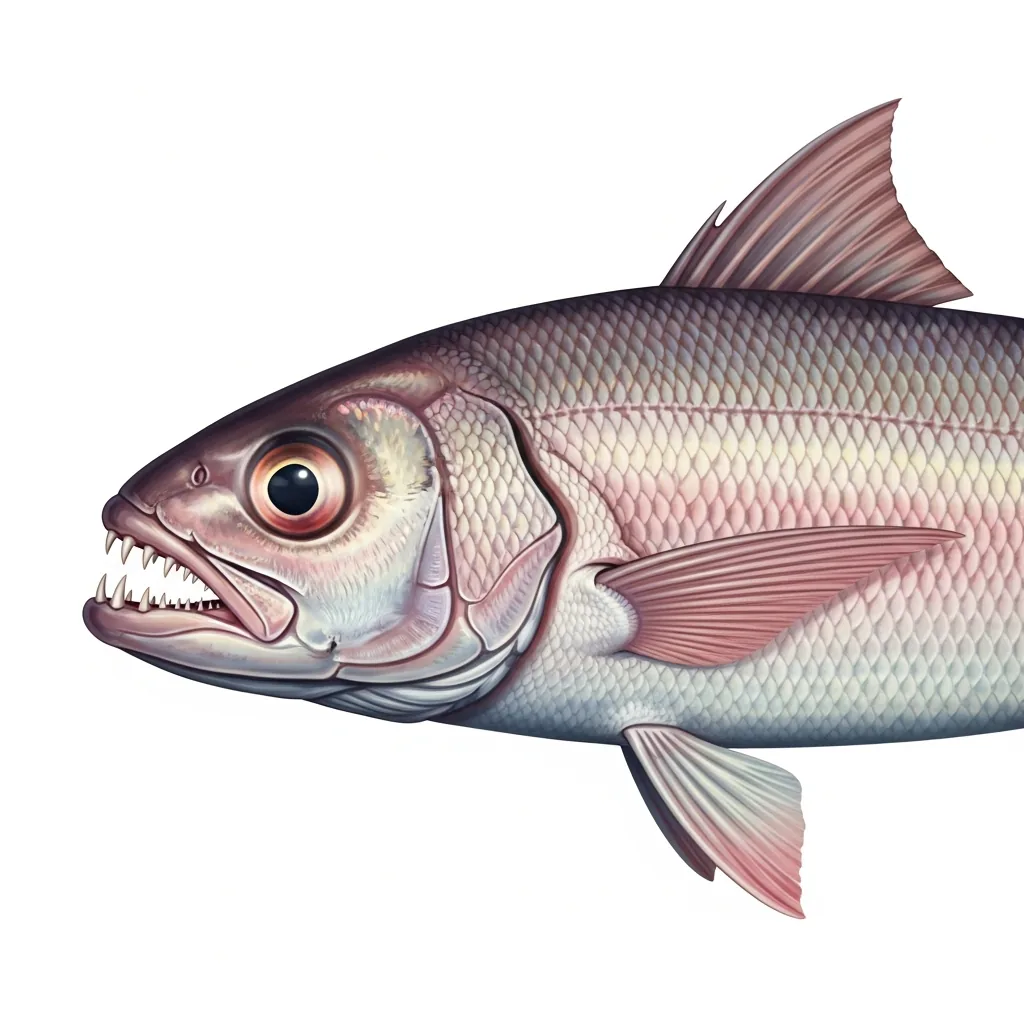
- The body is sturdy and elongated, with a massive head and a large, strong mouth.
- Colouration
- It features a bluish coloration on the back that fades to silvery on the sides and belly.
- Sexual dimorphism
- Absent/not noticeable
- Growth
- medium, with fast growth in the early years
Taxonomy
- Family
- Sparidae
- Order
- Perciformes
- Class
- Actinopterygii
Related species
Habitat & distribution
- Environment
- Coast, Open sea, Reefs
- Preferred bottom
- Rock, Reef, Sand
- Geographic distribution
- Found in the Mediterranean Sea and the northeastern Atlantic, from the UK coasts to the Canary Islands.
- Micro-habitat
- Often found near rocky shoals and edges where it hunts fish and rests.
Prefers rocky or moderately structured seabeds for hiding and hunting.
Presence by sea area
Diet
- Primary prey
- fish, crustaceans, mollusks
- Secondary prey
- octopuses, cuttlefish
- Occasional prey
- small cephalopods, annelids
- Feeding behaviour
- The dentex is an active predator mostly hunting fish and crustaceans, using its strength to surprise prey on the seabed.
- Natural predators
- sharks, tunas, dolphins
Diet is influenced by the seasonal availability of prey.
Behaviour
- Activity
- diurnal
- Social behaviour
- solitary
- Aggressiveness
- high
- Migration
- non-migratory
- Seasonal behaviour
- In winter, it moves to deeper waters for shelter and food, while in summer it's more active in shallower waters.
- Juveniles
- Young tend to form small groups near more protected coastal areas.
- Adults
- Adults are more solitary and occupy well-defined territories in rocky or reef bottoms.
Reproduction
- Spawning season
- April, May
- Spawning depth
- between 20 and 60 meters
- Eggs
- Small pelagic eggs dispersed by currents.
- Larval stage
- Larvae are pelagic, moving with currents until reaching a size to settle on the seabed.
- Sexual maturity
- varies between 2 and 5 years
When to catch Common dentex
Activity calendar
Activity by season
Best times
This species shows peak fishing activity in spring, summer and autumn, when the productivity index (FPI) reaches its highest values.
Ideal conditions
Atmospheric pressure
More active, rises from bottom to hunt.
Regular activity near structures.
Stays very close to bottom, more wary.
Less aggressive, stays deeper.
Active and hunts regularly. Stable pressure ideal.
Very aggressive, rises to shallower water to hunt.
Water temperature
Where to catch it
Best spots
Bottom preference
Spot type
Fishing techniques
Recommended
Other applicable
Recommended baits
Baits by pressure
How to really catch it
The common dentex is one of the great Mediterranean bottom predators: heavy-headed, solitary, armed with strong pointed teeth, and able to turn a stretch of rock into a true hunting ground. When it moves along drop-offs and rocky shoals in bright daytime water, targeting it becomes a technical challenge rewarded by sharp takes and deep, powerful fights.
🐟 Good to know
An important biological trait of the common dentex is its early pelagic phase: after spawning, the eggs and then the larvae remain in open water and are carried by currents before juveniles settle on the bottom. It is a crucial step in the life cycle and helps explain the species' link both to offshore waters and to structured seabeds.
🌊 Where & when
It lives along coasts, offshore grounds, and reefs, over rocky, mixed, and sandy bottoms, from shallow water down to great depths, but it is especially around rocky shoals and edges that it finds both shelter and ambush points. It is more active and reachable from spring to autumn, while in winter it tends to move deeper; between April and May it spawns from 20 to 60 meters.
🎣 How to really catch it
For common dentex, the most concrete approach is to work precisely over rocky shoals, submerged cliffs, and deep coastal areas with trolling or deep bottom fishing, using a heavy trolling rod, braided line, and a fluorocarbon leader. Cuttlefish, squid, octopus, and sardines match its natural prey spectrum well: presented close to the bottom, where it hunts, they make the difference. Once hooked, you must stay in control through its fast runs and deep dives.
💡 The detail that makes the difference
The most defensible practical secret is to focus on the edges of the structure, not the flattest top of the shoal: common dentex uses ledges and depth changes as hunting lines and resting zones. Running the bait right along that contour, staying close to bottom without dragging on it, makes the presentation more believable and helps keep it inside the fish's territory.
Catch & handling tips
- Fight
- When hooked, it offers powerful resistance with rapid runs and deep dives.
- Handling
- Use gloves to avoid injuries from sharp teeth and spiny fins.
- Release
- Handle with care, avoiding damage to fins and gills, and release quickly into the water.
Curiosities & culture
- Record catches
- Maximum documented size: up to about 100 cm and 14.3 kg (source: FishBase). There is no official IGFA All-Tackle record for this species.
- In the kitchen
- Dentex is prized for its firm white meat, excellent for grilling, baking, or stewing.
- Cultural notes
- In the Mediterranean, it is often celebrated in gastronomy for its flavorful meat.
- Historical notes
- Considered an important fish resource for Mediterranean fishermen since ancient times.