
Overview
Very intelligent coastal predator, active near estuaries, harbours and reefs.
Identification
- Body
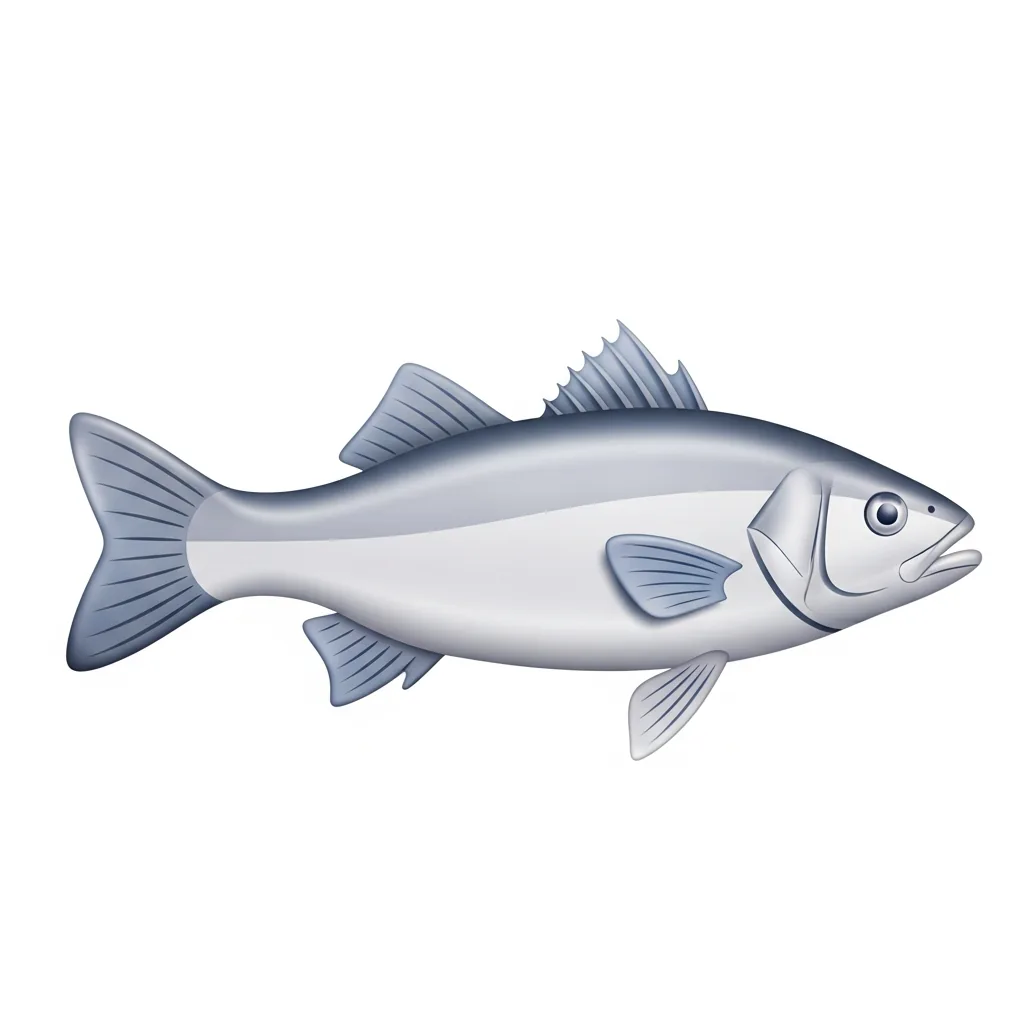
- Elongated and streamlined body, elegant and aerodynamic.
- Colouration
- Silvery-gray with greenish hues on the back and white on the belly.
- Sexual dimorphism
- Absent/not obvious
- Growth
- Fast in early life stages, slower in adults.
Taxonomy
- Family
- Moronidae
- Order
- Perciformes
- Class
- Actinopterygii
Related species
Habitat & distribution
- Environment
- Coast, Open sea, Estuaries
- Preferred bottom
- Sand, Rock, Posidonia
- Geographic distribution
- Found along the eastern Atlantic Ocean coasts, from North Africa to Norway, and in the Mediterranean Sea.
- Micro-habitat
- Hides among rocks, submerged trees, and river mouths.
Easily adapts to various coastal environments.
Presence by sea area
Diet
- Primary prey
- small fish, crustaceans, squid
- Secondary prey
- shrimp, mollusks, octopuses
- Occasional prey
- annelids, small cephalopods
- Feeding behaviour
- Actively hunts at dawn and dusk, employing quick movements and stealthy ambushes.
- Natural predators
- large sharks, tuna, humans
A varied diet allows it to exploit different seasonal food sources.
Behaviour
- Activity
- diurnal
- Social behaviour
- solitary
- Aggressiveness
- medium
- Migration
- Non-migratory but with seasonal movements to warmer or deeper waters.
- Seasonal behaviour
- In summer, moves closer to shore to feed. In colder months, moves to deeper waters.
- Juveniles
- Juveniles prefer sheltered waters such as estuaries and lagoons.
- Adults
- Adults can be found in open seas and coastal reefs.
Reproduction
- Spawning season
- February, March, April
- Spawning depth
- between 66 and 197 feet
- Eggs
- Pelagic eggs, about 0.04 inches in diameter, buoyant.
- Larval stage
- Larvae are pelagic and drift with ocean currents until they reach a more developed stage.
- Sexual maturity
- 3-4 years
When to catch European sea bass
Activity calendar
Activity by season
Best times
This species shows peak fishing activity in winter, when the productivity index (FPI) reaches its highest values.
Fishing activity decreases in spring and summer, when conditions are less favourable.
Ideal conditions
Atmospheric pressure
Very active, hunts on surface and near structures.
Regular activity, follows small fish schools.
Moves deeper, less aggressive.
Reduced activity 24-48h after rapid rise. Fewer bites.
Good activity with stable pressure between 1005-1020 hPa. Hunts regularly.
Very active before storms. Feeds frantically with falling pressure.
Water temperature
Where to catch it
Best spots
Bottom preference
Spot type
Fishing techniques
Recommended
Other applicable
Recommended baits
Baits by pressure
How to really catch it
European seabass is an elegant predator, with a streamlined body and a large mouth, able to appear suddenly among foam, current, and shadow. When it decides to hunt close to shore, every estuary, rocky point, or sandy beach can turn into a hotspot worth the wait.
🐟 Good to know
European seabass eggs are pelagic and buoyant, and the larvae also drift with marine currents during their early life stages. This is an important biological detail, because it helps explain the species’ link with estuaries, lagoons, and coastal environments used by juveniles as more sheltered areas.
🌊 Where & when
It lives along coasts, estuaries, and offshore waters, over sand, rock, and seagrass, often hiding among reefs, submerged structures, and river mouths. In summer it moves closer to shore to feed, while in colder months it tends to shift deeper; it remains especially interesting from December to February, right in the period that precedes or overlaps spawning from February to April, over bottoms between 20 and 60 meters.
🎣 How to really catch it
To truly target it, spinning is the most direct match for its nature: a medium spinning rod, 10-15 lb braid, and a 20 lb fluorocarbon leader let you work effectively in harbors, estuaries, along rocky shores, and over sandy beaches. Focus on dawn and dusk windows, when seabass actively hunt small fish, crustaceans, and squid with quick ambushes; alternatively, live bait fishing or a sliding sinker rig with circle hooks, baited with sardines, squid, shrimp, or long marine worms, remains highly practical.
💡 The detail that makes the difference
The most defensible secret is simple: focus your casts where current meets cover. Seabass relies on stealthy ambushes and frequents river mouths, rocks, and submerged structures; for that reason, the edge between faster water and shadowed water, or between whitewater and clean bottom, is often the lane to fish with the most confidence and persistence.
Catch & handling tips
- Fight
- Energetic and vigorous, frequently leaps out of the water.
- Handling
- Handle carefully to avoid gill injuries and avoid touching the scales.
- Release
- Gently release into deeper waters to enhance survival.
Curiosities & culture
- Record catches
- The IGFA All-Tackle world record for the European seabass (Dicentrarchus labrax) is about 10.25 kg (22 lb 6 oz), caught by Phillipe Boulet in 1999 at Pirou, France. Specimens over 5-7 kg are already considered notable trophies, and the largest fish can exceed 80-90 cm in length.
- In the kitchen
- Highly valued in cooking, used in dishes like 'baked bass' and 'bass in crazy water'.
- Cultural notes
- Symbol of resilience and strength, often mentioned in literature for its intelligence and adaptability.
- Historical notes
- Traditional fishing for at least two millennia along Mediterranean coasts.