
Overview
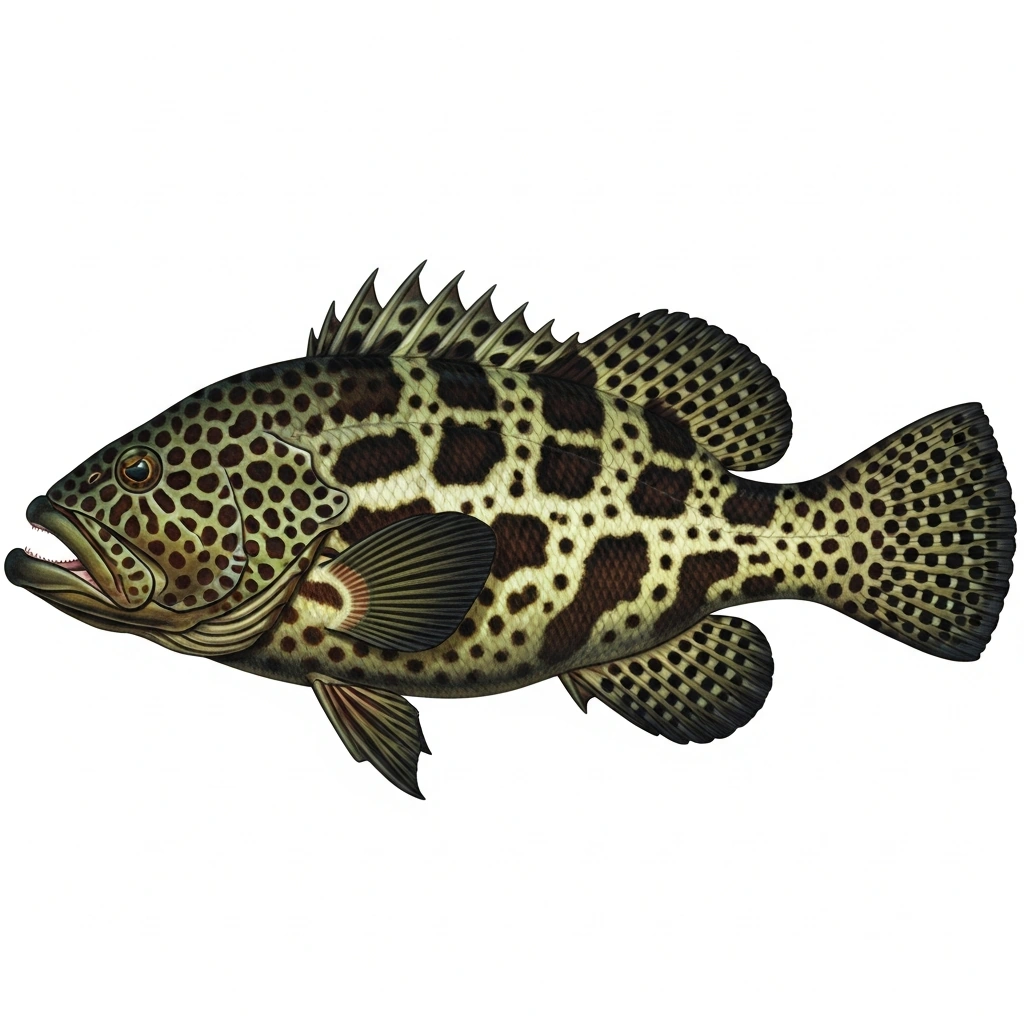
Large grouper of Brazilian and Caribbean reefs. Powerful ambush predator that hides in rocky structures.
Identification
- Body
- Robust and elongated body, with a large head and strong jaw.
- Colouration
- Generally dark with irregular black and green spots, darker on the back.
- Sexual dimorphism
- Males are generally larger with a hump on the nape.
- Growth
- Moderate, reaches maturity in a few years.
Taxonomy
- Family
- Serranidae
- Order
- Perciformes
- Class
- Actinopterygii
Related species
Habitat & distribution
- Environment
- Reefs, Coast, Open sea
- Preferred bottom
- Reef, Rock, Sand
- Geographic distribution
- Found along the coasts of the Americas, from Brazil to the Gulf of Mexico and in the Caribbean area.
- Micro-habitat
- Hides among rocky structures and coral of the reef, prefers deep crevices.
Adapts to various types of substrate, as long as there are adequate crevices and hiding places.
Presence by sea area
Diet
- Primary prey
- small fish, squid, octopus
- Secondary prey
- shrimp, crabs, marine arachnids
- Occasional prey
- other cephalopods, jellyfish
- Feeding behaviour
- Ambush predator, using its speed to catch unsuspecting prey that comes too close.
- Natural predators
- sharks, large barracuda, humans
Primarily preys on benthic organisms and fish that live near the reefs.
Behaviour
- Activity
- diurnal
- Social behaviour
- solitary
- Aggressiveness
- medium
- Migration
- Resident, with limited movements between different parts of the reef.
- Seasonal behaviour
- Remain closer to the shore in warm months and move deeper when temperatures drop.
- Juveniles
- Juveniles tend to live in shallower, protected waters.
- Adults
- Adults occupy defined territories and are dominant predators in their habitat.
Reproduction
- Spawning season
- April, May, June
- Spawning depth
- between 20 and 60 meters
- Eggs
- Pelagic eggs, small in size.
- Larval stage
- Larvae are planktonic and develop in open waters before settling to the bottom.
- Sexual maturity
- varies between 3 and 5 years.
When to catch Black grouper
Activity calendar
Activity by season
Best times
This species shows peak fishing activity in spring, summer and autumn, when the productivity index (FPI) reaches its highest values.
Fishing activity decreases in winter, when conditions are less favourable.
Ideal conditions
Atmospheric pressure
Comes out of lairs to hunt aggressively.
Stays near structure.
Hidden in lairs, hard to tempt.
Water temperature
Where to catch it
Best spots
Bottom preference
Spot type
Fishing techniques
Recommended
Other applicable
Recommended baits
Baits by pressure
How to really catch it
The black grouper is an imposing serranid, built with broad shoulders, large eyes, and slow movements that conceal sudden, very real power. It rules the reef like a silent owner: if you want to catch it for real, you must fish inside its maze, not merely above it.
🐟 Good to know
An important biological trait of the black grouper is its planktonic larval stage: after spawning, the larvae develop in open water before settling on the bottom. It is a crucial transition, linking the species’ early pelagic life to its later territorial existence among rocks, corals, and deep reef crevices.
🌊 Where & when
It is found along the coasts of the Americas, from Brazil to the Gulf of Mexico and throughout the Caribbean, between 5 and 150 meters, over reefs, rock, and sandy areas close to structure. Adults hold deep crevices and drop-offs; in warm months they stay closer to shore, while in cooler periods they move deeper. It is more fishable from March to November, with spawning from April to June, generally between 20 and 60 meters.
🎣 How to really catch it
To truly target it, the most concrete method is bottom fishing with live or natural bait dropped precisely on deep reefs, rocky structure, and ledges with current. A live baitfish, squid, or octopus presented close to a lair works exactly where this ambush predator waits. A heavy jigging rod, 50 lb braid, 80 lb fluorocarbon leader, strong J-hooks, and a heavy ball sinker are there to get down cleanly and stop its first run straight into the rocks.
💡 The detail that makes the difference
The practical edge is to keep the bait tight to the structure, without giving it too much room. Black grouper are solitary, hold defined territories, and strike from close range: if the bait travels too high above the reef, you may mark the fish on the sounder but never enter its true ambush window. Once it eats, the first response must be firm, because it immediately uses its weight to dive back into cover.
Catch & handling tips
- Fight
- Fights vigorously, using its weight to seek refuge in the rocks.
- Handling
- Avoid handling with bare hands, watch out for spines.
- Release
- Gently reintroduce into the water, supporting the body and allowing for proper ventilation.
Curiosities & culture
- Record catches
- Maximum documented size: up to about 150 cm and 100 kg (source: FishBase). IGFA All-Tackle record: 56.24 kg (124 lb), caught by Tim Oestreich II.
- In the kitchen
- Highly valued in cooking, often used in dishes like fish soup and grilled.
- Cultural notes
- Considered important in sport-fishing tales for its strength and size.
- Historical notes
- Traditionally caught by coastal communities in the Caribbean using artisanal techniques.