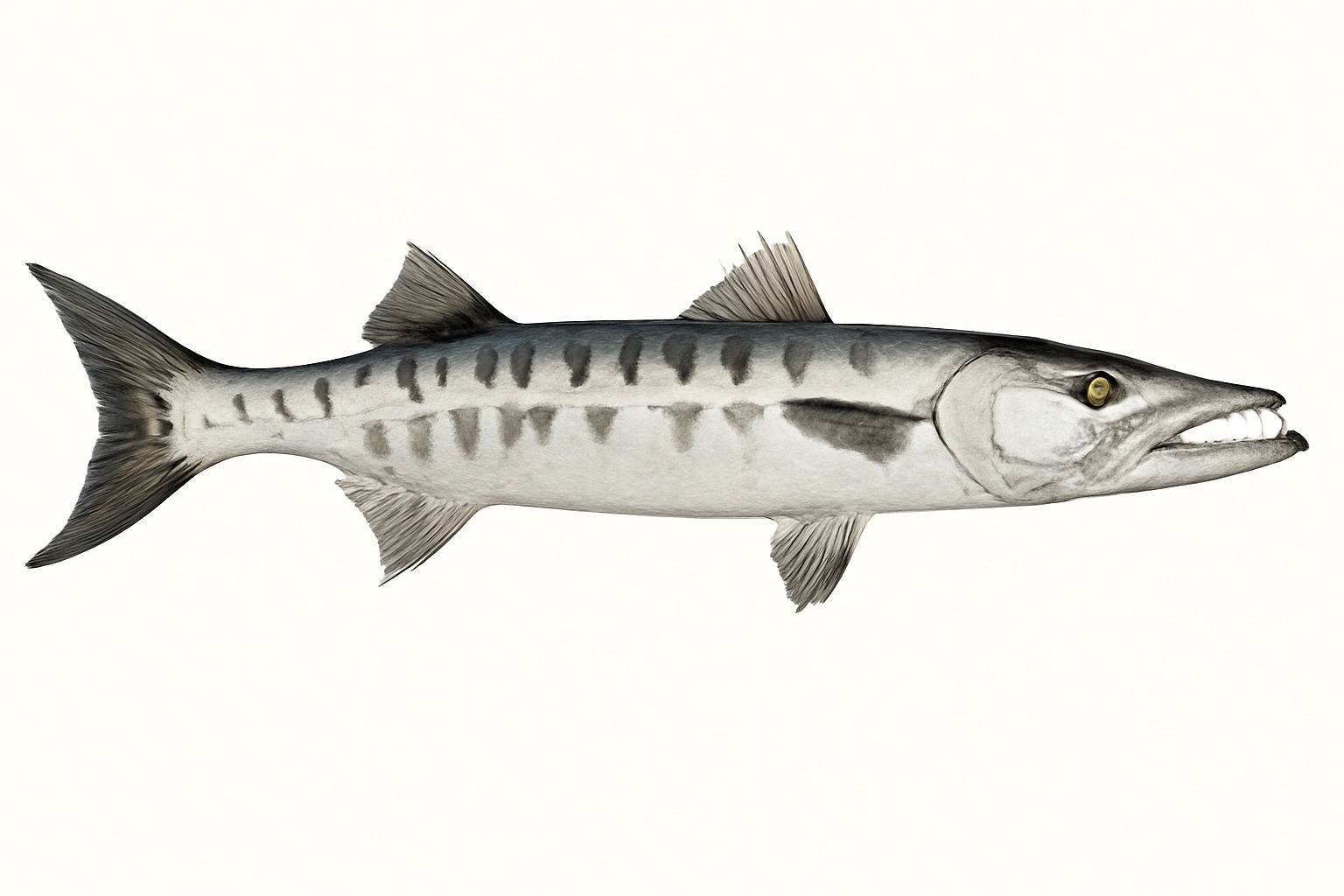

Overview
Tropical super predator with streamlined body and razor-sharp teeth. Hunts with lightning acceleration up to 50 km/h.
Identification
- Body
- Streamlined and elongated body with powerful musculature.
- Colouration
- Silver coloration with greenish or brownish hues on the sides.
- Sexual dimorphism
- Absent/not very evident
- Growth
- Fast; reaches maturity in just a few years.
Taxonomy
- Family
- Sphyraenidae
- Order
- Perciformes
- Class
- Actinopterygii
Related species
Habitat & distribution
- Environment
- Coast, Reefs, Open sea
- Preferred bottom
- Reef, Sand, Seagrass
- Geographic distribution
- Widely distributed in tropical and subtropical waters of the Atlantic, Pacific, and Indian Oceans.
- Micro-habitat
- Prefers areas along coral reefs and seagrass beds for hiding and hunting.
Often found near coral reefs, which provide plenty of prey.
Presence by sea area
Diet
- Primary prey
- pelagic fish, squid, crustaceans
- Secondary prey
- cephalopods, bottom fish, small sharks
- Occasional prey
- jellyfish, juvenile turtles
- Feeding behaviour
- Primarily hunts by sight, using quick bursts of speed and ambush tactics to catch its prey.
- Natural predators
- sharks, marlin, large tunas
Prefers to hunt during the day taking advantage of good visibility.
Behaviour
- Activity
- diurnal
- Social behaviour
- solitary
- Aggressiveness
- medium
- Migration
- Often migrates seasonally between reefs and open waters.
- Seasonal behaviour
- May approach the coast during certain times of the year for spawning.
- Juveniles
- Juveniles tend to form larger groups than adults.
- Adults
- Prefers a solitary lifestyle and personal territories.
Reproduction
- Spawning season
- May, June, July
- Spawning depth
- between 20 and 60 meters
- Eggs
- Pelagic eggs, small in size, dispersed in the water.
- Larval stage
- Pelagic larvae, tend to be carried by surface currents.
- Sexual maturity
- 3-4 years
When to catch Great barracuda
Activity calendar
Activity by season
Best times
This species shows peak fishing activity in spring, summer and autumn, when the productivity index (FPI) reaches its highest values.
Fishing activity decreases in winter, when conditions are less favourable.
Ideal conditions
Atmospheric pressure
Very aggressive, attacks on surface.
Hunts regularly.
Less aggressive, stays near reefs.
Less aggressive.
Hunts regularly on reefs.
Very aggressive, explosive attacks.
Water temperature
Where to catch it
Best spots
Bottom preference
Spot type
Fishing techniques
Recommended
Other applicable
Recommended baits
Baits by pressure
How to really catch it
The great barracuda is a predator drawn in pure lines, bright silver and exposed teeth, able to hang almost motionless and then shatter the calm with a lightning strike. If you want to target it seriously, you need to think like it does: sight, ambush, and sharp edges between cover and open water.
🐟 Good to know
One important biological trait is that it releases small pelagic eggs dispersed in the water, and its larvae are pelagic as well, carried by surface currents. This is a reproductive strategy common to many tropical marine fishes and helps spread the species across very wide areas.
🌊 Where & when
You’ll find it from the coast to reefs and open sea, from shallow water down to much greater depths, but the key zones are coral reefs, rocky edges, sand, and seagrass beds where it can hide and hunt by sight. It becomes especially interesting from March to November; from May to July it may move closer to shore for spawning, often between 20 and 60 meters.
🎣 How to really catch it
The most practical approach is spinning with fish-shaped artificials worked along the edges of reefs, rocky structures, and coastal lagoons, where it alternates waiting and sudden acceleration. Use a powerful spinning rod, 30-50 lb mono or braid, strong hooks, and above all a tooth-proof steel leader: that is the detail that turns a strike into a landed fish. Trolling, jigging, and even fly fishing remain valid options, as do baitfish, squid, and jigs.
💡 The detail that makes the difference
The most reliable tip is to run the lure close to a readable edge: the lip of a reef, a patch of seagrass, the break between pale sand and shadow. Great barracuda hunts mainly by sight and ambush, so a clean path through a natural hunting lane often matters more than a complicated retrieve.
Catch & handling tips
- Fight
- Fights vigorously with fast and sudden bursts.
- Handling
- Use gloves and exercise caution due to sharp teeth.
- Release
- Release quickly back into the water to minimize stress.
Curiosities & culture
- Record catches
- Maximum documented size: up to about 200 cm and 50 kg (source: FishBase). IGFA All-Tackle record: about 39.6 kg (87 lb), Christmas Island.
- In the kitchen
- Typically consumed grilled or baked, sometimes smoked.
- Cultural notes
- Often featured in tales of great anglers due to its aggressiveness.
- Historical notes
- Historically feared by divers for its sharp teeth and reputation as a predator.