
Overview
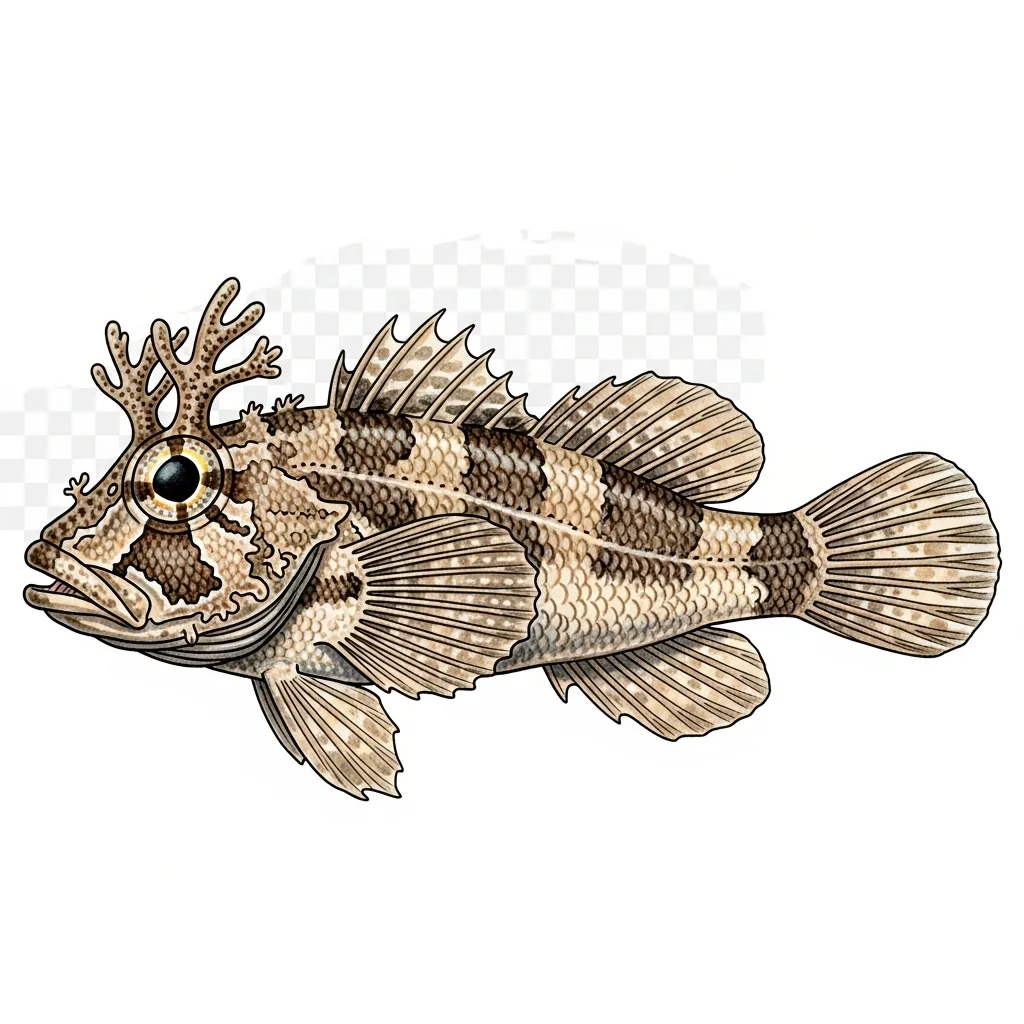
Small reef fish, very territorial and curious.
Identification
- Body
- The body is elongated and laterally compressed with a large head.
- Colouration
- Brownish coloration with irregular dark spots and a lighter lateral line.
- Sexual dimorphism
- Not very apparent
- Growth
- slow
Taxonomy
- Family
- Blenniidae
- Order
- Perciformes
- Class
- Actinopterygii
Related species
Habitat & distribution
- Environment
- Coast, Reefs
- Preferred bottom
- Rock, Reef, Seagrass
- Geographic distribution
- Common along the coasts of the Mediterranean Sea and the eastern Atlantic up to the British Isles.
- Micro-habitat
- Hides in small rocky crevices or under seaweeds.
Prefers areas with jagged rocks and abundant underwater vegetation.
Presence by sea area
Diet
- Primary prey
- algae, small invertebrates, mollusks
- Secondary prey
- crustaceans, polychaetes, zooplankton
- Occasional prey
- small fish, jellyfish
- Feeding behaviour
- Feeds by scraping algae off rocks and searching for small invertebrates hidden among them.
- Natural predators
- larger rocky fish, sea birds, octopuses
Adapted to eat a varied diet thanks to its ability to scrape and bite.
Behaviour
- Activity
- diurnal
- Social behaviour
- solitary
- Aggressiveness
- medium
- Migration
- resident
- Seasonal behaviour
- During the breeding season, it becomes more territorial and active.
- Juveniles
- Young ones tend to hide more frequently and form small groups.
- Adults
- Adults occupy defined territories that they defend vigorously.
Reproduction
- Spawning season
- May, June
- Spawning depth
- between 0 and 20 meters
- Eggs
- Adhesive eggs laid in rocky crevices, benthic.
- Larval stage
- Larvae are planktonic and are carried by currents.
- Sexual maturity
- varies between 2 and 3 years
When to catch Tompot blenny
Activity calendar
Activity by season
Best times
This species shows peak fishing activity in spring, summer and autumn, when the productivity index (FPI) reaches its highest values.
Fishing activity decreases in winter, when conditions are less favourable.
Ideal conditions
Atmospheric pressure
Very active and curious.
Regular activity.
Stays hidden.
Water temperature
Where to catch it
Best spots
Bottom preference
Spot type
Fishing techniques
Recommended
Other applicable
Recommended baits
Baits by pressure
How to really catch it
The blenny is a small rock-dwelling fish that lives tight to crevices, weed and shallow coastal light, always ready to vanish into a crack at the slightest disturbance. It is not impressive in size, but when you target it in the right place it shows a bold, territorial nature that makes the capture more technical than it looks.
🐟 Good to know
A notable biological feature of the blenny is its adhesive eggs laid inside rocky crevices: the eggs stay attached to the substrate, while the larvae, once hatched, enter a planktonic phase and are carried by currents. It is a clear transition between a strictly benthic life and an initial dispersal in open water.
🌊 Where & when
You find it along coasts, rocky shores, breakwaters and reefs with rocky bottom or seagrass, from very shallow water down to 30 meters, often hidden under seaweed or in small holes. It is a diurnal, resident species, more catchable from March to November; between May and June, during the breeding period from 0 to 20 meters, it also becomes more territorial and active.
🎣 How to really catch it
The most practical way to fish for it is with a light spinning rod or a simple shore line, working very short around rocks and weed with small sharp hooks, little lead, 4-6 lb braid and a 6-10 lb fluorocarbon leader. Small pieces of shrimp and marine worms are very sensible baits: they should be lowered precisely beside crevices and left almost in place, because the blenny feeds by scraping and probing rather than chasing far.
💡 The detail that makes the difference
The tip that really makes the difference is not to pull the bait away from the shelter: if you let it pass just in front of a crack or over an algae-covered stone, in a slow and controlled way, the presentation looks natural for a fish that feeds on rocks and hidden small invertebrates. Once hooked, keep it clear of the first hole immediately, because it tends to dive back into the rocks.
Catch & handling tips
- Fight
- Resilient and stubborn, tends to take refuge among rocks.
- Handling
- Handle carefully to avoid damaging the fins and the thin skin.
- Release
- Release gently near the capture site to minimize stress.
Curiosities & culture
- Record catches
- Maximum documented size: up to about 30 cm in length (source: FishBase); maximum weight is not officially reported. There is no IGFA All-Tackle record for this species.
- In the kitchen
- Not commonly used for food due to its small size, but sometimes featured in regional soup dishes.
- Cultural notes
- In Italian folklore, it symbolizes tenacity and resilience due to its territorial behavior.
- Historical notes
- Present in paintings from ancient Mediterranean civilizations, appreciated for its vibrant personality.