
Overview
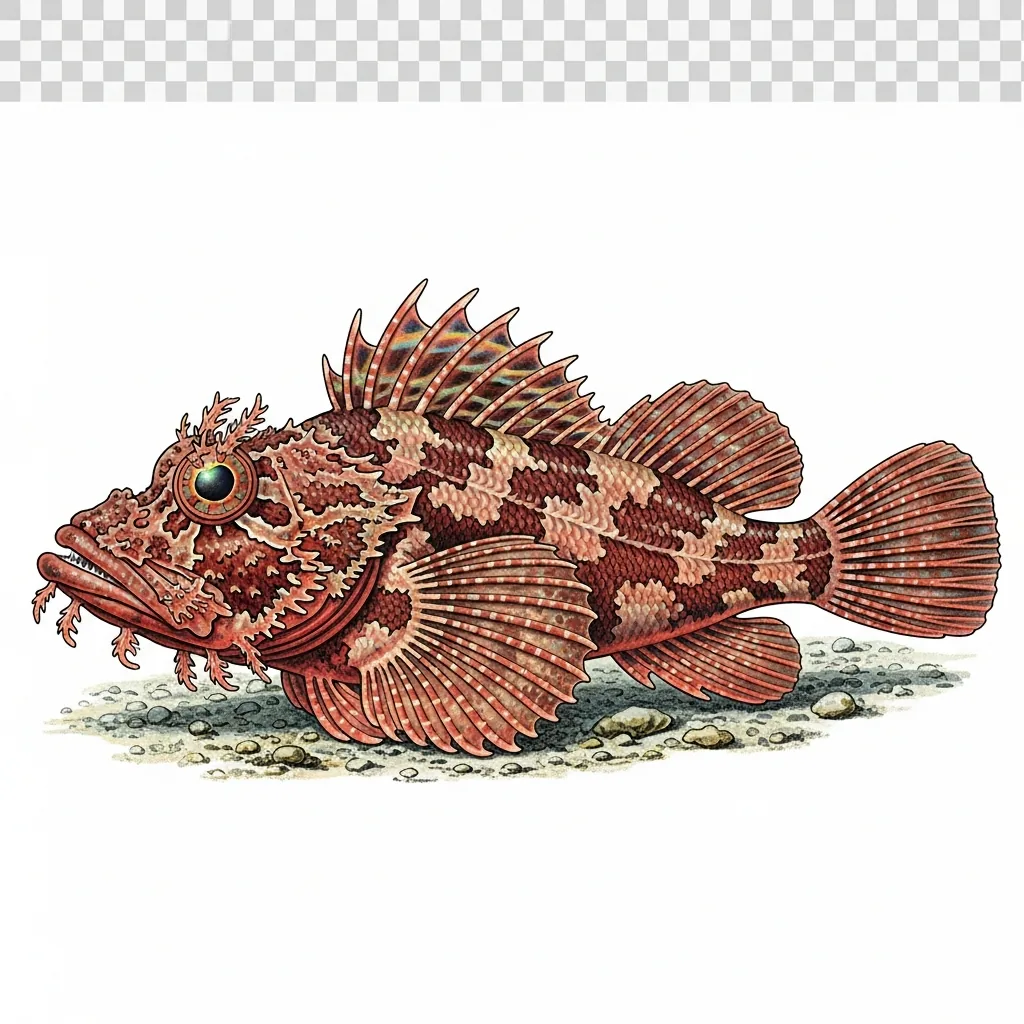
Camouflaged bottom predator, still and lethal, lives among rocks and crevices.
Identification
- Body
- Robust, laterally compressed body with a large spiny head.
- Colouration
- The body is a deep red color with dark spots and white patches for camouflage.
- Sexual dimorphism
- Absent/not obvious
- Growth
- Slow, being a solitary sedentary predator
Taxonomy
- Family
- Scorpaenidae
- Order
- Scorpaeniformes
- Class
- Actinopterygii
Related species
Habitat & distribution
- Environment
- Coast, Reefs, Deep sea
- Preferred bottom
- Rock, Reef
- Geographic distribution
- Found in the Mediterranean Sea and Eastern Atlantic Ocean, extending to the coasts of West Africa.
- Micro-habitat
- Hides among rocks and corals, perfectly camouflaged while waiting for prey.
Adapts well to degraded seabeds thanks to its resilience and camouflage ability.
Presence by sea area
Diet
- Primary prey
- small fish, croakers, shrimps
- Secondary prey
- mollusks, octopuses, squids
- Occasional prey
- annelids, jellyfish
- Feeding behaviour
- Ambush predator, remains still until prey comes close enough to capture with a quick strike.
- Natural predators
- moray eels, congers, large dentex
Besides hunting, it can scavenge both live and dead food thanks to its opportunistic nature.
Behaviour
- Activity
- nocturnal
- Social behaviour
- solitary
- Aggressiveness
- medium
- Migration
- non-migratory
- Seasonal behaviour
- More active in warm seasons due to the higher abundance of prey.
- Juveniles
- Juveniles are more vulnerable and tend to hide among small rocks.
- Adults
- Adults are territorial and solitary, rarely moving far from their refuge.
Reproduction
- Spawning season
- May, June
- Spawning depth
- between 20 and 60 meters
- Eggs
- Small spherical pelagic eggs.
- Larval stage
- Larvae are pelagic and swim freely before settling on the seabed.
- Sexual maturity
- 3-4 years
When to catch Red scorpionfish
Activity calendar
Activity by season
Best times
This species shows peak fishing activity in spring, summer and autumn, when the productivity index (FPI) reaches its highest values.
Ideal conditions
Atmospheric pressure
More active and less wary.
Regular activity.
Stays motionless in crevices.
Water temperature
Where to catch it
Best spots
Bottom preference
Spot type
Fishing techniques
Recommended
Other applicable
Recommended baits
Baits by pressure
How to really catch it
You do not hunt the red scorpionfish by chasing it; you draw it out from its hiding places, where rock turns to shadow and the bottom seems still. It is a solitary, camouflaged ambush predator, and that is why the finest capture comes when you read the seabed before you ever feel the take.
🐟 Good to know
One notable biological trait of the red scorpionfish is the contrast between its benthic adult life and its dispersive early stage: it releases pelagic eggs, and the larvae also swim freely in the water column before settling to the bottom. As an adult, it becomes resident and closely tied to a specific refuge among rocks and reefs.
🌊 Where & when
It lives on rocky bottoms and reefs from 20 to 200 meters, along coasts, submerged cliffs, wrecks, and coral environments in the Mediterranean and the eastern Atlantic as far as West Africa. It hides among rocks and corals, perfectly camouflaged. It is more active in the warm seasons and is especially worthwhile from March to November, with spawning between May and June from 20 to 60 meters.
🎣 How to really catch it
The most practical way to catch it is light bottom fishing with a bolentino rig kept firmly near the seabed, working precisely over rocky ground, the edges of submerged cliffs, and wrecks. A light bolentino rod, 0.30-0.40 main line, 0.25 fluorocarbon leader, size 1/0-2/0 hooks, and a 100-150 g sinker let you present sardine, squid, shrimp, or fish strips exactly where it waits motionless. When hooked, it gives quick bursts, then tends to tire.
💡 The detail that makes the difference
The most defensible secret is to stay on the spot rather than roam too much: the adult is territorial, solitary, and rarely moves far from its refuge. If you find a good lair among rock and crevice and place the bait exactly there, precise boat position matters more than constantly searching for new ground. Always handle it carefully because the dorsal spines are venomous.
Catch & handling tips
- Fight
- Puts up quick resistance but tires quickly.
- Handling
- Be careful not to touch the venomous dorsal spines.
- Release
- Handle gently using a cloth to avoid spines and release quickly.
Curiosities & culture
- Record catches
- Maximum documented size: up to about 50 cm and 3 kg (source: FishBase). There is no official IGFA All-Tackle record for this species.
- In the kitchen
- Highly valued in stews and fish soups like cacciucco.
- Cultural notes
- Symbol of cunning and deception in various Mediterranean cultures.
- Historical notes
- Traditionally also caught with traps and pots in ports and shallow waters.