
Overview
Smaller version of the red scorpionfish, very common on shallow reefs.
Identification
- Body
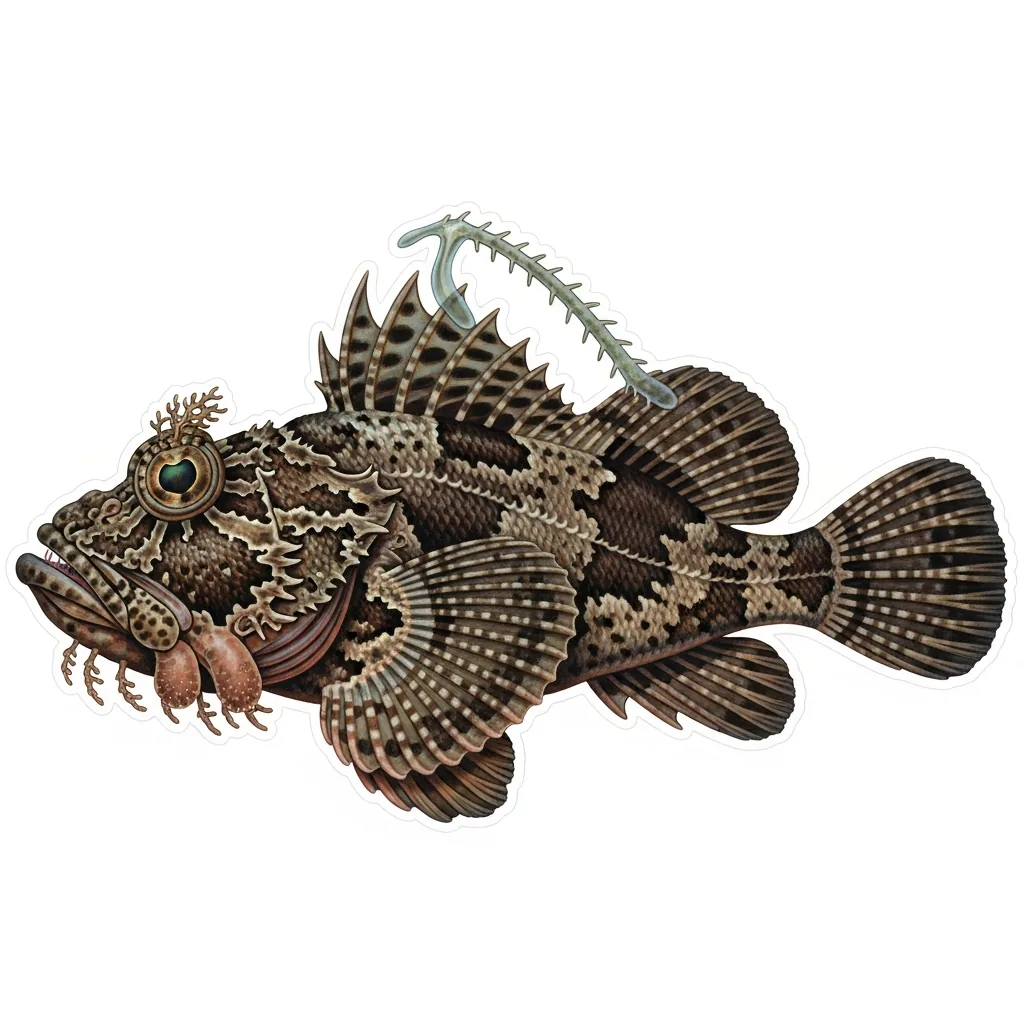
- Robust, flat body with a large, spiny head.
- Colouration
- Dark brown with irregular spots and bands on the body.
- Sexual dimorphism
- Absent/not prominent
- Growth
- Slow, with relatively slow growth over its lifespan.
Taxonomy
- Family
- Scorpaenidae
- Order
- Scorpaeniformes
- Class
- Actinopterygii
Related species
Habitat & distribution
- Environment
- Coast, Reefs
- Preferred bottom
- Rock, Reef, Gravel
- Geographic distribution
- Found in the Mediterranean Sea and the eastern Atlantic Ocean, from the Bay of Biscay to the Moroccan coast.
- Micro-habitat
- Lives in caves, crevices, and shaded areas of cliffs and coral reefs.
Often found in favorite spots, hiding among rocks waiting for prey.
Presence by sea area
Diet
- Primary prey
- small fish, shrimp, crustaceans
- Secondary prey
- crabs, mollusks, cephalopods
- Occasional prey
- worms, small rays, benthic invertebrates
- Feeding behaviour
- Carnivorous, hunting at dusk and night, often sits still waiting for prey.
- Natural predators
- moray eels, conger, some large predatory fish
Sit-and-wait predator, uses camouflage effectively.
Behaviour
- Activity
- nocturnal
- Social behaviour
- solitary
- Aggressiveness
- medium
- Migration
- Sedentary
- Seasonal behaviour
- Active year-round but favors calmer conditions in summer months.
- Juveniles
- Juveniles tend to hide among rocks or in seaweed for protection.
- Adults
- Adults are territorial and blend in among the rocks.
Reproduction
- Spawning season
- May, June, July
- Spawning depth
- between 20 and 60 meters
- Eggs
- Small, translucent pelagic eggs.
- Larval stage
- Planktonic larvae drift with currents until they find a suitable habitat.
- Sexual maturity
- 2-3 years
When to catch Black scorpionfish
Activity calendar
Activity by season
Best times
This species shows peak fishing activity in spring, summer and autumn, when the productivity index (FPI) reaches its highest values.
Ideal conditions
Atmospheric pressure
Very active and less wary.
Regular activity.
Stays motionless among rocks.
Water temperature
Where to catch it
Best spots
Bottom preference
Spot type
Fishing techniques
Recommended
Other applicable
Recommended baits
Baits by pressure
How to really catch it
The black scorpionfish is a rock-dwelling predator that seems to be part of the bottom itself: still, dark, spiny, almost invisible until it decides to strike. Catching it well means reading shadows, crevices, and small bottom changes, exactly where the sea seems to hold its breath.
🐟 Good to know
A remarkable biological trait of Scorpaena porcus is its reproductive strategy with pelagic eggs and planktonic larvae: adults are sedentary and tied to their shelter, but the earliest life stages are dispersed by currents before settling onto suitable habitat. It is a sharp contrast between territorial adult life and a drifting beginning.
🌊 Where & when
It lives along coasts and reefs, over rock, gravel, and mixed bottoms, from very shallow water down to about 50 meters, with a clear preference for caves, crevices, and shaded areas. It is active year-round, but during the calmer months from summer into autumn it becomes more regular; at dusk and at night it leaves its stillness and becomes easier to tempt.
🎣 How to really catch it
The most practical method is light boat bolognino-style bottom fishing, lowered precisely along rocky cliffs, artificial reefs, piers, or edges of mixed ground. A short boat rod, 0.25 mm monofilament, 0.30 mm fluorocarbon leader, small eyed hooks, and an olive sinker are enough: shrimp, worms, or fish strips work well if kept close to the bottom, almost inside the shelter.
💡 The detail that makes the difference
The detail that changes the session is not looking for it in open ground: the black scorpionfish is an ambush hunter and territorial as an adult, so it pays to insist on hard shadows, the foot of rocks, or the mouth of crevices. When it feeds, it often does so because the bait passes very close, inside its narrow space.
Catch & handling tips
- Fight
- Generally not a strong fighter, but spines make handling tricky.
- Handling
- Use gloves to avoid venomous spines.
- Release
- Handle carefully and release quickly to minimize stress.
Curiosities & culture
- Record catches
- Maximum documented size: up to about 40 cm and 0.9 kg (source: FishBase). There is no official IGFA All-Tackle record for this species.
- In the kitchen
- Its meat is prized and used in fish soups and broths.
- Cultural notes
- Linked to danger legends among fishermen due to its venomous spines.
- Historical notes
- Valued by sailors for surviving in harsh environments and as an indicator of good fishing areas.