
Overview
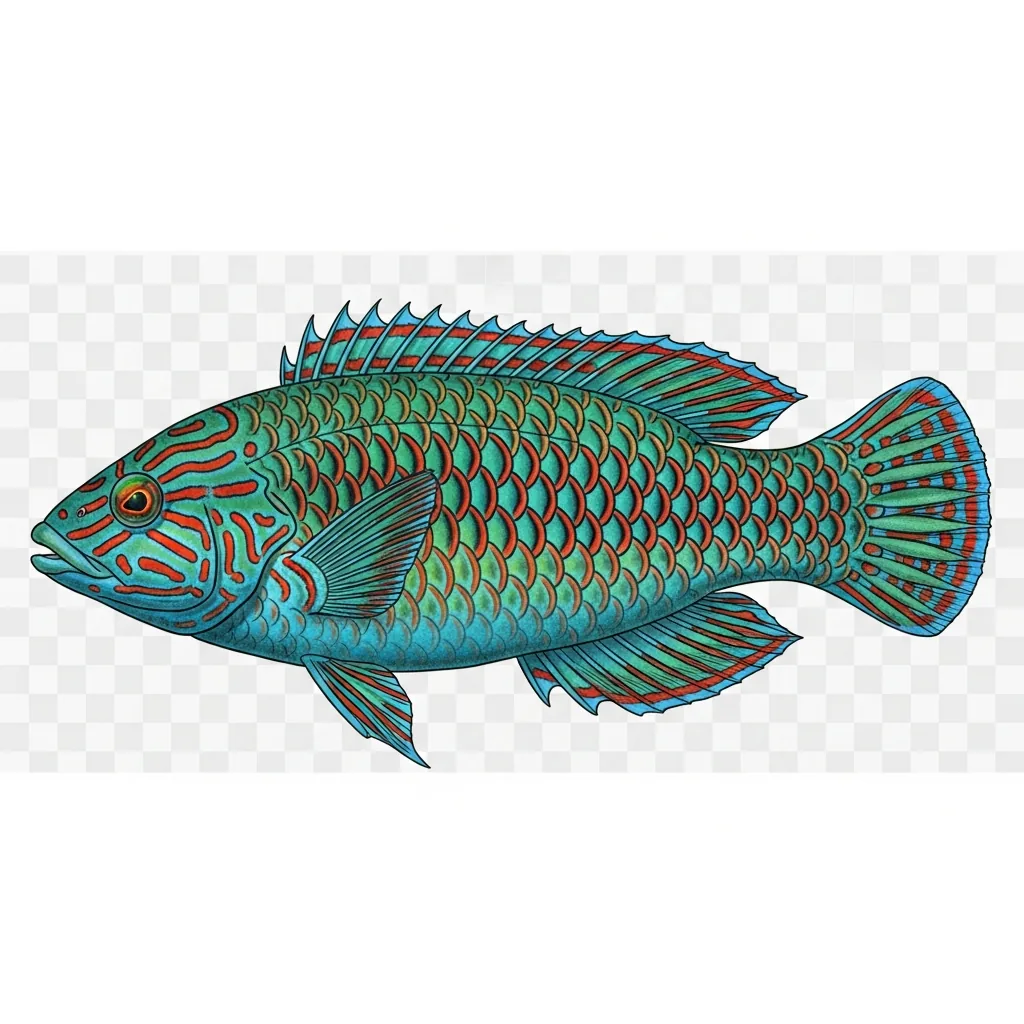
Very colorful and fast fish, common on reefs and Posidonia.
Identification
- Body
- Elongated, laterally compressed body.
- Colouration
- Bright coloring with green, blue, red, and yellow bands.
- Sexual dimorphism
- Not very noticeable
- Growth
- medium
Taxonomy
- Family
- Labridae
- Order
- Perciformes
- Class
- Actinopterygii
Related species
Habitat & distribution
- Environment
- Coast, Reefs
- Preferred bottom
- Reef, Seagrass
- Geographic distribution
- Found in the Mediterranean Sea and the eastern Atlantic Ocean, from the Portuguese coast to the Canary Islands.
- Micro-habitat
- Often found near rocks and seagrass, hiding in rock crevices.
Attached to habitats rich in natural hiding spots.
Presence by sea area
Diet
- Primary prey
- crustaceans, mollusks, echinoderms
- Secondary prey
- small fish, algae
- Occasional prey
- plankton, fish eggs
- Feeding behaviour
- Uses its speed to actively hunt prey among rocks and algae.
- Natural predators
- groupers, moray eels, large pelagic fish
Diet varies according to season and availability.
Behaviour
- Activity
- diurnal
- Social behaviour
- small_groups
- Aggressiveness
- medium
- Migration
- residential
- Seasonal behaviour
- More active in the summer months when the water is warmer.
- Juveniles
- Juveniles tend to hide among algae to protect themselves from predators.
- Adults
- Adults are more territorial and defend their space among the rocks.
Reproduction
- Spawning season
- May, June, July
- Spawning depth
- between 10 and 30 meters
- Eggs
- Small pelagic eggs.
- Larval stage
- Pelagic larvae develop in shallow waters.
- Sexual maturity
- 2-3 years
When to catch Ornate wrasse
Activity calendar
Activity by season
Best times
This species shows peak fishing activity in spring, summer and autumn, when the productivity index (FPI) reaches its highest values.
Ideal conditions
Atmospheric pressure
Very active and curious.
Regular activity.
Stays near bottom.
Water temperature
Where to catch it
Best spots
Bottom preference
Spot type
Fishing techniques
Recommended
Other applicable
Recommended baits
Baits by pressure
How to really catch it
The ornate wrasse is a small rocky-bottom wrasse that lights up the inshore zone with bright colors and quick movements, constantly patrolling crevices, seagrass tufts, and rocky slabs. It is not an impressive fish in size, but when it decides to feed it strikes sharply and fights with surprising nervous energy, making every capture more fun than it looks.
🐟 Good to know
Like many wrasses, the ornate wrasse lays pelagic eggs: after spawning, the eggs remain suspended in the water and the larvae develop in the surface layers. It is an important detail, because it describes a species closely tied to the coast as an adult but entrusted to currents in the earliest stages of life.
🌊 Where & when
Look for it along Mediterranean and eastern Atlantic coasts, from Portugal to the Canary Islands, especially over rocky shores, seagrass, and mixed bottoms from 1 to 50 meters. It is a diurnal, residential species and becomes livelier in warm water; from March to November it stays catchable, with summer especially favorable, while from May to July it spawns between 10 and 30 meters.
🎣 How to really catch it
The most practical way to catch it is light inshore bottom fishing or handlining worked short and close in, right beside rocks and holes. A light spinning rod, 0.20 nylon, 0.18 fluorocarbon leader, small size 10-12 hooks, and tiny split-shot style leads are enough: lower small crustaceans, shrimp, annelids, or small pieces of mollusk and keep the bait alive on the bottom, letting it brush algae and stones.
💡 The detail that makes the difference
The tip that really matters is not to move the bait too far away from structure. The ornate wrasse actively hunts crustaceans and mollusks among rocks and algae, so it responds best when the bait passes tight along a crevice or the edge of seagrass: if you lift it too high, you spend less time in its feeding zone.
Catch & handling tips
- Fight
- Fights vigorously with quick jerks and sudden changes in direction.
- Handling
- Handle with care to avoid damaging its vibrant scales.
- Release
- Release near rocky bottoms to increase survival chances.
Curiosities & culture
- Record catches
- Maximum documented size: up to about 25 cm in length (source: FishBase). There is no official IGFA All-Tackle record for this species.
- In the kitchen
- Occasionally used in fish soups in Mediterranean cuisine.
- Cultural notes
- A symbol of liveliness and beauty in Mediterranean folk tales.
- Historical notes
- Considered of little commercial interest, mainly appreciated by sport fishermen.