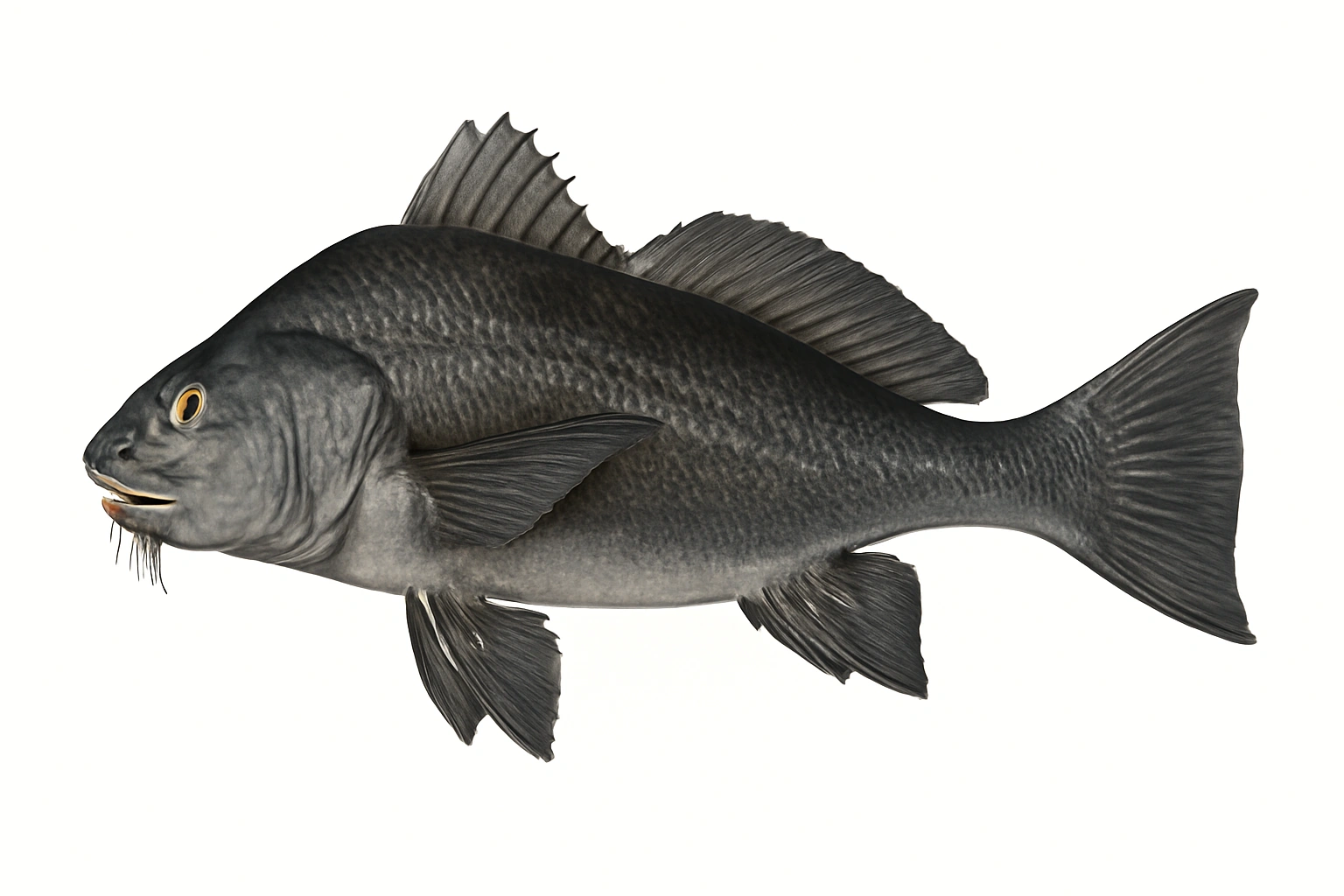

Overview
Large coastal fish of the western Atlantic. Produces a drumming sound and feeds on mollusks and crustaceans on the bottom.
Identification
- Body
- Robust, rounded body with a massive head
- Colouration
- Dark gray or black with vertical bands in juveniles that fade with age
- Sexual dimorphism
- Absent/not evident
- Growth
- Medium, grows rapidly in early years then slows down
Taxonomy
- Family
- Sciaenidae
- Order
- Perciformes
- Class
- Actinopterygii
Related species
Habitat & distribution
- Environment
- Coast, Estuaries, Brackish
- Preferred bottom
- Sand, Mud
- Geographic distribution
- Western Atlantic coasts from the Gulf of Mexico to the North Sea
- Micro-habitat
- Hides among oyster beds and in muddy bottoms
Prefers sandy and muddy bottoms rich in benthic organisms
Presence by sea area
Diet
- Primary prey
- mollusks, crustaceans, crabs
- Secondary prey
- shrimp, fish anus, polychaetes
- Occasional prey
- small fish, insect larvae
- Feeding behaviour
- Bottom hunts, using barbells to find prey beneath the sand
- Natural predators
- sharks, large coastal predators, humans
Ability to locate and capture prey beneath sand and mud
Behaviour
- Activity
- diurnal
- Social behaviour
- small_groups
- Aggressiveness
- low
- Migration
- Resident, with movements to estuaries for spawning
- Seasonal behaviour
- Moves closer to the coast and estuaries in spring for spawning
- Juveniles
- Lives in shallower waters, closer to the shore
- Adults
- Prefers deeper waters of the coastal area
Reproduction
- Spawning season
- March, April
- Spawning depth
- between 1 and 25 meters
- Eggs
- Pelagic egg, small, transparent
- Larval stage
- Pelagic, depends on currents for distribution
- Sexual maturity
- Between 4 and 6 years
When to catch Black drum
Activity calendar
Activity by season
Best times
This species shows peak fishing activity in spring, summer and autumn, when the productivity index (FPI) reaches its highest values.
Fishing activity decreases in winter, when conditions are less favourable.
Ideal conditions
Atmospheric pressure
Active, feeds on bottom.
Regular activity.
Less active, slows down.
Slows down activity.
Feeds regularly.
Very active on bottom.
Water temperature
Where to catch it
Best spots
Bottom preference
Spot type
Fishing techniques
Recommended
Other applicable
Recommended baits
Baits by pressure
How to really catch it
The black drum is a heavy-bodied bottom fish, built to root through sediment and find food where the water seems silent. When you look for it in the right place, among mud, sand, and oysters, the bite comes deep and weighty, with that stubborn pull that drives straight back to the bottom.
🐟 Good to know
Its name is no accident: the black drum can produce a drumming sound through muscular contraction. It is a real trait of the species and, together with its inferior mouth, fleshy lips, and chin barbels, it clearly reflects a life spent searching tirelessly along the bottom.
🌊 Where & when
It lives along coasts, estuaries, and brackish waters, over sand and mud bottoms from 1 to 50 meters, often hiding around oyster beds and soft ground. In spring it moves closer to the coast and estuaries to spawn, between March and April, becoming especially relevant from March to November; juveniles stay shallower and closer in, while adults favor somewhat deeper coastal water.
🎣 How to really catch it
For black drum, the most concrete approach is bottom fishing: a 7-9 foot heavy-action rod, 20-30 lb line, 30-50 lb leader, size 2-4 circle hooks, and a 30-60 g egg sinker to keep the bait pinned close to the bottom. Shrimp, clams, and crabs are the most natural baits; work estuaries, piers, sandy beaches, and muddy bottoms, leaving the offering where the fish truly feeds, right against the sediment.
💡 The detail that makes the difference
The most defensible tip is simple: focus on the edges of oyster beds and nearby muddy patches, not featureless open water. Black drum feed on the bottom, using their barbels to locate prey beneath sand and mud, so a bait set firmly, still, and naturally often outperforms a presentation that moves too much.
Catch & handling tips
- Fight
- Resists on the line, pulls hard toward the bottom
- Handling
- Handle with care to avoid gill damage
- Release
- Gently release into the water and ensure it's active before full release
Curiosities & culture
- Record catches
- Maximum documented size: up to about 170 cm and 66 kg (source: FishBase). IGFA All-Tackle record: 51.28 kg (113 lb 1 oz), caught at Cape Henlopen, Delaware Bay (USA), in 1975.
- In the kitchen
- Often consumed grilled or smoked; valued for its firm meat
- Cultural notes
- Present in the narratives of coastal communities as a symbol of spring fishing
- Historical notes
- Traditionally fished by coastal communities for its nutritional value