
Overview
Very common species on sandy and muddy bottoms, feeds by digging in sediment.
Identification
- Body
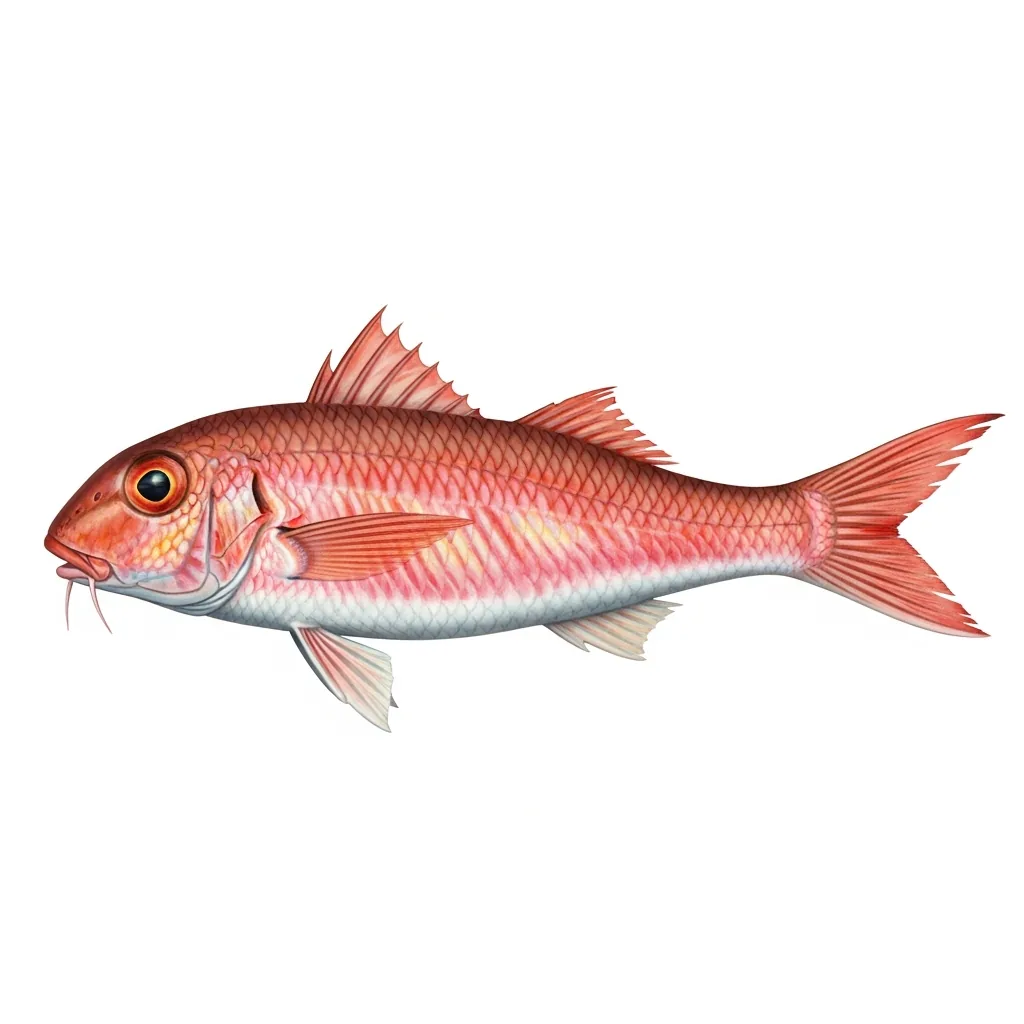
- The body is elongated and laterally compressed.
- Colouration
- It has a reddish coloring with yellow and silver longitudinal bands.
- Sexual dimorphism
- Absent/not very noticeable
- Growth
- Moderate with steady growth during early years
Taxonomy
- Family
- Mullidae
- Order
- Perciformes
- Class
- Actinopterygii
Related species
Habitat & distribution
- Environment
- Coast, Open sea, Reefs
- Preferred bottom
- Sand, Mud
- Geographic distribution
- Predominantly found in the Mediterranean Sea, Black Sea, and eastern Atlantic from European coasts to Senegal.
- Micro-habitat
- It hides in sandy and muddy bottoms, often near sea grasses, searching for food.
Often found near nutrient-rich coastal areas.
Presence by sea area
Diet
- Primary prey
- small crustaceans, marine worms, mollusks
- Secondary prey
- small fish, marine insect larvae, zooplankton
- Occasional prey
- algae, organic debris
- Feeding behaviour
- Feeds during the day by digging into the sediment to find food using its barbels.
- Natural predators
- octopuses, predatory fish like bass, groupers, seagulls
Feeds mainly by digging in the substrate for hidden prey.
Behaviour
- Activity
- diurnal
- Social behaviour
- small_groups
- Aggressiveness
- low
- Migration
- Sedentary, but may move slightly to find food.
- Seasonal behaviour
- Moves closer to shore in summer, prefers deeper waters in winter.
- Juveniles
- Young often form small groups near the coast.
- Adults
- Adults are solitary or in small groups, preferring sandy bottoms.
Reproduction
- Spawning season
- May, June, July
- Spawning depth
- between 20 and 60 meters
- Eggs
- The eggs are pelagic, small, and transparent, floating on the surface.
- Larval stage
- Larvae are planktonic and develop near the surface until reaching the juvenile stage.
- Sexual maturity
- Varies between 2 and 3 years
When to catch Red mullet
Activity calendar
Activity by season
Best times
This species shows peak fishing activity in spring, summer and autumn, when the productivity index (FPI) reaches its highest values.
Ideal conditions
Atmospheric pressure
Very active on bottom.
Regular activity.
Stays close to bottom.
Water temperature
Where to catch it
Best spots
Bottom preference
Spot type
Fishing techniques
Recommended
Other applicable
Recommended baits
Baits by pressure
How to really catch it
The red mullet is a graceful, discreet bottom fish, easier to find than to truly read. When the seabed looks still, it combs through it with its barbels and reveals its presence only to those who know where to look.
🐟 Good to know
Its barbels beneath the mouth are not decoration: they are sensory organs used to explore sand and mud while it feeds during the day. This biology explains why the species favors soft bottoms and responds well to natural baits presented close to the sediment.
🌊 Where & when
It lives from 10 to 150 meters over sandy and muddy bottoms, often near seagrass, along coasts, offshore grounds, and also near rocks and river mouths. In the Mediterranean, Black Sea, and eastern Atlantic, it is more approachable from spring to autumn; in summer it comes closer inshore, while in winter it tends to seek deeper water. Between May and July it spawns between 20 and 60 meters.
🎣 How to really catch it
To really catch it, a light handline approach is the most practical choice: light rod, 0.20 nylon, 0.15 fluorocarbon leader, small size 6-8 hooks, and small olive sinkers to keep the bait right on the bottom. Target sand or mud near rocks, seagrass beds, or estuaries and use shrimp, annelids, or mollusk pieces, keeping the presentation clean and natural. The bite can be subtle and, once hooked, it usually stays low more than it fights.
💡 The detail that makes the difference
The detail that makes the difference is not lifting the bait too far off bottom: red mullet feeds by digging into the sediment with its small inferior mouth and barbels. If your rig works tight to the seabed, over a readable patch of sand or mud, you are matching its feeding behavior exactly.
Catch & handling tips
- Fight
- Offers little resistance when hooked, primarily tries to hide at the bottom.
- Handling
- Handle with care to avoid damaging the delicate skin.
- Release
- Release quickly and carefully, keeping the fish moist.
Curiosities & culture
- Record catches
- Maximum documented size: up to about 38 cm in length (source: FishBase). There is no official IGFA All-Tackle record for this species.
- In the kitchen
- Frequently used in fish soups and fried, typical of Mediterranean cuisine.
- Cultural notes
- A culinary specialty in many Italian coastal regions.
- Historical notes
- Celebrated since ancient Roman times, appreciated for its delicate flavor.