
Overview
Very wary and powerful fish, loves mixed sand/rock bottoms and Posidonia meadows.
Identification
- Body
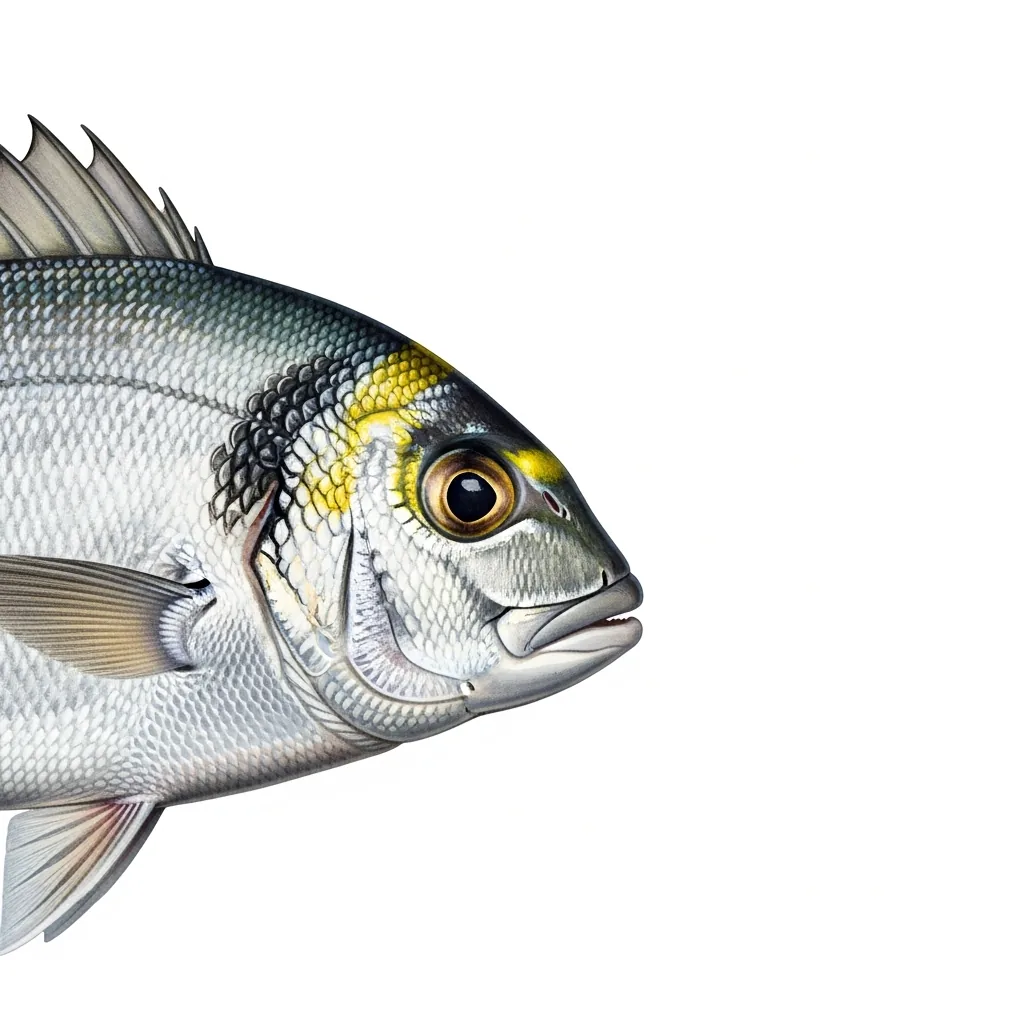
- Oval body laterally compressed with a rounded head.
- Colouration
- Silvery body with golden reflections, distinctive gold band between the eyes.
- Sexual dimorphism
- Males often larger with slightly different coloration during the breeding season.
- Growth
- medium, matures in a few years.
Taxonomy
- Family
- Sparidae
- Order
- Perciformes
- Class
- Actinopterygii
Related species
Habitat & distribution
- Environment
- Coast, Reefs, Seagrass
- Preferred bottom
- Sand, Rock, Posidonia
- Geographic distribution
- Found in the Mediterranean Sea and the eastern Atlantic Ocean, from the British Isles to Cape Verde.
- Micro-habitat
- Hides in sandy and rocky bottoms, often near seagrass beds.
Seeks refuge among seagrass beds, crucial for its life cycle.
Presence by sea area
Diet
- Primary prey
- mollusks, crustaceans, small fish
- Secondary prey
- algae, polychaetes, annelids
- Occasional prey
- marine insects, echinoderms
- Feeding behaviour
- Feeds primarily by scraping the seabed with its strong mouth, it is an omnivorous species.
- Natural predators
- groupers, dentex fish, sharks, humans
Broad omnivorous diet allows adaptation to different food availabilities.
Behaviour
- Activity
- diurnal
- Social behaviour
- small_groups
- Aggressiveness
- low
- Migration
- non-migratory
- Seasonal behaviour
- Moves closer to the coast in warmer months, especially in autumn for spawning.
- Juveniles
- Juveniles form small schools and are often found in shallow coastal waters.
- Adults
- Adults tend to live deeper and often alone or in small groups.
Reproduction
- Spawning season
- October, November
- Spawning depth
- between 20 and 60 meters
- Eggs
- Pelagic eggs; spherical, averaging about 1 mm in diameter.
- Larval stage
- Larvae are pelagic, develop pigmentation before settling.
- Sexual maturity
- 3-4 years
When to catch Gilthead sea bream
Activity calendar
Activity by season
Best times
This species shows peak fishing activity in spring, summer and autumn, when the productivity index (FPI) reaches its highest values.
Ideal conditions
Atmospheric pressure
Very active, feeds near shore.
Regular activity on mixed bottoms.
Stays deeper and more wary.
Reduced activity with rapidly rising pressure. Wait for stabilization.
Ideal conditions for fishing. Sea bream feeds regularly with stable pressure.
Increases feeding activity before storms. Excellent moment to fish for it.
Water temperature
Where to catch it
Best spots
Bottom preference
Spot type
Fishing techniques
Recommended
Other applicable
Recommended baits
Baits by pressure
How to really catch it
The gilthead seabream carries the silver flash of an elegant fish and the stubbornness of a true bottom feeder. When it moves over sand, rock and seagrass with that golden band between the eyes, understanding how to present the bait makes all the difference.
🐟 Good to know
An important biological trait of the gilthead seabream is its strong dentition: its robust canines and powerful mouth let it work the bottom and feed on mollusks and crustaceans by scraping and crushing hard prey. This specialization helps explain why it seeks mixed areas rich in benthic life.
🌊 Where & when
You find it along coasts, reefs, seagrass beds and mixed sandy or rocky bottoms, from the shoreline down to considerable depths. It becomes more approachable in the warmer months and from March to November, when it moves closer to shore; in autumn this shift overlaps with spawning, which takes place between October and November, from 20 to 60 meters.
🎣 How to really catch it
For gilthead seabream, bottom fishing is the most reliable path: picture a sliding sinker settling neatly on the edge between sand and rock, while a shrimp, mussel, annelid or strip of squid stays natural just above the bottom. A medium-heavy rod, 10-15 lb mono or braid, a 20-30 lb fluorocarbon leader and 1/0-3/0 circle hooks give you control and strength when it answers with sideways runs and tight fast circles.
💡 The detail that makes the difference
The practical detail that often changes the day is to target transitions between habitats: the edge of a seagrass bed, a sandy patch among rocks, a mixed bottom in front of a marina basin. The gilthead seabream feeds by scraping the seabed, so a still, tidy presentation right on these margins matches its real behavior better.
Catch & handling tips
- Fight
- Strong fighter, resists with side runs and quick circles.
- Handling
- Avoid dorsal spines and handle with wet cloths to preserve protective slime.
- Release
- Gently release after reviving in water, handle as little as possible.
Curiosities & culture
- Record catches
- Maximum documented size: up to about 70 cm and 17.2 kg (source: FishBase). IGFA All-Tackle record: 7.36 kg (16 lb 3 oz), caught at Brest (France).
- In the kitchen
- Valued for its delicate flavor, often grilled or baked with Mediterranean herbs.
- Cultural notes
- Symbol of wealth and prosperity in the Mediterranean; mentioned in ancient writings.
- Historical notes
- Traditionally fished along Mediterranean coasts for centuries.