
Overview
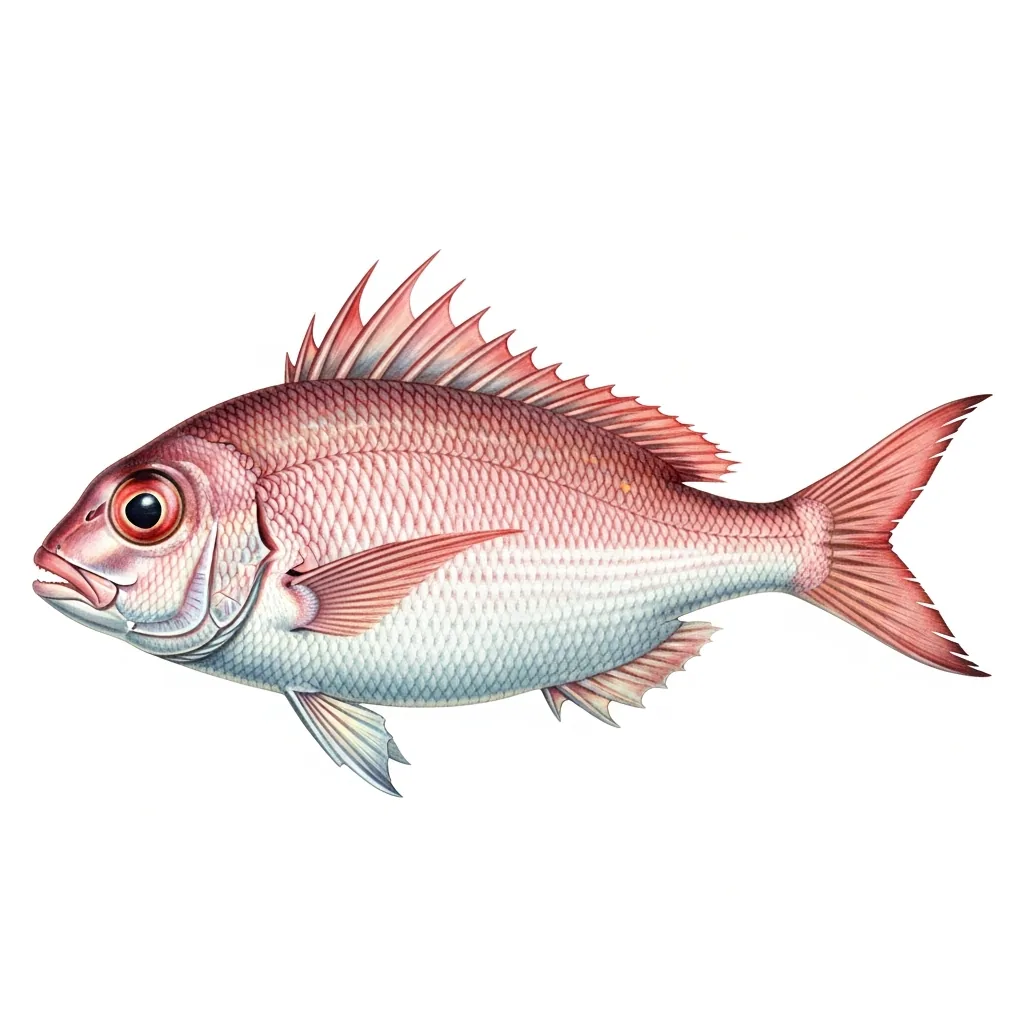
Very appreciated fish, lives on mixed and sandy bottoms, often in small schools.
Identification
- Body
- Elongated and laterally compressed body.
- Colouration
- Pinkish coloration with silver hues; red fins.
- Sexual dimorphism
- Absent/not very noticeable
- Growth
- Medium, with rapid growth in the first years, then stabilizing.
Taxonomy
- Family
- Sparidae
- Order
- Perciformes
- Class
- Actinopterygii
Related species
Habitat & distribution
- Environment
- Coast, Open sea, Reefs
- Preferred bottom
- Sand, Rock, Seagrass
- Geographic distribution
- Found in the Mediterranean Sea, Black Sea, and along the Atlantic coast of Europe up to the British Isles.
- Micro-habitat
- Hides among seagrass meadows and in areas with mixed seabeds.
Prefers areas rich in cover and natural hideouts.
Presence by sea area
Diet
- Primary prey
- crustaceans, mollusks, annelids
- Secondary prey
- small fish, echinoderms, polychaetes
- Occasional prey
- plankton, algae
- Feeding behaviour
- Feeds primarily at night, searching for small organisms on the seabed and in marine sediments.
- Natural predators
- groupers, barracuda, dolphins, gray sharks
Diet variety depends on the seasonal availability of prey.
Behaviour
- Activity
- nocturnal
- Social behaviour
- small_groups
- Aggressiveness
- low
- Migration
- Non-migratory
- Seasonal behaviour
- More active during the warm months due to abundant food in coastal habitats.
- Juveniles
- Juveniles are often found closer to shore in areas with marine vegetation.
- Adults
- Adults tend to remain in deeper waters and form small groups.
Reproduction
- Spawning season
- June, July, August
- Spawning depth
- between 20 and 60 meters
- Eggs
- Pelagic eggs, transparent and buoyant, small in size.
- Larval stage
- Pelagic larvae develop in surface waters following currents.
- Sexual maturity
- 3-4 years
When to catch Common pandora
Activity calendar
Activity by season
Best times
This species shows peak fishing activity in spring, summer and autumn, when the productivity index (FPI) reaches its highest values.
Ideal conditions
Atmospheric pressure
Actively feeds on bottom.
Regular activity.
Stays deeper.
Water temperature
Where to catch it
Best spots
Bottom preference
Spot type
Fishing techniques
Recommended
Other applicable
Recommended baits
Baits by pressure
How to really catch it
The common pandora is an elegant, discreet bottom fish, with large eyes, a small mouth, and a pinkish body that seems to glow over mixed sand, rock, and seagrass. It is not a brutal predator: you have to fish for it with restraint, reading the seabed and waiting for the moment it leaves cover to feed.
🐟 Good to know
The common pandora lays pelagic eggs that are transparent and buoyant, while the larvae develop near the surface and drift with the currents: a sharp contrast with adult life, which is tied to the bottom. It is a non-migratory species, but in its earliest stages it crosses open water before settling on coastal and deeper habitats.
🌊 Where & when
You find it from 10 to 150 meters over sandy bottoms, rocky ground, seagrass meadows, offshore shallows, and submerged reefs, in the Mediterranean, the Black Sea, and along Europe’s Atlantic coasts up to the British Isles. It is more active in the warm months and remains especially worth targeting from March to November; at night it feeds on the bottom, while in summer it spawns between 20 and 60 meters.
🎣 How to really catch it
To catch it consistently, a simple line approach is the most concrete option: a light spinning rod, 0.30 mm nylon, a 0.25 mm fluorocarbon leader, size 4-6 hooks, and 20-50 g teardrop sinkers are enough to work the bottom properly. Present the bait close to seagrass, mixed sand, or rock, and use natural offerings that match its diet, especially shrimp and annelids; squid mantle and sardine can also make a difference.
💡 The detail that makes the difference
The soundest tip is to focus on mixed bottom rather than featureless clean ground. The common pandora searches for small organisms in the sediment but also uses shelter such as seagrass and bottom irregularities: fishing the edge between sand and cover places the bait where it truly feeds, especially after dark.
Catch & handling tips
- Fight
- Fights with quick, decisive movements but tires easily.
- Handling
- Handle carefully to avoid stress and minimize injury risk.
- Release
- Release quickly into deeper water to ensure recovery.
Curiosities & culture
- Record catches
- Maximum documented size: up to about 60 cm and 3.2 kg (source: FishBase). There is no official IGFA All-Tackle record for this species.
- In the kitchen
- Valued for its delicate flesh, featured in dishes like fish soups and grills.
- Cultural notes
- Known in Mediterranean cuisine, historically caught with artisanal techniques.
- Historical notes
- Historically associated with life in fishing villages, part of artisanal fishing traditions.