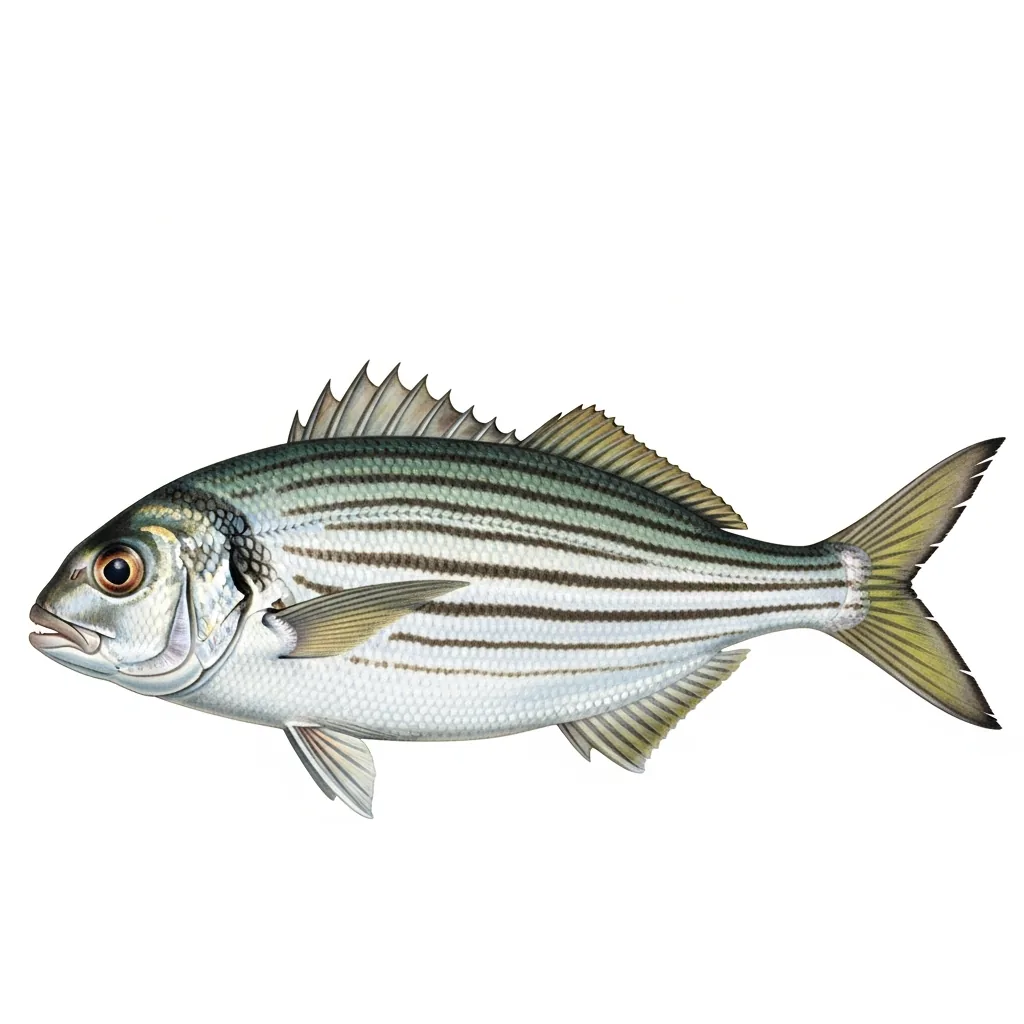

Overview
Very wary fish, loves sandy bottoms and clear water.
Identification
- Body
- Elongated body with a slightly rounded dorsal profile.
- Colouration
- Silvery color with dark crossbands on the body.
- Sexual dimorphism
- Absent/little noticeable
- Growth
- Moderate, gradually grows to adult size over a few years.
Taxonomy
- Family
- Sparidae
- Order
- Perciformes
- Class
- Actinopterygii
Related species
Habitat & distribution
- Environment
- Coast, Reefs, Pelagic
- Preferred bottom
- Sand, Seagrass
- Geographic distribution
- Found in the Mediterranean Sea, the eastern Atlantic Ocean, and along the coasts of West Africa.
- Micro-habitat
- Prefers sandy bottoms and hides among seagrass meadows.
Often spotted near seagrass meadows where it finds food and protection.
Presence by sea area
Diet
- Primary prey
- small crustaceans, mollusks, polychaetes
- Secondary prey
- algae, small fish, zooplankton
- Occasional prey
- jellyfish, fish eggs
- Feeding behaviour
- Primarily feeds by foraging on the sandy bottom for small invertebrates.
- Natural predators
- sea bass, grouper, large predatory fish
Known for rooting around the sandy bottom in search of hidden food.
Behaviour
- Activity
- diurnal
- Social behaviour
- solitary
- Aggressiveness
- low
- Migration
- Resident, but may make small seasonal movements.
- Seasonal behaviour
- More active during warm months, moving toward the coast to spawn.
- Juveniles
- Juveniles tend to form small groups in shallower waters.
- Adults
- Adults are more solitary, preferring deeper waters.
Reproduction
- Spawning season
- June, July, August
- Spawning depth
- between 10 and 50 meters
- Eggs
- Small pelagic eggs.
- Larval stage
- Pelagic larvae that rapidly develop and become self-sufficient.
- Sexual maturity
- 3-4 years
When to catch Striped sea bream
Activity calendar
Activity by season
Best times
This species shows peak fishing activity in spring, summer and autumn, when the productivity index (FPI) reaches its highest values.
Ideal conditions
Atmospheric pressure
Very active and less wary.
Regular activity.
Very wary, stays away from shore.
Water temperature
Where to catch it
Best spots
Bottom preference
Spot type
Fishing techniques
Recommended
Other applicable
Recommended baits
Baits by pressure
How to really catch it
The striped seabream is an elegant, discreet bottom fish, built to vanish over sand and seagrass until a bite gives it away. If you really want to catch it, you need to think like it does: close to the bottom, just slow enough, focused on the small details that matter along the shore.
🐟 Good to know
The striped seabream lays small pelagic eggs, and its larvae also spend a pelagic phase before becoming self-sufficient quite early. It is a little-seen part of its biology for shore anglers, yet it explains how a species tied to the bottom begins life suspended in the water column.
🌊 Where & when
You will mainly find it over sandy bottoms and around seagrass meadows, along coasts, beaches, estuary mouths, and harbor areas in the Mediterranean, the eastern Atlantic, and the coasts of West Africa. It is more active in the warm months and moves closer to shore to spawn from June to August, laying between 10 and 50 meters; from March to November it is generally a much more approachable target.
🎣 How to really catch it
The most reliable approach is light surfcasting on sandy beaches, letting the bait work where the fish roots through the bottom for small invertebrates. A 4.2 m surfcasting rod, 0.25 main line, 0.20 fluorocarbon leader, Aberdeen hooks in sizes 6-8, and a running sinker up to 80 g make a very fitting setup. Ragworm and Korean worm are the most consistent baits; shrimp is useful, sardine more secondary. On the strike and retrieve, expect a lively fish that often swims sideways to shake free.
💡 The detail that makes the difference
The practical edge is simple: place the bait truly on clean sand, right near the edge of the seagrass but not buried in it. The striped seabream feeds by searching sandy ground for small crustaceans, mollusks, and worms; if your offering sits naturally and still on that transition line, you are putting it directly into its feeding path.
Catch & handling tips
- Fight
- The Mormora puts up a fight and tends to swim sideways to shake off.
- Handling
- Handle carefully to avoid damaging the delicate fins.
- Release
- Always release in the water to prevent thermal shock.
Curiosities & culture
- Record catches
- Maximum documented size: up to about 55 cm in length (source: FishBase). There is no official IGFA All-Tackle record for this species.
- In the kitchen
- The Mormora is valued in cooking, often baked or grilled and served with vegetables.
- Cultural notes
- Featured in many local fishermen's stories and a symbol of seasonal catches at fish markets.
- Historical notes
- Highly prized since ancient times by Greeks and Romans, often depicted in mosaics.