
Overview
Very prized bottom fish, loves rocky and mixed bottoms.
Identification
- Body
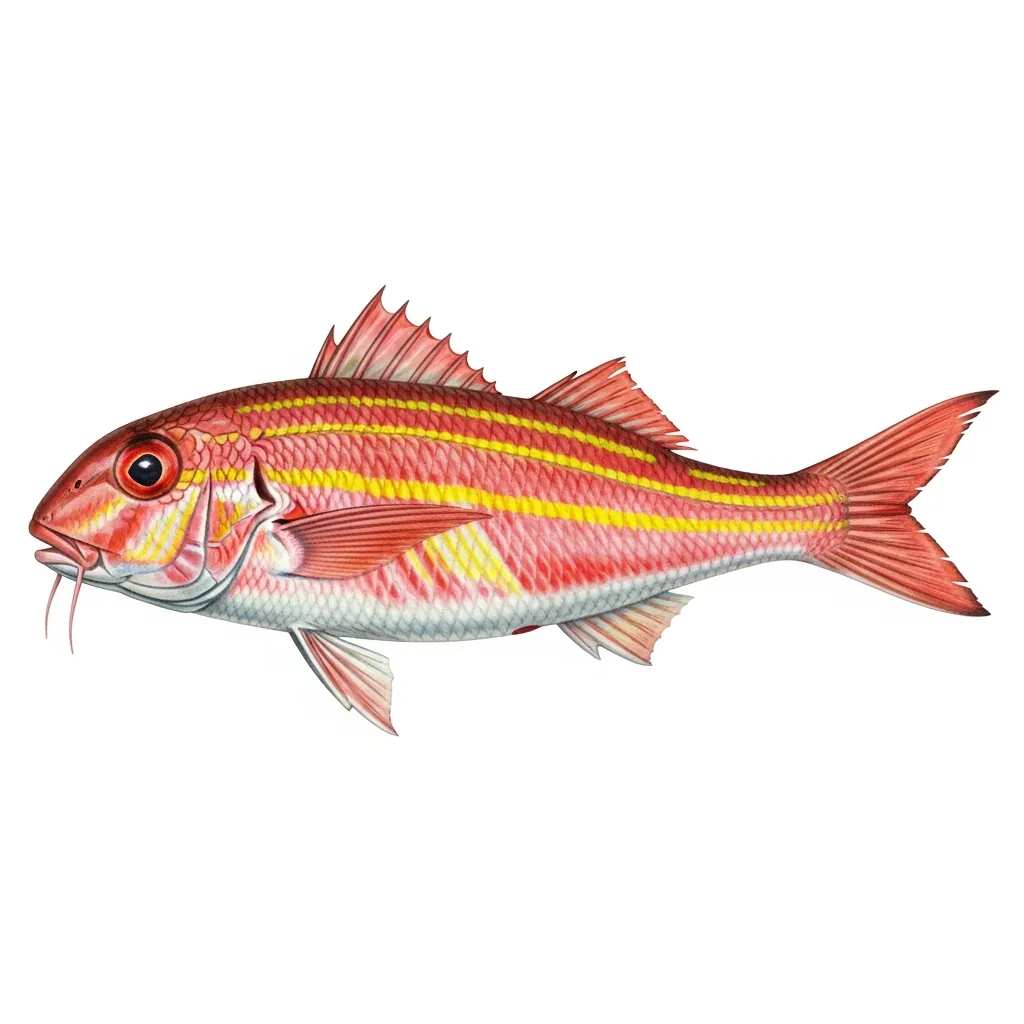
- Elongated body with a pointed head and two barbels on the chin.
- Colouration
- Golden-red pattern with yellowish transverse bands.
- Sexual dimorphism
- absent/not noticeable
- Growth
- medium, reaches maturity in a few years
Taxonomy
- Family
- Mullidae
- Order
- Perciformes
- Class
- Actinopterygii
Related species
Habitat & distribution
- Environment
- Coast, Reefs
- Preferred bottom
- Rock, Sand, Gravel
- Geographic distribution
- Mediterranean Sea, northeastern Atlantic from the Netherlands to Senegal.
- Micro-habitat
- Hides among rocks and digs in sand or gravel to find food.
Prefers mixed bottoms ranging from reefs to sandy areas.
Presence by sea area
Diet
- Primary prey
- crustaceans, mollusks, marine worms
- Secondary prey
- small fish, shrimp, algae
- Occasional prey
- organic debris, plankton, fish eggs
- Feeding behaviour
- Uses barbels to detect hidden prey in the sandy bottom and substrate.
- Natural predators
- sea bream, grouper, octopus, squid, seagulls
Primarily carnivorous, easily adapts to what its habitat offers.
Behaviour
- Activity
- diurnal
- Social behaviour
- small_groups
- Aggressiveness
- low
- Migration
- residential with small seasonal movements
- Seasonal behaviour
- More active in summer and fall when the water temperature is warmer.
- Juveniles
- Juveniles tend to seek shelter in shallow waters for protection.
- Adults
- Adults move to greater depths to feed and reproduce.
Reproduction
- Spawning season
- May, June, July
- Spawning depth
- between 20 and 60 meters
- Eggs
- Pelagic eggs that are small and transparent.
- Larval stage
- Larvae are pelagic and feed on zooplankton.
- Sexual maturity
- 2-3 years
When to catch Surmullet
Activity calendar
Activity by season
Best times
This species shows peak fishing activity in spring, summer and autumn, when the productivity index (FPI) reaches its highest values.
Ideal conditions
Atmospheric pressure
Very active on bottom.
Regular activity.
Stays very close to bottom.
Water temperature
Where to catch it
Best spots
Bottom preference
Spot type
Fishing techniques
Recommended
Other applicable
Recommended baits
Baits by pressure
How to really catch it
The striped red mullet is an elegant, lively bottom fish, its barbels constantly reading the seam where rock, sand, and gravel meet. Picture it nosing through the substrate in small groups, and it becomes clear at once: to catch it consistently, you need to fish low, precisely, and naturally.
🐟 Good to know
Its two chin barbels are not decorative: they are sensory organs used to explore the bottom and detect prey hidden in the substrate. This is central to its biology and explains why striped red mullet spend so much time digging through sand and gravel for crustaceans, mollusks, and marine worms.
🌊 Where & when
It lives along coasts and around reefs over rocky, sandy, and gravel bottoms, from very shallow water down to 120 meters, across the Mediterranean and the northeastern Atlantic. It is more active in summer and autumn, while from May to July adults also move between 20 and 60 meters to feed and reproduce; juveniles more often remain in shallow inshore water.
🎣 How to really catch it
The most practical approach is a light handline worked right on the bottom with small olive sinkers, a 0.15 fluorocarbon leader, and size 8-12 hooks baited with marine annelids, shrimp, or small pieces of mollusk. Target mixed bottoms, submerged reefs, and rocky areas, keeping the bait tight to the substrate, because striped red mullet feed by day while searching exactly there.
💡 The detail that makes the difference
The detail that makes the difference is not lifting the bait too far off the bottom: striped red mullet search for food with their barbels in the substrate, not in midwater. If the sinker holds and the bait stays close to sand, gravel, or the foot of rocks, it truly enters the fish's natural feeding window.
Catch & handling tips
- Fight
- Puts up moderate resistance with short lateral runs.
- Handling
- Handle carefully to avoid losing scales.
- Release
- Make sure it is well oxygenated before releasing.
Curiosities & culture
- Record catches
- Maximum documented size: up to about 40 cm and 1 kg (source: FishBase). There is no official IGFA All-Tackle record for this species.
- In the kitchen
- Highly valued in fish soups and grilled.
- Cultural notes
- Appears in artworks and traditional Mediterranean dishes.
- Historical notes
- A prized fish since ancient times, often featured in Roman banquets.