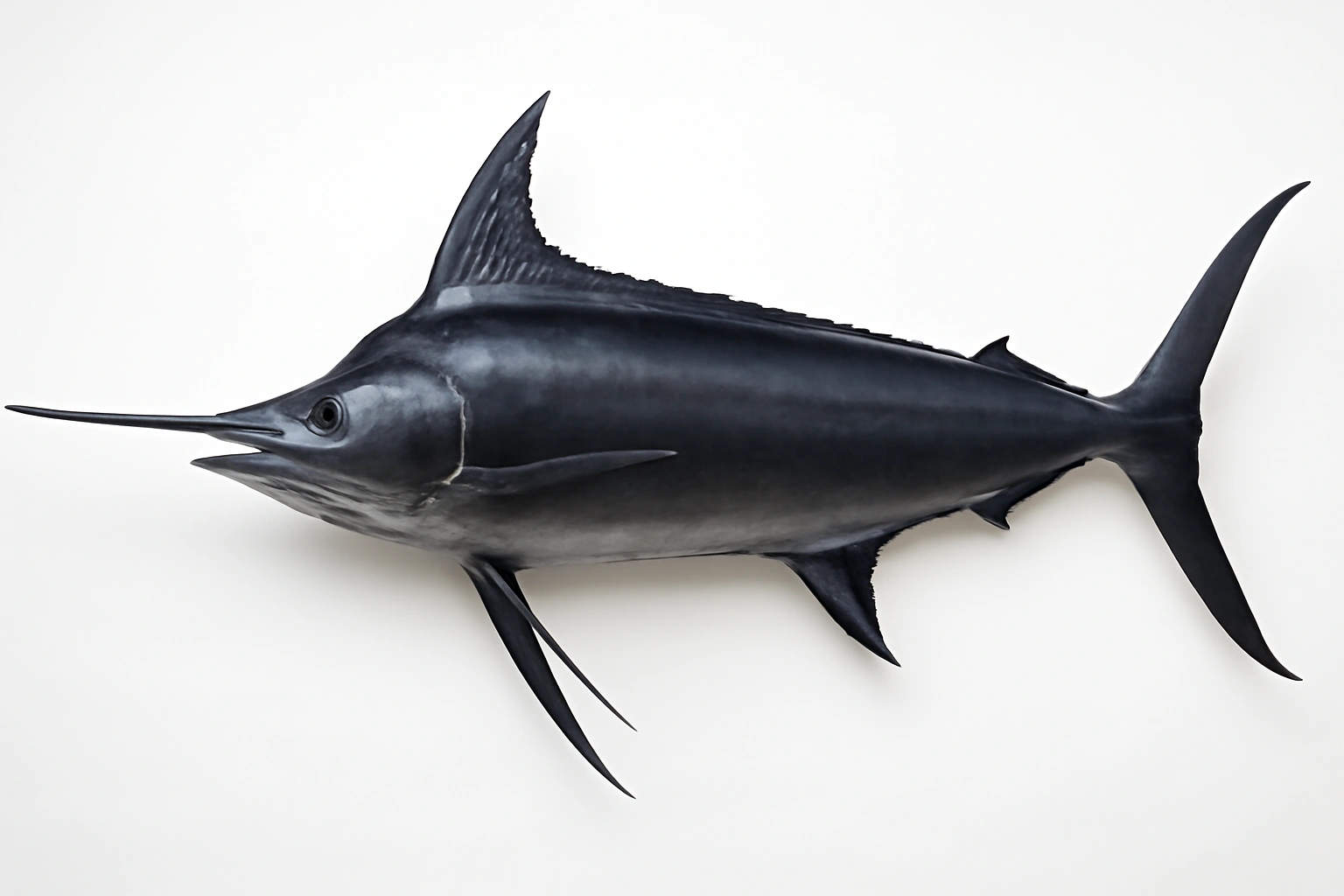

Overview
The Black Marlin is the undisputed king of Australian sport fishing. The biggest and most powerful fish that can be caught in Australian waters, with specimens exceeding 500 kg. The Great Barrier Reef hosts one of the world's largest concentrations of giant black marlin.
Identification
- Body
- Long and robust body, characterized by a pronounced snout and a distinctive dorsal fin.
- Colouration
- Blue or black coloration on the back and silver on the sides, with possible stripes on the body.
- Sexual dimorphism
- Barely evident
- Growth
- Fast, reaching large sizes in a few years
Taxonomy
- Family
- Istiophoridae
- Order
- Perciformes
- Class
- Actinopterygii
Related species
Habitat & distribution
- Environment
- Open sea, Reefs, Coast
- Preferred bottom
- Open sea, Reefs
- Geographic distribution
- Wide distribution in tropical and subtropical waters of the Pacific and Indian Oceans, with large concentrations in Australian waters.
- Micro-habitat
- Prefers waters near coral reefs, especially for hunting.
Loves clear and warm waters, often near coral reefs and drop-offs.
Presence by sea area
Diet
- Primary prey
- flying fish, small tunas, needlefish
- Secondary prey
- squid, cephalopods, garfish
- Occasional prey
- jellyfish, crabs
- Feeding behaviour
- Fast and powerful predator, known for chasing prey in open waters, utilizing speed to catch unsuspecting targets.
- Natural predators
- large sharks, orcas, sperm whales
Speed and agility allow it to be an efficient predator occupying the pelagic niche.
Behaviour
- Activity
- diurnal
- Social behaviour
- solitary
- Aggressiveness
- high
- Migration
- Seasonal migrator, follows currents and prey availability.
- Seasonal behaviour
- Active mainly during warm seasons, with presences near the Great Barrier Reef.
- Juveniles
- Juveniles tend to remain in warmer coastal waters.
- Adults
- Adults are more inclined to migrate to pelagic waters in search of abundant prey.
Reproduction
- Spawning season
- October, November
- Spawning depth
- Typically occurs in warm surface waters
- Eggs
- Pelagic eggs, small in size, floating in the water column.
- Larval stage
- Larvae are pelagic, growing rapidly in the first months of life.
- Sexual maturity
- Varies between 3 and 5 years
When to catch Black Marlin
Activity calendar
Activity by season
Best times
This species shows peak fishing activity in spring, summer and autumn, when the productivity index (FPI) reaches its highest values.
Fishing activity decreases in winter, when conditions are less favourable.
Ideal conditions
Water temperature
Where to catch it
Best spots
Bottom preference
Spot type
Fishing techniques
Recommended
Other applicable
Recommended baits
Baits by pressure
How to really catch it
The black marlin is one of the great hunters of the tropical blue: massive, solitary, aggressive, built to chase down and overwhelm prey in open water. If you really want to target it, think like it hunts: along currents, drop-offs, and reef edges, where the water looks empty until it suddenly comes alive.
🐟 Good to know
Unlike many other large pelagic fish, the black marlin has rigid pectoral fins, a distinctive morphological trait of the species. Together with its robust body, crescent tail, and highly developed gills, this forms the profile of a predator built for great power in open water.
🌊 Where & when
It lives across open sea, coasts, and reefs in tropical and subtropical waters of the Pacific and Indian Oceans, with major concentrations in Australian waters and a clear preference for areas near coral reefs. It is most active in the warm seasons, with the most interesting window running from March to November; in October and November it may spawn in warm surface waters.
🎣 How to really catch it
The most concrete approach is big-game trolling: work wide off the Great Barrier Reef, following currents, drop-off edges, and areas rich in small prey, towing baits that match its real menu, such as flying fish, squid, cuttlefish, or tuna strips. Proper big-game tackle is essential: a dedicated rod, 100-130 lb line, 200-300 lb fluorocarbon leader, and strong 14/0-20/0 circle hooks.
💡 The detail that makes the difference
The detail that makes the difference is not fishing “random blue water”: black marlin hunt by day and track prey and currents, so focus your effort where the sea creates natural funnels near reefs and depth changes. If you find small bait concentrated in lively, structured water, you are reading its feeding table before seeing the strike.
Catch & handling tips
- Fight
- Extremely powerful fight, with spectacular jumps and rapid dives.
- Handling
- Requires care and appropriate equipment for handling and release.
- Release
- Avoid damage to the bill, support the body in water during release.
Curiosities & culture
- Record catches
- Maximum documented size: up to about 4.65 m and 750 kg (source: FishBase). IGFA All-Tackle record: 707.61 kg (1,560 lb), caught by Alfred C. Glassell Jr. at Cabo Blanco (Peru) in 1953.
- In the kitchen
- Consumed in some countries, but often avoided due to mercury content. Traditional dishes include sashimi.
- Cultural notes
- Symbol of strength and endurance, often represented in sport fishing culture.
- Historical notes
- Fishing for black marlin is a historical benchmark for sporting activities in Australian waters.