
Overview
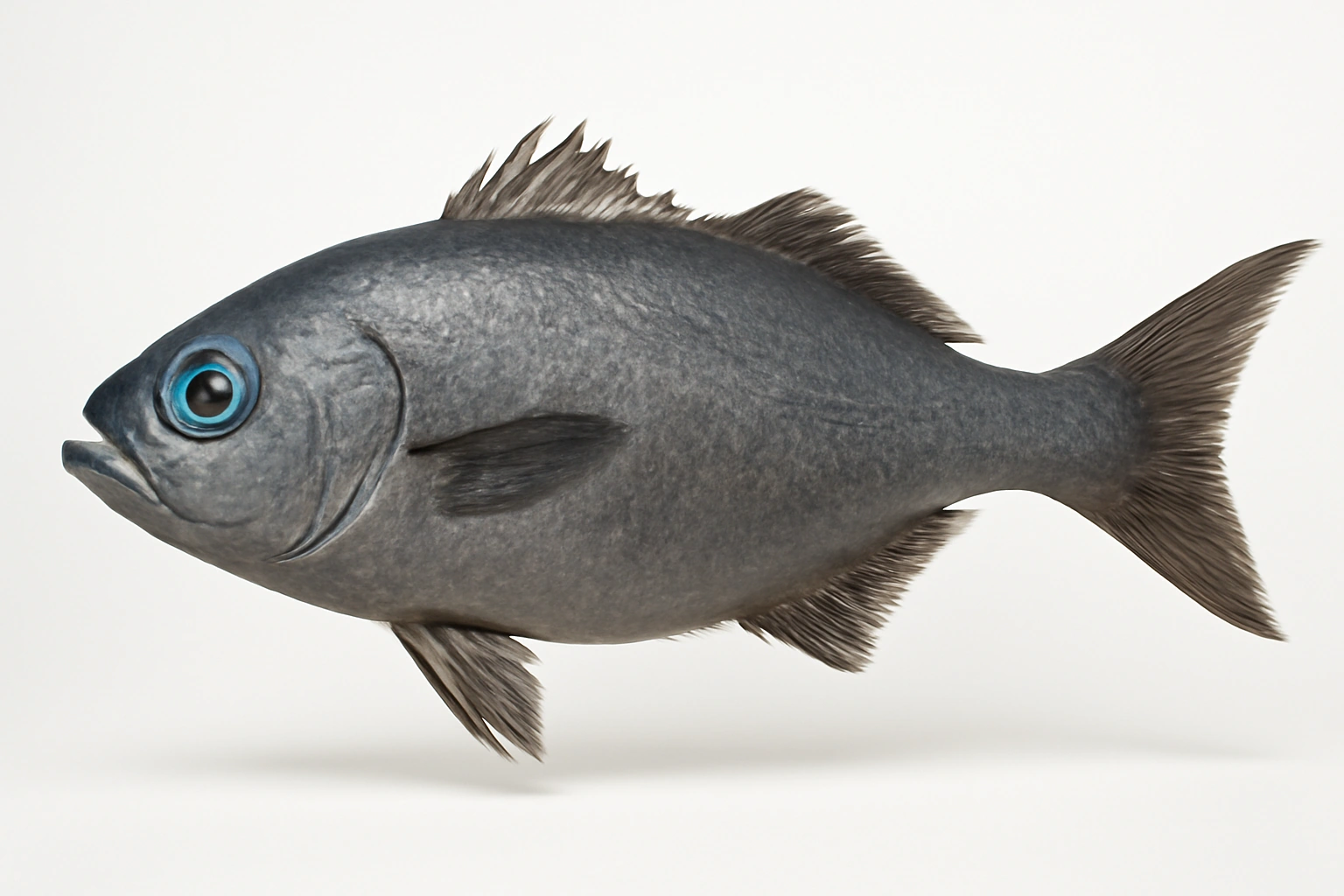
The Blue-eye Trevalla is a deep-water fish found in southern Australian waters. With its characteristic blue eyes, it lives at depths between 200 and 500 metres. Its flesh is considered top quality, similar to cod but more flavourful.
Identification
- Body
- The body is elongated and fusiform with a powerful caudal fin.
- Colouration
- Mainly dark blue with silver highlights and distinctive blue eyes.
- Sexual dimorphism
- Absent/not obvious
- Growth
- Medium, takes several years to reach adult size.
Taxonomy
- Family
- Stromateidae
- Order
- Perciformes
- Class
- Actinopterygii
Related species
Habitat & distribution
- Environment
- Deep sea, Open sea
- Preferred bottom
- Rock, Reef
- Geographic distribution
- Along the southern coasts of Australia and in some regions of the southwestern Atlantic Ocean.
- Micro-habitat
- Often found near underwater structures and deep reefs.
Prefers structured environments to ambush prey.
Presence by sea area
Diet
- Primary prey
- squid, small fish, crustaceans
- Secondary prey
- jellyfish, cuttlefish, octopus
- Occasional prey
- zooplankton, fish larvae
- Feeding behaviour
- Opportunistic predator, prefers to hunt at great depths using darkness to its advantage.
- Natural predators
- sharks, large pelagic fish, orcas
Adapts its diet to the availability of prey in the water column.
Behaviour
- Activity
- nocturnal
- Social behaviour
- solitary
- Aggressiveness
- low
- Migration
- Resident, generally remains in the same deep areas.
- Seasonal behaviour
- No significant seasonal variations, maintains stable behavior throughout the year.
- Juveniles
- Juveniles often gather in small groups near reef structures.
- Adults
- Adults are solitary and establish a specific hunting territory.
Reproduction
- Spawning season
- December, January
- Spawning depth
- Between 200 and 500 meters
- Eggs
- The eggs are pelagic and transparent, small in size.
- Larval stage
- Larvae are initially pelagic and shift to a benthic life as they mature.
- Sexual maturity
- Varies between 3 and 5 years
When to catch Blue-eye Trevalla
Activity calendar
Activity by season
Best times
This species shows peak fishing activity in spring, summer and autumn, when the productivity index (FPI) reaches its highest values.
Fishing activity decreases in winter, when conditions are less favourable.
Ideal conditions
Water temperature
Where to catch it
Best spots
Bottom preference
Spot type
Fishing techniques
Recommended
Other applicable
Recommended baits
Baits by pressure
How to really catch it
The blue-eye trevalla is a deep-water fish that lives where light fades, among rocks, reefs, and submerged structure. Solitary, powerful, and not inclined to reveal itself, it is truly encountered only when you think like a predator of darkness.
🐟 Good to know
A biologically interesting trait of Hyperoglyphe antarctica is its shift in lifestyle as it grows: the larvae are pelagic, then move toward a benthic life tied to deep bottoms as they mature. Juveniles also tend to gather in small groups, while adults become territorial and solitary.
🌊 Where & when
Look for it between 200 and 500 meters, along the southern coasts of Australia and in some areas of the southwestern Atlantic, especially on deep reefs, canyon edges, underwater pinnacles, and deep rocky banks. It is a resident species with fairly stable behavior year-round, but it is more fishable from March to November; in December and January it enters its spawning period at the same deep range.
🎣 How to really catch it
The most concrete approach is deep bottom fishing: a heavy bottom rod, strong braided line, a 60 lb fluorocarbon leader, 4/0 circle hooks, and 500 g sinkers to keep the rig near the seabed. Squid, fish pieces, and crustaceans are perfectly matched to its diet; work the terminal close to rocks and structure, because that is where it hunts using darkness to its advantage.
💡 The detail that makes the difference
The detail that makes a difference is precision on the microhabitat: rather than probing empty water, stay tight to a clearly defined deep structure. Adults are solitary and tied to a specific hunting territory, so if the spot is right it pays to hold neatly on the bottom and work the same band consistently instead of moving too soon.
Catch & handling tips
- Fight
- Fighting and resilient, it executes sudden accelerations to escape.
- Handling
- Use protective gloves to handle the animal safely.
- Release
- Release quickly into the water to minimize stress.
Curiosities & culture
- Record catches
- Maximum documented size: up to about 140 cm and 63 kg (source: FishBase). IGFA All-Tackle record: 13.24 kg (29 lb 3 oz).
- In the kitchen
- The meat, similar to cod, is excellent for filleting and baking recipes.
- Cultural notes
- Considered a luxury fish in Australian seafood restaurants.
- Historical notes
- Long sought after in commercial fishing in Australian waters for its prized meat.