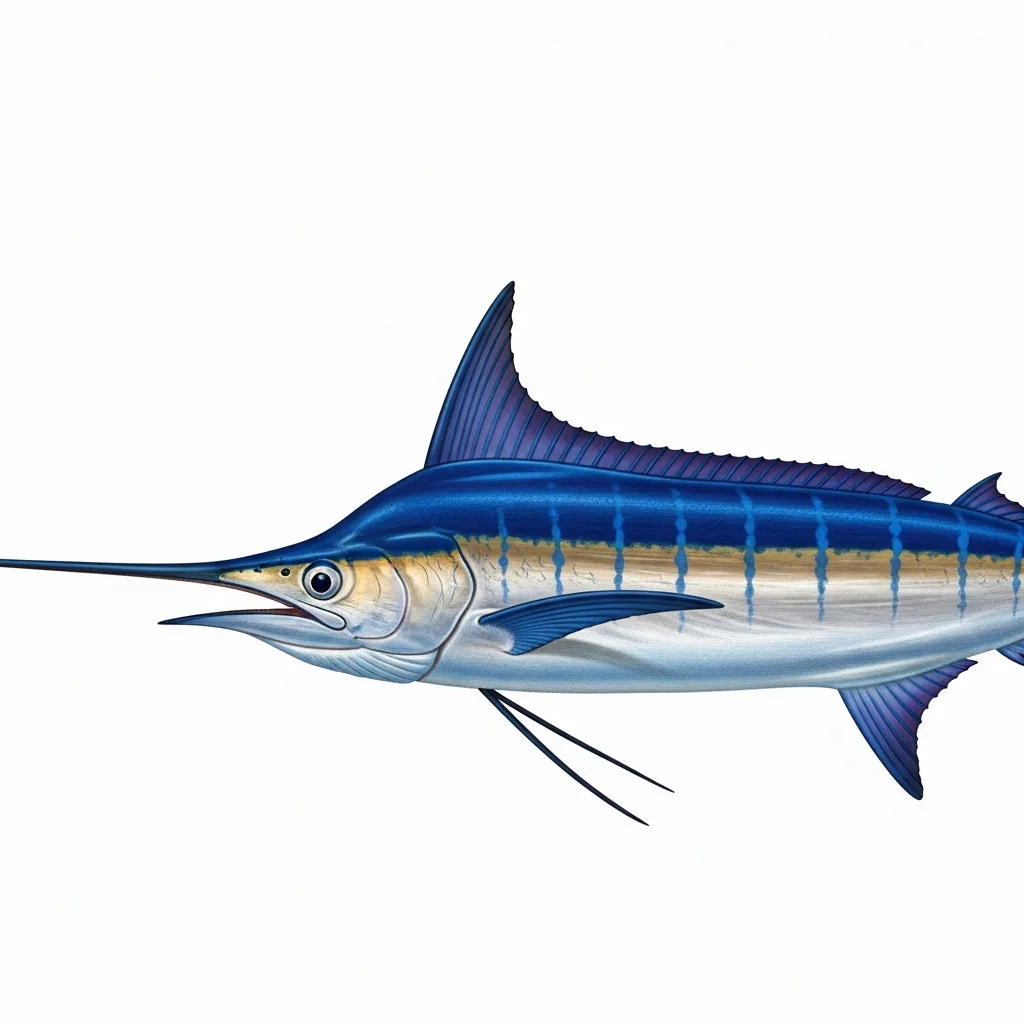

Overview
The ultimate trophy of offshore fishing, legendary power and endurance.
Identification
- Body
- Elongated, fusiform body with a long, pointed dorsal fin.
- Colouration
- Dark blue coloring on the back and white on the belly, with light blue vertical stripes on the body.
- Sexual dimorphism
- Not very evident, but females are generally larger than males.
- Growth
- fast - the blue marlin grows quickly in its early years.
Taxonomy
- Family
- Istiophoridae
- Order
- Perciformes
- Class
- Actinopterygii
Related species
Habitat & distribution
- Environment
- Open sea, Pelagic
- Preferred bottom
- Reef, Open sea
- Geographic distribution
- Found in tropical and subtropical waters of the Atlantic, Pacific, and Indian Oceans.
- Micro-habitat
- Often found near coral reefs and deep waters in search of prey.
Prefers open environments and the freedom of pelagic waters.
Presence by sea area
Diet
- Primary prey
- tunas, flying fish, sardines
- Secondary prey
- mackerels, squids, cuttlefish
- Occasional prey
- shrimp, jellyfish
- Feeding behaviour
- Fast and active predator, uses its long bill to stun fish before eating them.
- Natural predators
- sharks, orcas, large predatory fish
Ability to travel long distances to catch moving prey.
Behaviour
- Activity
- diurnal
- Social behaviour
- solitary
- Aggressiveness
- high
- Migration
- Long migration in search of warm waters and prey.
- Seasonal behaviour
- During warm seasons, migrates to more temperate regions, while in cold periods it moves towards the equator.
- Juveniles
- Young marlins often school in small groups.
- Adults
- Adults usually lead a solitary life except during the breeding season.
Reproduction
- Spawning season
- June, July, August
- Spawning depth
- between 20 and 60 meters
- Eggs
- The eggs are pelagic and float near the surface of the sea.
- Larval stage
- Pelagic larvae that develop quickly, characterized by a long, slender bill.
- Sexual maturity
- varies between 2 and 5 years
When to catch Blue marlin
Activity calendar
Activity by season
Best times
This species shows peak fishing activity in spring, summer and autumn, when the productivity index (FPI) reaches its highest values.
Fishing activity decreases in winter, when conditions are less favourable.
Ideal conditions
Atmospheric pressure
Hunts on surface, feeding frenzy.
Follows fish schools.
Deeper and more scattered.
Water temperature
Where to catch it
Best spots
Bottom preference
Spot type
Fishing techniques
Recommended
Other applicable
Recommended baits
Baits by pressure
How to really catch it
The blue marlin is the ruler of the open sea: a streamlined body, a sharp bill, and power that erupts at the surface in spectacular jumps. Meeting one is not just a difficult catch, it is a true encounter with pure pelagic water, where every trolling pass can change the entire day.
🐟 Good to know
One well-documented biological trait of the blue marlin is its use of the long bill while hunting: it is not only for seizing prey, but also for striking and stunning schools of fish before feeding. That helps explain why it often attacks fast prey in open water, where surprise matters as much as speed.
🌊 Where & when
It lives in the open sea, in tropical and subtropical waters of the Atlantic, Pacific, and Indian Oceans, often across wide pelagic areas, near coral reefs, drop-offs, and deep water where forage gathers. It becomes more approachable from March to November; in warm seasons it moves toward more temperate regions, while from June to August it may also use spawning zones between 20 and 60 meters.
🎣 How to really catch it
For blue marlin, the most concrete method remains heavy trolling in deep water and along drop-offs, working baits such as squid, flying fish, small tunas, or mackerel with a clean and steady presentation. A heavy trolling rod, 80-130 lb braid, 50 lb fluorocarbon leader, 8/0 hooks, and a quick-release sinker create a credible setup for a solitary, diurnal, aggressive species.
💡 The detail that makes the difference
The practical edge is to insist where blue water meets structure and depth: near reefs and ledges, marlin hunt fast pelagic prey, not fish sitting on the bottom. That is why it pays to present the bait on a natural, continuous track, avoiding abrupt maneuvers that break the illusion of a real escape.
Catch & handling tips
- Fight
- The blue marlin is known for its spectacular jumps out of the water and powerful resistance.
- Handling
- Use gloves to avoid abrasions from the bill and handle with care.
- Release
- Limit time out of the water, handle gently, and let it swim near the boat before release.
Curiosities & culture
- Record catches
- Maximum documented size: up to about 5 m and over 630 kg (source: FishBase). IGFA All-Tackle record: 636 kg (1,402 lb 2 oz), caught by Paulo Amorim at Vitória (Brazil) in 1992.
- In the kitchen
- Not commonly consumed due to its esteem as a sport fishing species.
- Cultural notes
- Known as a coveted trophy in sport fishing, symbolizing strength and agility.
- Historical notes
- Historically valued by sport anglers for its impressive size and fighting ability.