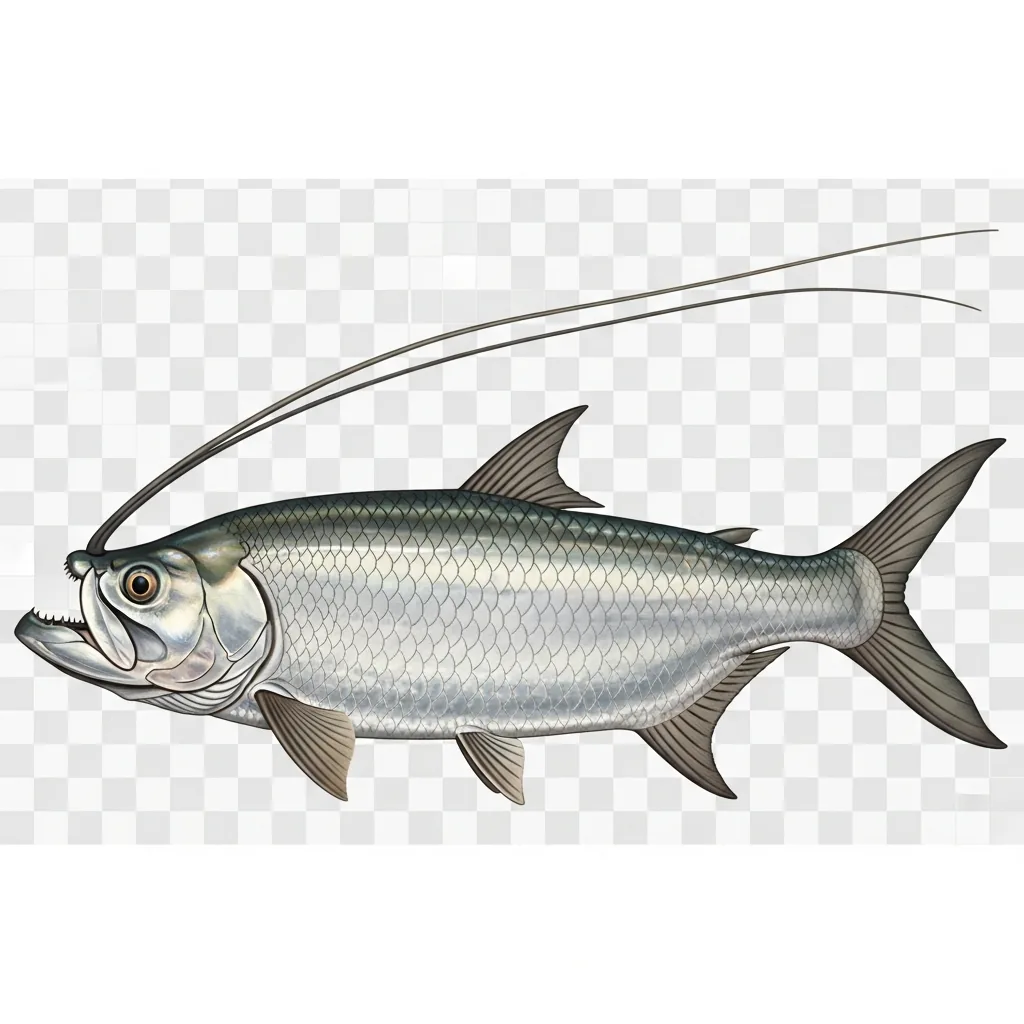

Overview
King of tropical game fish, famous for its spectacular jumps.
Identification
- Body
- Long, laterally compressed body with large silver scales.
- Colouration
- Silver with a darker blue-green back.
- Sexual dimorphism
- Absent/minimal
- Growth
- Moderate, can grow rapidly in juvenile stages
Taxonomy
- Family
- Megalopidae
- Order
- Elopiformes
- Class
- Actinopterygii
Related species
Habitat & distribution
- Environment
- Coast, Estuaries, Brackish
- Preferred bottom
- Mud, Seagrass
- Geographic distribution
- Found along the Atlantic coast of the Americas, from Massachusetts to Brazil, and in the Caribbean.
- Micro-habitat
- Often hides near mangroves and in coastal lagoons during growth.
Mangroves provide protection and abundant food for young tarpon.
Presence by sea area
Diet
- Primary prey
- small fish, shrimp, crabs
- Secondary prey
- insect larvae, benthic crustaceans, plankton
- Occasional prey
- squid, jellyfish
- Feeding behaviour
- Opportunistic predator that hunts on the surface, often foraging in schools to chase smaller prey.
- Natural predators
- sharks, crocodiles, dolphins
Often hunts at dawn and dusk to exploit more favorable light conditions.
Behaviour
- Activity
- crepuscular
- Social behaviour
- small_groups
- Aggressiveness
- medium
- Migration
- Often migrates between coastal and estuarine habitats for spawning.
- Seasonal behaviour
- Most active during warmer months, tends to move closer to shore in summer.
- Juveniles
- Younger fish prefer protected habitats like lagoons and brackish waters.
- Adults
- Adults tend to move to deeper, open waters.
Reproduction
- Spawning season
- May, June, July
- Spawning depth
- between 20 and 60 meters
- Eggs
- Small, transparent pelagic eggs.
- Larval stage
- Larvae are leptocephalus, translucent and eel-like.
- Sexual maturity
- Varies between 6 and 8 years
When to catch Tarpon
Activity calendar
Activity by season
Best times
This species shows peak fishing activity in spring, summer and autumn, when the productivity index (FPI) reaches its highest values.
Fishing activity decreases in winter, when conditions are less favourable.
Ideal conditions
Atmospheric pressure
Extremely active, jumps on surface.
Good hunting activity.
Less mobile but still catchable.
Water temperature
Where to catch it
Best spots
Bottom preference
Spot type
Fishing techniques
Recommended
Other applicable
Recommended baits
Baits by pressure
How to really catch it
Tarpon is impossible to ignore: a long body, silver scales, a wide mouth, and a power you feel at once through the water. When it moves into a lagoon, an estuary, or along a mangrove edge, fishing becomes a game of reading the water and keeping your nerves steady.
🐟 Good to know
A distinctive biological fact about tarpon is its leptocephalus larval stage: the larvae are translucent, flattened, and eel-like, a real but little-known trait outside biology. This phase is part of its life cycle between coastal and estuarine environments.
🌊 Where & when
It lives along the Atlantic coast of the Americas, from Massachusetts to Brazil, and throughout the Caribbean, in coasts, estuaries, and brackish waters, over soft bottoms and seagrass, from very shallow water down to about 30 meters. It is most active in warmer months and tends to move closer to shore in summer; from May to July it also migrates between coast and estuary for spawning.
🎣 How to really catch it
The most concrete way to target it is spinning in estuarine waters, lagoons, coastal flats, and along mangroves, where it hunts small fish and crustaceans especially at dusk and dawn. A sturdy spinning rod, 50-80 lb braid, and a 60-100 lb fluorocarbon leader give control during the fight; among baits, baitfish, mackerel, live shrimp, and metal lures make sense because they match its diet.
💡 The detail that makes the difference
The practical edge is to work the bait where the fish truly has a reason to feed: mangrove edges, protected lagoons, brackish water, and shallow zones where it pushes prey in groups. If you fish during crepuscular light and run the bait just outside cover, you are intersecting an opportunistic predator in its natural feeding lane.
Catch & handling tips
- Fight
- Vigorous fighter known for its acrobatic jumps and sudden water escapes.
- Handling
- Handle carefully to respect the delicate skin and scales.
- Release
- Ensure a quick and careful release to minimize stress.
Curiosities & culture
- Record catches
- Maximum documented size: up to about 250 cm and 160 kg (source: FishBase). IGFA All-Tackle record: 129.98 kg (286 lb 9 oz), caught by Max Domecq at Rubane (Guinea-Bissau) in 2003.
- In the kitchen
- Generally not consumed for its meat, but valued for broth in some local cuisines.
- Cultural notes
- Appreciated as a symbol of strength and challenge by sport fishermen, often celebrated in international competitions.
- Historical notes
- Historically known and fished by the native peoples of the Americas, tarpon gained popularity in sport fishing circles starting in the 20th century.